Karen Lynch and Elizabeth Taylor are two prominent women whose careers unfolded in completely different worlds. Lynch built a career in healthcare, insurance, and corporate leadership, eventually becoming president and CEO of CVS Health. Taylor became one of Hollywood’s most recognizable actresses before turning much of her public influence toward HIV/AIDS advocacy and humanitarian work.
That difference is important because the names Karen Lynch and Elizabeth Taylor sometimes appear together in online searches. Naturally, that raises a question: Are Karen Lynch and Elizabeth Taylor related, did they work together, or is there another documented connection between them?
The available public record does not establish a verified family, personal, or professional relationship between Karen S. Lynch and Elizabeth Taylor. There is no well-documented business partnership or joint career linking the two.
What makes the topic interesting, however, is that both women became influential public figures in their own fields. Lynch became a major healthcare executive and corporate leader. Taylor became a celebrated Hollywood actress, entrepreneur, and prominent HIV/AIDS advocate.
So, rather than treating a search-engine association as proof of a relationship, it makes more sense to examine the evidence and then understand each woman’s remarkable career.
Are Karen Lynch And Elizabeth Taylor Related?
The short answer is that no verified public evidence establishes that Karen Lynch and Elizabeth Taylor were related.
Elizabeth Taylor’s documented family history is extensive. Her official biography identifies her as the daughter of Francis Taylor and Sara Sothern and records her own family life, including four children, ten grandchildren, and four great-grandchildren. She was born in London in 1932 and died in Los Angeles in 2011.
Karen S. Lynch has a separate documented professional and personal history. Corporate biographies identify her as an American business leader who began her career at Ernst & Young before moving into healthcare. ADP’s 2025 announcement describes her as having more than three decades of experience in the highly regulated healthcare industry.
Nothing in these authoritative biographies establishes a family connection between the two.
What The Public Record Shows
When investigating a claim involving two public figures, the most useful question isn’t simply, “Do people online say they’re connected?”
A better question is:
What reliable evidence actually connects them?
For Karen Lynch and Elizabeth Taylor, the documented records point to different careers, different industries, different professional networks, and different historical contexts.
Taylor’s public legacy centers on:
- Hollywood filmmaking
- acting
- celebrity entrepreneurship
- fragrance and beauty
- philanthropy
- HIV/AIDS advocacy
- humanitarian work
Lynch’s professional legacy centers on:
- healthcare insurance
- corporate management
- Aetna
- CVS Health
- healthcare strategy
- pharmacy services
- healthcare delivery
- corporate boards
Those are substantial careers, but they aren’t the same career.
Were They Family Members?
Searches such as Karen Lynch and Elizabeth Taylor family, Karen Lynch Elizabeth Taylor family connection, and are Karen Lynch and Elizabeth Taylor related suggest that some readers are looking for an ancestry link.
There is no documented evidence establishing one.
It is also worth remembering that the absence of a public family connection should be described carefully. Public biographies cannot prove every detail of a person’s private life. Therefore, the most accurate wording is that no verified public family relationship has been established.
That is more precise than claiming that the two women could never have encountered each other privately.
Did Karen Lynch And Elizabeth Taylor Work Together?
There is also no documented professional partnership between the two.
Lynch’s career developed in the healthcare industry, beginning in accounting and healthcare financial reporting before progressing through Cigna, Magellan Health Services, Aetna, and CVS Health.
Taylor’s professional world was primarily Hollywood and entertainment, followed later by humanitarian advocacy and entrepreneurship. Her official biography describes a six-decade acting career alongside her work in HIV/AIDS activism and business.
No reliable source establishes a shared employer, joint company, business partnership, charitable project, or other formal professional relationship between them.
Did Karen Lynch Know Elizabeth Taylor?
There is no reliable public documentation establishing a personal friendship or professional relationship between Karen Lynch and Elizabeth Taylor.
That distinction matters.
It would be inaccurate to turn the absence of documentation into a claim about everything that may have happened privately. Instead, the evidence supports a narrower conclusion: there is no documented public relationship between Karen Lynch and Elizabeth Taylor.
Why Are Karen Lynch And Elizabeth Taylor Being Searched Together?
This is where online information can become confusing.
Search engines organize information through relationships among names, words, websites, queries, and user behavior. A person may therefore encounter two names together without there being a meaningful real-world relationship between them.
The Difference Between Search Association And A Real Relationship
Seeing two names together in a search result doesn’t establish that the people knew each other.
For example, a search page might associate two people because:
- websites discuss both names in comparison articles
- users repeatedly search both names together
- an article mentions both people
- an AI-generated page connects their biographies
- related-search systems detect a recurring query pattern
- another website publishes an unsupported claim
- different people with similar names become mixed together
The key point is simple:
Search association is not documentary evidence.
If a claim matters, it should be checked against biographies, corporate records, foundation records, historical archives, or other reliable sources.
Namesake Confusion Can Add To The Problem
The name Karen Lynch itself isn’t unique.
That’s why the full name Karen S. Lynch becomes useful when researching the healthcare executive. ADP’s corporate announcement identifies her as a former CVS Health president and CEO, a former Aetna president, and a director of Thermo Fisher Scientific.
Meanwhile, Elizabeth Taylor’s full name was Elizabeth Rosemond Taylor. Her official biography places her career and family history firmly within the context of British-American Hollywood history.
Using full names, employers, dates, and professional roles makes factual verification much easier.
What Can And Cannot Be Verified?
| Question | Evidence-Based Finding |
| Are Karen Lynch and Elizabeth Taylor related? | No verified public family relationship has been established. |
| Did they work together? | No documented joint professional relationship has been identified. |
| Were they business partners? | No verified partnership has been established. |
| Did they share a profession? | No. Lynch worked primarily in healthcare and corporate leadership while Taylor worked primarily in entertainment. |
| Did their lifetimes overlap? | Yes. Taylor lived from 1932 to 2011 while Lynch’s professional career developed during the modern healthcare era. |
| Is there a documented friendship? | No reliable public record establishes one. |
| Why do their names appear together online? | The specific original trigger isn’t reliably established by the available evidence. |
Who Is Karen S. Lynch?
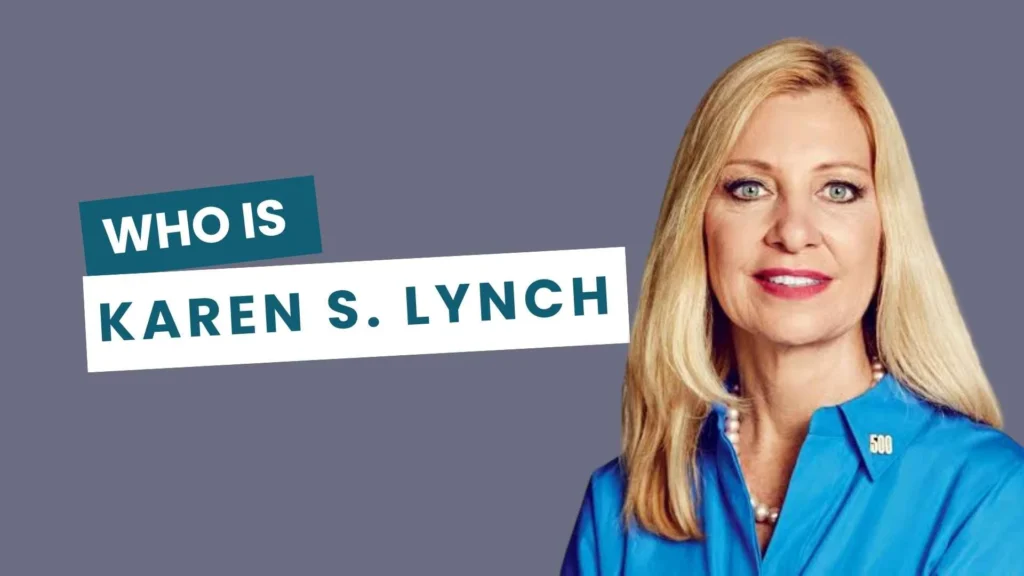
Karen S. Lynch is an American healthcare executive whose career spans more than three decades.
Her path is especially notable because she didn’t begin as a traditional healthcare executive. She started her career as a certified public accountant at Ernst & Young before moving into healthcare. ADP’s 2025 corporate announcement confirms her background at Ernst & Young and later leadership roles at Aetna and CVS Health.
Her professional progression eventually took her from financial reporting and health insurance operations to the top position at one of America’s largest healthcare companies.
Karen Lynch’s Background And Career
Lynch’s early experience in accounting gave her a strong foundation in financial management.
Her move into healthcare came in 1991, when she joined Cigna in health-plan financial reporting. Fortune’s profile of Lynch connects that career decision partly to her personal experience helping care for her aunt during a serious illness. Lynch later explained that navigating the healthcare system made her want to help other people avoid feeling lost within it.
That experience became an important thread running through her career.
Rather than remaining in accounting, Lynch moved deeper into healthcare operations and leadership. She later worked at Magellan Health Services and eventually joined Aetna.
Her career trajectory illustrates how financial expertise can become a foundation for broader business leadership.
Her Career At Magellan Health
Lynch became president of Magellan Health Services in 2009.
The role gave her experience leading a healthcare organization dealing with complex services and regulated markets. Her later career would involve even larger organizations and more complicated integrations.
By this stage, she had developed a reputation for handling challenging businesses and large-scale operational changes.
Karen Lynch At Aetna
Lynch joined Aetna in 2012 after the company had attempted to recruit her several times, according to Fortune’s profile.
In 2015, she became president of Aetna.
That position placed her at the center of a major health insurance company and expanded her experience in healthcare strategy, insurance operations, and organizational leadership.
Her Aetna years also prepared her for one of the most consequential transactions in her career: CVS Health’s acquisition of Aetna.
The CVS Health And Aetna Deal
CVS Health completed its acquisition of Aetna in 2018 for approximately $70 billion.
Lynch became an executive vice president of CVS Health after the acquisition. Forbes notes that she joined CVS in that role when the company completed the acquisition and later became CEO in 2021.
The transaction was significant because it brought together businesses operating across different parts of healthcare.
The broader CVS Health model included:
- health insurance
- pharmacy benefits
- retail pharmacies
- healthcare services
- clinical care
- consumer health services
For Lynch, the deal was more than a transaction. It became a major test of corporate leadership, integration, and healthcare strategy.
Karen Lynch As CVS Health CEO
On February 1, 2021, Lynch became president and CEO of CVS Health.
Fortune described the appointment as a major moment in corporate America because CVS Health was one of the largest companies ever to be led by a woman at the time.
Her tenure began during the COVID-19 pandemic, when CVS Health played a major role in administering vaccines and providing testing through its healthcare network.
Lynch’s leadership agenda also involved transforming CVS from a traditional pharmacy-centered business into a broader healthcare organization.
The company’s strategy included greater emphasis on:
- primary care
- pharmacy services
- insurance
- healthcare delivery
- technology
- value-based care
- access to medical services
Her tenure also included major acquisitions. Forbes reported that CVS acquired Oak Street Health for approximately $10 billion and Signify Health for approximately $8 billion in 2023.
These deals reflected the company’s effort to expand into primary care and home-based healthcare services.
Her Departure From CVS Health
Lynch’s tenure as CVS Health CEO ended in October 2024.
On October 18, 2024, CVS Health announced that David Joyner had been appointed president and CEO effective October 17, replacing Lynch. The company said Lynch had stepped down from the position in agreement with its board.
Joyner had previously led CVS Caremark, the company’s pharmacy services business.
The leadership transition is important when researching what Karen Lynch is doing now because descriptions that still identify her as the current CVS Health CEO are outdated.
In September 2025, ADP announced that Lynch had been nominated to its board of directors. The same announcement identified her as a director of Thermo Fisher Scientific and noted her more than three decades of healthcare-industry experience.
As of the latest cited corporate information, her post-CEO career therefore includes continued involvement in corporate governance and board leadership.
What Is Karen Lynch Known For?
Karen Lynch is best known for her rise through the healthcare industry and her leadership at Aetna and CVS Health.
Her career covers several layers of the healthcare system rather than a single specialty.
Healthcare Leadership
Lynch’s professional experience spans:
- health insurance
- healthcare operations
- pharmacy-related services
- corporate strategy
- mergers and acquisitions
- healthcare delivery
- executive leadership
- corporate governance
That range helps explain why her career became notable in women in leadership discussions.
Women In Executive Leadership
Lynch became a prominent example of a woman reaching the highest level of a major U.S. corporation.
Fortune ranked her No. 1 on its Most Powerful Women list in 2021 and again in 2022. Those rankings were Fortune’s editorial assessments at the time rather than an objective measurement of every aspect of leadership.
Her inclusion reflected the scale of CVS Health and her position at its helm.
The significance goes beyond a ranking, though. Lynch’s career shows how women have increasingly occupied senior positions in sectors that historically had fewer women at the very top.
Corporate Boards And Post-CEO Career
Lynch’s career did not end when she left CVS Health.
ADP announced in September 2025 that it had nominated her for its board. The announcement also identified her as a director of Thermo Fisher Scientific.
Board work requires a different kind of leadership from running a company day to day.
A CEO manages operations, people, strategy, and execution. A board director focuses more heavily on oversight, governance, risk, executive succession, and long-term corporate direction.
Who Was Elizabeth Taylor?
Elizabeth Taylor was one of the defining figures of classic Hollywood.
Born in London in 1932, she became a child actor before developing into an internationally famous leading actress. Her career lasted roughly six decades and included major films, Academy Award-winning performances, business ventures, and extensive humanitarian work.
Her story is much larger than celebrity glamour.
By the later decades of her life, Taylor had become an influential celebrity advocate, especially in the fight against HIV/AIDS.
Elizabeth Rosemond Taylor’s Early Life
Taylor was born on February 27, 1932, in London.
Her parents were Francis Taylor and Sara Sothern. Her family later moved to the United States, where Taylor’s acting career began while she was still a child. Her official biography describes a career that eventually stretched across six decades.
Her transition from child star to adult leading actress was unusually successful.
Many child performers struggle to maintain a career after adolescence. Taylor instead became one of the most recognizable actresses of her generation.
Elizabeth Taylor As A Child Star
One of her major early breakthroughs came with National Velvet in 1944.
The film helped establish Taylor as a serious young screen presence. Her later roles demonstrated that she could move beyond child-star parts and take on emotionally demanding adult characters.
The American Film Institute describes Taylor as a performer who began on film as a child and eventually developed into a major actress whose career covered much of her life.
Elizabeth Taylor’s Hollywood Career
Taylor’s filmography includes several landmark movies.
Some of the most important include:
- National Velvet (1944)
- A Place in the Sun (1951)
- Cat on a Hot Tin Roof (1958)
- Butterfield 8 (1960)
- Cleopatra (1963)
- Who’s Afraid of Virginia Woolf? (1966)
Her career coincided with major changes in Hollywood.
She worked during the transition from the classic studio system toward a more modern film industry in which major stars could exercise greater control over their careers and commercial identities.
Her Academy Award Career
Elizabeth Taylor won two Academy Awards for Best Actress.
Her first came for Butterfield 8, and her second came for Who’s Afraid of Virginia Woolf? The Academy’s official database records both wins and also records her 1993 Jean Hersholt Humanitarian Award.
Her award history includes five acting nominations overall.
| Year | Film / Award | Result |
| 1957 | Raintree County | Acting nomination |
| 1958 | Cat on a Hot Tin Roof | Acting nomination |
| 1959 | Suddenly, Last Summer | Acting nomination |
| 1960 | Butterfield 8 | Best Actress win |
| 1966 | Who’s Afraid of Virginia Woolf? | Best Actress win |
| 1992 | Jean Hersholt Humanitarian Award | Winner |
The Academy’s records provide the authoritative award history.
Elizabeth Taylor’s Humanitarian And HIV/AIDS Advocacy
Taylor’s greatest later-life public contribution was not another movie.
It was her decision to use celebrity influence to fight HIV/AIDS stigma and support research, care, and advocacy.
Why Elizabeth Taylor Became An AIDS Advocate
Taylor became deeply involved in HIV/AIDS advocacy during the 1980s.
Her long-time friend Rock Hudson died from AIDS in 1985. Taylor had already been concerned about the epidemic, but Hudson’s illness and the public reaction to AIDS sharpened her determination to act. amfAR’s official history says Taylor became particularly disturbed by the suffering and discrimination faced by people affected by the disease.
At the time, HIV/AIDS carried intense stigma.
Fear and misinformation were widespread. People living with HIV could face discrimination simply because of their diagnosis.
Taylor used her public profile to challenge that environment.
Elizabeth Taylor And amfAR
In 1985, Taylor helped establish amfAR, the Foundation for AIDS Research, alongside Dr. Mathilde Krim and others.
amfAR describes Taylor as its founding national chairman and a major public spokesperson. She used her celebrity status to bring mainstream attention to HIV/AIDS.
Her involvement went well beyond attaching her name to a charity.
She:
- appeared in public service announcements
- participated in fundraising events
- traveled internationally on behalf of HIV/AIDS causes
- spoke publicly about discrimination
- advocated for research funding
- testified before Congress
- supported federal HIV/AIDS legislation
Her advocacy helped connect celebrity culture with public health advocacy at a time when the subject was especially difficult to discuss.
The Elizabeth Taylor AIDS Foundation
Taylor founded The Elizabeth Taylor AIDS Foundation in 1991.
The organization focused on supporting direct AIDS services while complementing the research, education, and advocacy work associated with amfAR.
The foundation remains part of Taylor’s enduring humanitarian legacy.
Its work illustrates an important distinction between different forms of philanthropy.
Research can help develop new knowledge and treatments. Advocacy can influence policy and public attitudes. Direct-service funding can help organizations provide practical assistance to people affected by HIV.
Taylor supported all three dimensions at different points in her advocacy.
Her Advocacy Beyond Fundraising
Taylor also testified before Congress in support of HIV/AIDS funding.
amfAR records her advocacy for the Ryan White CARE Act of 1990, legislation that became an important federal source of funding for HIV/AIDS programs.
That work demonstrated the unusual reach of celebrity advocacy.
Taylor could attract media attention to an issue that many political and institutional leaders struggled to communicate to the broader public.
Her advocacy also challenged the idea that HIV/AIDS was somebody else’s problem.
She repeatedly emphasized compassion, care, and respect for people living with the disease.
Elizabeth Taylor’s Awards, Honors, And Recognition
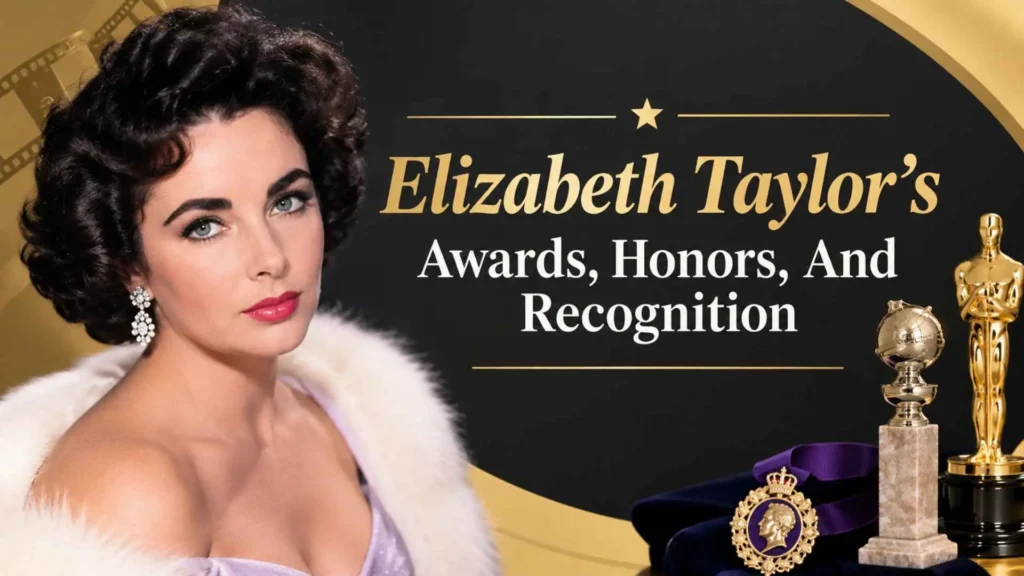
Taylor received major recognition for both acting and humanitarian work.
Academy Awards
Taylor won two Best Actress Oscars.
Those victories came for:
- Butterfield 8
- Who’s Afraid of Virginia Woolf?
The Academy also honored her humanitarian work with the Jean Hersholt Humanitarian Award.
Jean Hersholt Humanitarian Award
In 1993, Taylor received the Jean Hersholt Humanitarian Award at the Academy Awards.
The honor reflected her extensive HIV/AIDS advocacy.
It also demonstrated how her public identity had evolved. She was no longer known solely as a Hollywood actress. Her humanitarian work had become a central part of her legacy.
Dame Commander Of The Order Of The British Empire
In 2000, Queen Elizabeth II appointed Taylor a Dame Commander of the Order of the British Empire.
That honor added another dimension to her public recognition.
Taylor’s honors crossed entertainment, humanitarian work, and international public life. Her official biography also notes recognition including the Légion d’honneur and Presidential Citizens Medal.
American Film Institute Recognition
The American Film Institute honored Taylor with its Life Achievement Award.
AFI describes her as the youngest recipient of that award and highlights a career that stretched across roughly half a century.
That recognition places Taylor firmly within the history of classic American cinema.
Elizabeth Taylor’s Business Ventures And Cultural Influence
Taylor wasn’t only an actress.
She also became an early example of a modern celebrity entrepreneur.
White Diamonds And The Fragrance Business
Taylor’s name became closely associated with luxury fragrances.
White Diamonds became one of the best-known celebrity fragrance brands and formed a major part of her commercial legacy.
Her official biography describes her as a pioneering celebrity entrepreneur and notes her role in launching a successful fragrance business.
This was significant because celebrity fragrances later became a huge commercial category.
Taylor was an early figure in turning personal fame into a recognizable consumer brand.
Jewelry And Entrepreneurship
Taylor also developed a strong connection with jewelry.
Her public image frequently included elaborate jewelry and luxury fashion, and her business activities extended beyond acting.
That entrepreneurial side is easy to overlook because her film career was so famous.
Yet it shows why describing Taylor only as a Hollywood actress doesn’t capture the full scope of her career.
Celebrity, Business, And Advocacy
Taylor’s public life eventually combined three major roles:
- Actress
- Entrepreneur
- Humanitarian advocate
Few Hollywood stars of her generation moved so visibly between those worlds.
Her celebrity gave her a platform. Her businesses gave her another commercial identity. Her activism transformed that visibility into public advocacy.
Karen Lynch And Elizabeth Taylor Compared
At first glance, the two women appear to have little in common.
One built a career in corporate healthcare. The other became a film legend.
Yet a factual comparison reveals several interesting parallels.
| Category | Karen S. Lynch | Elizabeth Taylor |
| Primary field | Healthcare and corporate leadership | Film, entertainment, entrepreneurship, humanitarian advocacy |
| Best known for | Aetna and CVS Health leadership | Acting and HIV/AIDS advocacy |
| Industry | Healthcare | Entertainment |
| Major leadership role | CVS Health president and CEO | Public advocate and foundation founder |
| Major organizations | CVS Health, Aetna, Magellan Health | amfAR, Elizabeth Taylor AIDS Foundation |
| Academy Awards | Not an acting figure | Two Best Actress wins |
| Humanitarian recognition | Corporate and leadership recognition | Jean Hersholt Humanitarian Award and other honors |
| HIV/AIDS advocacy | Not the defining focus of her public career | Major part of her later public legacy |
| Business activity | Healthcare and insurance | Fragrance and jewelry |
| Public legacy | Healthcare executive leadership | Hollywood, entrepreneurship, and humanitarian advocacy |
The comparison makes one fact especially clear: there is no need to invent a relationship to make either career interesting.
Both women already have substantial individual stories.
The Real Similarities Between Karen Lynch And Elizabeth Taylor
Although their careers were different, some broad similarities are worth examining.
Both Built High-Profile Careers
Lynch became a highly visible female CEO in corporate America.
Taylor became one of the most recognizable women in the history of Hollywood.
Their forms of influence were different, but both developed public identities that extended well beyond their immediate professional roles.
Both Became Recognizable Women In Traditionally Male-Dominated Spaces
For Lynch, the relevant arena was corporate healthcare and executive leadership.
For Taylor, the situation was different. Hollywood included powerful women, but the entertainment industry was still shaped heavily by male studio executives, producers, directors, and business leaders during much of her early career.
Taylor later gained greater control over her commercial identity and public advocacy.
Lynch’s influence came through organizational authority. Taylor’s came largely through celebrity, public communication, and philanthropy.
Those aren’t interchangeable forms of power.
Both Extended Their Influence Beyond Their Primary Careers
Lynch’s career expanded from accounting into healthcare leadership and later corporate board work.
Taylor moved from acting into fragrance, jewelry, philanthropy, and HIV advocacy.
That ability to build influence outside an original profession is one of the most interesting similarities between them.
The Major Differences Between Karen Lynch And Elizabeth Taylor
The differences are even more substantial.
Healthcare Executive Vs. Hollywood Actress
Karen Lynch spent her career working within the healthcare system.
Elizabeth Taylor spent most of her working life in film and entertainment.
One dealt with:
- health insurance
- healthcare operations
- corporate strategy
- pharmacy services
- healthcare delivery
- executive management
The other dealt primarily with:
- acting
- film production
- celebrity culture
- entertainment
- consumer branding
- humanitarian advocacy
These aren’t overlapping professions.
Corporate Leadership Vs. Celebrity Advocacy
Lynch’s influence came from formal organizational authority.
As CEO, she was responsible for strategy, operations, financial performance, employees, acquisitions, and other aspects of corporate management.
Taylor’s advocacy worked differently.
She could mobilize attention because millions of people already recognized her face and name. That visibility helped her bring HIV/AIDS into conversations that might otherwise have received less mainstream attention.
Different Generations And Historical Contexts
Taylor was born in 1932 and entered Hollywood as a child.
Lynch’s professional career developed decades later in modern corporate healthcare.
The historical context matters.
Taylor worked through the golden age of Hollywood, the decline of the studio system, major social changes, and the emergence of HIV/AIDS as a global public health crisis.
Lynch’s career developed amid healthcare consolidation, digital transformation, changing insurance markets, pharmacy integration, and the growth of value-based healthcare.
Comparing the two without considering those contexts would flatten two very different stories.
Karen Lynch And Elizabeth Taylor Timeline
A timeline helps show just how different their professional journeys were.
Elizabeth Taylor’s Timeline
| Year | Milestone |
| 1932 | Elizabeth Taylor is born in London |
| 1944 | Stars in National Velvet |
| 1958 | Receives an Oscar nomination for Cat on a Hot Tin Roof |
| 1960 | Wins Best Actress for Butterfield 8 |
| 1963 | Stars in Cleopatra |
| 1966 | Wins Best Actress for Who’s Afraid of Virginia Woolf? |
| 1980s | Becomes increasingly active in HIV/AIDS advocacy |
| 1985 | Helps establish amfAR |
| 1991 | Establishes The Elizabeth Taylor AIDS Foundation |
| 1993 | Receives the Jean Hersholt Humanitarian Award |
| 2000 | Becomes a Dame Commander of the Order of the British Empire |
| 2011 | Dies in Los Angeles at age 79 |
Taylor’s official biography and amfAR’s historical account document the major milestones in her acting and advocacy career.
Karen Lynch’s Timeline
| Year | Milestone |
| Early career | Begins professional career at Ernst & Young as a CPA |
| 1991 | Moves into healthcare through Cigna |
| 2009 | Becomes president of Magellan Health Services |
| 2012 | Joins Aetna |
| 2015 | Becomes president of Aetna |
| 2018 | CVS Health completes its acquisition of Aetna |
| 2021 | Becomes president and CEO of CVS Health |
| 2021 | Ranked No. 1 on Fortune’s Most Powerful Women list |
| 2022 | Ranked No. 1 again by Fortune |
| 2023 | CVS expands through Oak Street Health and Signify Health acquisitions |
| 2024 | Steps down as CVS Health CEO |
| 2025 | ADP announces her nomination to its board |
ADP’s corporate biography confirms Lynch’s Ernst & Young, Aetna, CVS Health, and board experience. CVS Health confirms that David Joyner replaced her as CEO in October 2024.
What The Search Results Get Wrong About Karen Lynch And Elizabeth Taylor
Online information can make unrelated people appear connected.
That doesn’t necessarily mean somebody deliberately created false information. Sometimes the problem develops gradually as articles, search queries, automated systems, and copied content reinforce the same association.
A Search Result Does Not Prove A Relationship
If Karen Lynch and Elizabeth Taylor appear beside each other in a search result, that doesn’t prove:
- they were relatives
- they were friends
- they worked together
- they shared a company
- they belonged to the same organization
- they had a business partnership
A search engine organizes information. It doesn’t certify the historical truth of every relationship implied by the arrangement.
Repeated Claims Are Not Independent Confirmation
Imagine that one website publishes an unsupported statement.
Five other websites copy it.
A reader then finds six websites making the same claim.
It may look well-established.
But if all six pages trace back to the same unsupported statement, the number of pages doesn’t provide six independent pieces of evidence.
That’s why documented evidence matters more than repetition.
For biographical questions, primary sources are particularly valuable.
Useful sources include:
- official corporate biographies
- SEC filings
- company investor-relations pages
- foundation records
- Academy records
- archival organizations
- established biographical references
Why “No Documented Connection” Is The More Accurate Wording
There is an important difference between these two statements:
“Karen Lynch and Elizabeth Taylor were never connected in any way.”
and:
“No verified public record establishes a family, professional, or personal relationship between Karen Lynch and Elizabeth Taylor.”
The second statement is more responsible because it describes what the evidence actually supports.
That distinction is especially important when discussing public figures.
Karen Lynch And Elizabeth Taylor FAQ
Are Karen Lynch And Elizabeth Taylor Related?
No verified public evidence establishes a family relationship between Karen S. Lynch and Elizabeth Taylor. Their documented biographies describe separate family histories and professional careers.
Did Karen Lynch Know Elizabeth Taylor?
There is no reliable public documentation establishing a friendship or personal relationship between the two. That doesn’t allow anyone to make claims about every private interaction, but no documented public connection has been identified.
Did Karen Lynch And Elizabeth Taylor Ever Work Together?
No documented joint professional project or business partnership has been established.
Lynch worked primarily in healthcare and corporate leadership. Taylor worked primarily in entertainment, entrepreneurship, and humanitarian advocacy.
Why Are Karen Lynch And Elizabeth Taylor Mentioned Together?
The exact origin of the online association isn’t reliably established by the available evidence. Search engines and online publishing systems can associate unrelated public figures through repeated queries, comparison pages, automated content, or copied claims.
Who Is Karen S. Lynch?
Karen S. Lynch is an American healthcare executive who served as president and CEO of CVS Health from 2021 until October 2024. She previously served as president of Aetna and held leadership positions at Magellan Health and Cigna.
What Was Elizabeth Taylor Famous For?
Elizabeth Taylor was famous for her long Hollywood acting career, major films such as National Velvet, Butterfield 8, Cleopatra, and Who’s Afraid of Virginia Woolf?, as well as her later HIV/AIDS advocacy and entrepreneurial activities.
Was Elizabeth Taylor A Healthcare Executive?
No. Taylor was primarily an actress, entrepreneur, and humanitarian advocate. Her healthcare-related public work centered largely on HIV/AIDS advocacy, fundraising, public education, and support for affected communities.
Was Karen Lynch An Actress?
No. Karen Lynch’s documented career is in accounting, healthcare, insurance, executive management, and corporate governance.
What Did Karen Lynch Do At CVS Health?
Lynch became president and CEO of CVS Health in February 2021. Her tenure included the company’s healthcare transformation strategy, pandemic response, and expansion into areas such as primary care and home-based healthcare. She left the CEO position in October 2024.
Who Replaced Karen Lynch As CVS Health CEO?
David Joyner replaced Karen Lynch as president and CEO of CVS Health, effective October 17, 2024.
CVS Health later announced that Joyner would also become chairman of the board effective January 1, 2026.
What Was Elizabeth Taylor’s Role In HIV/AIDS Advocacy?
Taylor became one of the most visible celebrity advocates for HIV/AIDS research, funding, education, and anti-discrimination efforts. She helped establish amfAR in 1985 and founded The Elizabeth Taylor AIDS Foundation in 1991.
What Is The Elizabeth Taylor AIDS Foundation?
The foundation is the organization Taylor established in 1991 to support direct AIDS services and complement broader research, education, and advocacy efforts.
Did Elizabeth Taylor Win An Academy Award?
Yes. Elizabeth Taylor won two Best Actress Academy Awards, for Butterfield 8 and Who’s Afraid of Virginia Woolf? She also received the Jean Hersholt Humanitarian Award.
How Many Academy Awards Did Elizabeth Taylor Win?
Taylor won two competitive acting Oscars. She also received the Academy’s Jean Hersholt Humanitarian Award in 1993.
What Is Karen Lynch Doing After CVS Health?
After leaving CVS Health, Lynch continued her corporate leadership career. ADP announced in September 2025 that she had been nominated for its board of directors. The announcement also identified her as a director of Thermo Fisher Scientific.
Did Karen Lynch And Elizabeth Taylor Have A Business Partnership?
No verified public record establishes a business partnership between them.
Final Facts About Karen Lynch And Elizabeth Taylor
The phrase Karen Lynch and Elizabeth Taylor may suggest a hidden connection, but the documented evidence tells a different story.
Karen S. Lynch and Elizabeth Taylor were two separate public figures with distinctly different careers.
Lynch built her reputation as a healthcare executive, moving from accounting into healthcare leadership and eventually becoming president and CEO of CVS Health. Her career included senior positions at Cigna, Magellan Health, Aetna, and CVS Health, followed by corporate board work.
Taylor became a Hollywood legend, beginning as a child actress and developing into an Academy Award-winning performer, entrepreneur, and internationally recognized humanitarian. Her later work with amfAR and The Elizabeth Taylor AIDS Foundation made HIV/AIDS advocacy a defining part of her legacy.
The two stories intersect mainly at the level of broad themes: both women built highly visible careers, became influential in their respective fields, and extended their public influence beyond their original professional roles.
But that doesn’t establish a personal relationship.
No verified public source currently establishes that Karen Lynch and Elizabeth Taylor were relatives, business partners, colleagues, or close friends.
That is the key fact behind the search.
And it also illustrates an important lesson about online information: two names appearing together doesn’t automatically mean two lives were connected. When a claim involves public figures, the strongest approach is to follow the documented record rather than letting search associations fill in the gaps.

Oliver Harrington is a British author and language researcher known for his engaging writing on the meanings of words, communication, and personal growth. Born in Oxford, England, he developed a passion for literature and etymology at an early age, later studying English Literature before pursuing a full-time writing career. His work combines historical research with practical insights, making complex language concepts easy for readers to understand. Over the years, he has contributed to educational publications, spoken at literary events, and inspired thousands of readers with his thoughtful approach to language. When he is not writing, Oliver enjoys exploring historic libraries, travelling across the British countryside, and researching the origins of English expressions.
Books:
- The Language of Meaning
- Words That Shaped the World
 Edward Whitmore