If you’ve ever seen someone reply “based” to a TikTok, Reddit comment, meme, or group-chat message, you may have wondered what they actually mean. In modern internet slang, “based” usually expresses strong approval of an opinion, action, or attitude.
The word often carries more meaning than a simple “I agree.” Someone might call a statement based because they think it’s honest, bold, authentic, independent, or unapologetic. In some situations, however, people use it sarcastically or ironically.
The history of the term is even more interesting. Modern “based” is closely associated with rapper Lil B, also known as The BasedGod, who reclaimed an older negative slang term and gave it a positive meaning centered on being yourself and not worrying about other people’s opinions.
So, what does based mean in slang today? Here’s the complete explanation, including its origin, meaning in texting, social media usage, examples, comparisons, and common questions.
What Does Based Mean in Slang?
In modern based slang, based generally means that someone approves of a statement, opinion, action, or person because it seems bold, authentic, confident, or unapologetic.
In simple terms, calling something “based” can mean:
“I respect that.”
It can also mean:
- “I agree with that.”
- “That’s a good take.”
- “I respect your honesty.”
- “You’re not afraid to say what you think.”
- “That’s confidently authentic.”
- “I support that.”
- “That was a bold move.”
The exact meaning depends on context and tone.
For example, imagine someone says:
“I stopped buying expensive clothes because I’d rather save the money.”
Someone might respond:
“Based.”
Here, the person probably approves of the decision and respects the speaker’s independence.
However, “based” doesn’t necessarily mean the speaker thinks the statement is objectively correct. It can praise the confidence behind the opinion rather than the opinion itself.
That distinction matters.
Based Definition in Simple English
A practical based definition is:
Based describes something a person considers admirable because it is confident, authentic, bold, independent, or worthy of approval.
As an online reaction, it can function almost like a one-word endorsement.
| Expression | Likely meaning |
| Based | Strong approval or respect |
| Very based | Stronger approval |
| Based take | Approval of someone’s opinion |
| Based opinion | Respect for a confident or unconventional view |
| That’s based | “I respect or approve of that” |
| Bro is based | “That person is acting confidently or authentically” |
| BASED | Strong emphasis or excitement |
Based Meaning in Text and Texting
The based meaning in text is usually straightforward: the sender approves of something you said or did.
Because texting often relies on short reactions, a single word can replace an entire sentence.
For example:
Person A: “I don’t care if everyone hates pineapple on pizza. I like it.”
Person B: “Based.”
The response doesn’t necessarily mean Person B loves pineapple pizza. It may simply show respect for Person A’s willingness to state an unpopular preference.
Another example:
Person A: “I’m taking a break from social media for a month.”
Person B: “Based.”
Here, the reaction could communicate admiration for the decision.
What Does “Based” Mean When Texting?
When someone sends “based” by itself, it usually works as an approving reaction.
Its meaning may include:
- agreement
- respect
- admiration
- encouragement
- recognition of confidence
- appreciation for authenticity
- humorous approval
The surrounding conversation determines which shade is intended.
For instance:
“I don’t need everyone to like me.”
Based.
That response probably praises the person’s confidence.
But:
“I eat cereal with orange juice.”
Based.
That could be sincere, playful, or completely ironic.
That’s why dictionary-style definitions don’t always capture internet slang perfectly. Context does much of the work.
Is “Based” a Compliment?
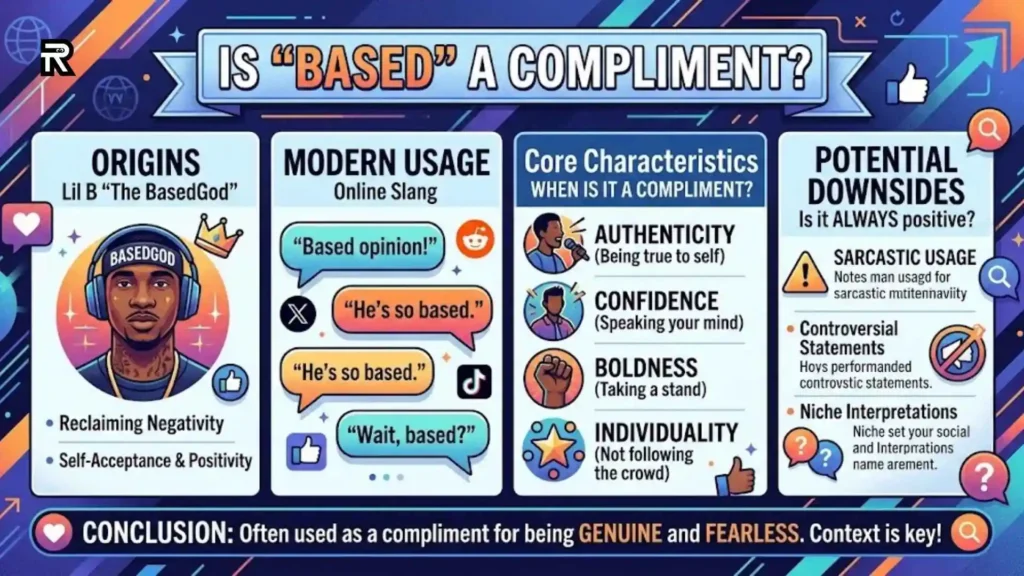
Yes, based is usually a compliment in modern online communication.
However, it’s a particular kind of compliment. Instead of simply saying that something is attractive, intelligent, successful, or correct, “based” often praises someone’s attitude or stance.
It can recognize:
- confidence
- authenticity
- independence
- boldness
- honesty
- unapologetic behavior
- strong opinions
For example:
“Everyone told him to change his style, but he kept wearing what he liked.”
A person might comment:
“Based.”
The compliment focuses on independence.
Based Does Not Always Mean “Correct”
This is one of the most important details about based meaning slang.
Calling something based doesn’t automatically mean:
“This is objectively true.”
Instead, it can mean:
“I respect the fact that you said or did this.”
Consider this example:
“I don’t like the popular restaurant everyone recommends. The small local place is much better.”
Someone might respond:
“Based take.”
The person could agree completely. Alternatively, they might simply appreciate the confidence behind the unpopular opinion.
Does Based Mean “I Agree”?
Sometimes. Not always.
This is probably the easiest way to understand the difference.
When someone says “based,” they may agree with the statement. But they can also approve of the speaker’s courage, independence, or authenticity without fully sharing the same view.
Compare these responses:
“I agree.”
This directly communicates agreement.
“Facts.”
This usually signals agreement that something is true.
“Based.”
This can communicate agreement plus approval, respect, or admiration for the stance.
That extra layer makes based distinctive.
Based and Valid
You may also see:
“Based and valid.”
Here, valid usually means that the person’s point or feeling is reasonable or legitimate.
Based adds a stronger social reaction. It can praise the confidence, honesty, or boldness behind the position.
For example:
“It’s okay to say no when you don’t have the time to help someone.”
Based and valid.
The speaker is both accepting the idea and praising the underlying attitude.
Based Meaning Depending on Context and Tone
The based meaning can change dramatically depending on tone.
The same word may be sincere, humorous, sarcastic, ironic, or exaggerated.
Sincere Use of Based
A sincere use expresses genuine approval.
“I deleted the apps that were wasting my time.”
“Based.”
The person likely respects the decision.
Ironic Use of Based
Online communities frequently use slang ironically.
For example:
“I just ate an entire cake before breakfast.”
“Based.”
The responder may not seriously recommend eating an entire cake for breakfast. The humor comes from treating an absurd action as something worthy of praise.
This is why ironic meaning matters when interpreting internet language.
Sarcastic Use of Based
Someone may also use “based” sarcastically when they obviously don’t support the statement.
For example:
“I haven’t slept in two days because energy drinks are my personality.”
“Very based.”
Depending on the relationship between the speakers, this could be playful exaggeration rather than genuine approval.
Exaggerated Use of Based
Internet users often intensify slang for comedic effect.
You may see:
- very based
- extremely based
- incredibly based
- ultra based
- common based
- maximum based
These expressions don’t represent separate dictionary definitions. They’re usually forms of playful exaggeration.
What Does Based Mean Online?
The based meaning online has become broader than its original philosophy.
Today, people use the term as a quick reaction to:
- opinions
- memes
- personal choices
- jokes
- political statements
- lifestyle decisions
- entertainment preferences
- gaming decisions
- unusual behavior
- controversial takes
It works especially well in online communication because internet conversations often move quickly.
Instead of writing:
“I strongly respect your willingness to express that unpopular opinion despite potential criticism.”
Someone can simply write:
“Based.”
One word does the job.
Why Does Internet Slang Work This Way?
Digital communication rewards compact expressions.
Words such as based, W, facts, real, and valid can act like conversational shortcuts. Each carries a cluster of social meaning that regular sentences might take much longer to express.
This is part of internet culture and the constantly changing internet lexicon.
Based Meaning on Social Media
The core meaning of “based” usually remains similar across platforms. What changes is the surrounding community, tone, and subject matter.
Based Meaning on TikTok
On TikTok, based commonly appears in comments beneath videos featuring strong opinions, unusual choices, jokes, or controversial takes.
For example:
“I don’t follow fashion trends. I just wear what feels comfortable.”
Comment:
“Based.”
The commenter is probably praising independence.
You may also see:
“Based take.”
This usually signals approval of the creator’s opinion.
Because TikTok comments often rely on short reactions, “based” fits naturally into the platform’s fast-moving social media slang culture.
Based Meaning on Instagram
On Instagram, people may use based in comments under Reels, posts, memes, or opinion-driven content.
For example:
“I’m spending less money on things I don’t actually need.”
A comment might simply say:
“Based.”
The term doesn’t have a special Instagram-only definition. Its interpretation still depends on the content and the relationship between users.
Based Meaning on Reddit
Reddit provides a particularly interesting environment for based because different communities have different norms.
A user might call an unpopular but confidently defended opinion a based take.
For example:
“Everyone says this game is perfect, but I think its older version was better.”
Another user might respond:
“Based.”
That could mean:
“I agree with you.”
Or:
“I respect you for saying what many people won’t.”
The subreddit context helps determine which interpretation makes more sense.
Based Meaning on Discord
On Discord, based often appears in fast-moving conversations.
You’ll find it in:
- gaming servers
- friend groups
- community servers
- meme channels
- private conversations
For example:
“I’m skipping the new game and replaying the classic.”
“Based.”
The response might express agreement or simply playful approval.
Based Meaning on Snapchat and X
The same basic principle applies on Snapchat and X.
A user might write based after seeing a bold statement, unusual opinion, meme, or controversial comment.
On X, especially, the word can appear in political conversations. That doesn’t mean every use of “based” is political. The term has broader uses well beyond politics.
How “Based” Became Internet Slang
The history of based slang is unusual because the modern positive meaning developed through a major semantic shift.
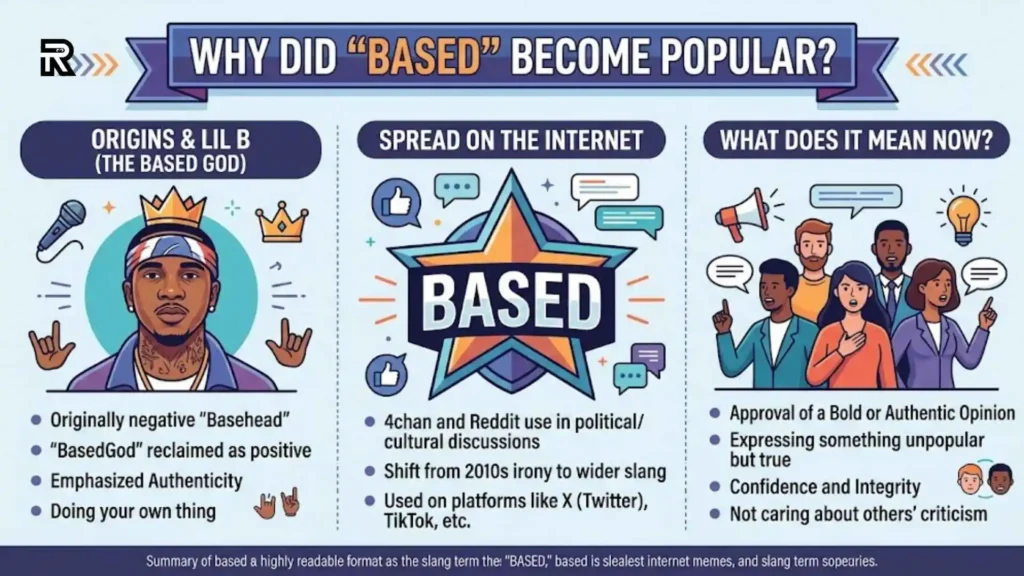
The older slang history is connected to basehead, a derogatory term associated with people who used freebase cocaine. Dictionary.com describes the earlier usage as a negative label connected to crack cocaine and freebasing.
The modern positive meaning is strongly associated with rapper Lil B, whose real name is Brandon McCartney.
Lil B and The BasedGod
Lil B became closely associated with the term during the late 2000s and early 2010s.
His public persona included the nickname The BasedGod. He also used “based” as part of his broader philosophy of individuality, positivity, and freedom from other people’s judgments.
A particularly important point in the history came from a 2010 interview in which Lil B explained that people had used the word negatively toward him. He described reclaiming it and turning the insult into something positive.
That process is an example of semantic reclamation.
Instead of accepting a negative label, the speaker takes the word and assigns it a new positive identity.
From Lil B to Internet Culture
Lil B’s use helped move “based” into online communities.
The word eventually became detached from its original personal philosophy in many contexts. Online users began using it more broadly as a reaction meaning approval, respect, or admiration.
Know Your Meme identifies Based Boys, released by The Pack in 2007, as an early documented use connected to the later slang development. It also identifies Lil B’s 2010 explanation as an important point in the modern meaning’s development.
The word then traveled through online communities and developed additional meanings.
The Political Phase of “Based”
During the 2010s, based became especially common in some political internet communities.
In those spaces, users sometimes used it to praise statements considered anti-establishment, politically incorrect, or outside mainstream opinion. The term was also associated with phrases such as “based and redpilled.”
That history matters because some audiences can still interpret “based” through a political lens.
However, the word isn’t inherently a political term.
Today, someone can call a restaurant recommendation, gaming strategy, personal choice, or joke “based” without making any political statement at all.
Why Did “Based” Become Popular?
Several features made based particularly useful for online communication.
It Is Extremely Short
Typing “based” takes seconds.
The word works perfectly in comments and chats where users want to react quickly.
It Communicates More Than Simple Agreement
“I agree” can sound neutral.
“Based” can carry additional signals of:
- respect
- admiration
- confidence
- authenticity
- boldness
That richer meaning helped it survive as internet slang.
It Works With Serious and Humorous Content
The word can praise a serious opinion.
It can also describe an absurd joke.
That flexibility makes it useful across different online communities.
It Fits Meme Culture
Internet memes thrive on recognizable phrases.
“Based” became easy to repeat, exaggerate, remix, and combine with other expressions.
That’s a classic feature of meme culture: a short phrase gains new shades of meaning as different communities reuse it.
Common Situations Where People Say “Based”
The word can appear after almost anything that someone considers worthy of approval.
Based Opinion
A based opinion usually describes a viewpoint that seems bold, honest, or independent.
“I don’t care what critics say. This is my favorite movie.”
Based opinion.
Based Take
A based take is an approving reaction to someone’s viewpoint.
“The original version was better than the remake.”
“Based take.”
The commenter may agree with the argument or simply appreciate the confidence behind it.
Based Choice
A based choice praises someone’s decision.
“I chose the small local restaurant instead of the expensive chain.”
“Based choice.”
Based Decision
The same idea applies to decisions.
“I’m saving my money instead of upgrading my phone every year.”
“Based decision.”
Based Advice
Someone may also call practical or straightforward advice based.
“Don’t spend money just to impress people.”
“Based advice.”
Based Strategy
In gaming, based strategy can describe a move that another player respects.
“Everyone used the popular build, but he created his own strategy.”
“Based strategy.”
The term here doesn’t necessarily mean the strategy is objectively optimal. It may simply show admiration for the player’s unconventional approach.
What Do “Very Based,” “Extremely Based,” and “Incredibly Based” Mean?
These expressions simply intensify the reaction.
| Phrase | Typical effect |
| Based | Approval |
| Very based | Strong approval |
| Extremely based | Very strong approval |
| Incredibly based | Strong approval with possible exaggeration |
| BASED | Emphatic or excited approval |
For example:
“I brought snacks for everyone.”
“Very based.”
The extra word very adds emphasis.
Similarly:
“BASED.”
Capitalization can make the reaction feel louder or more enthusiastic. It doesn’t create a completely different definition.
Based Examples in Sentences
Here are practical examples showing how the term works in different contexts.
| Example | What “based” communicates |
| “I don’t care what people think.” — “Based.” | Respect for confidence |
| “I’m saving money instead of buying a new phone.” — “Based choice.” | Approval of the decision |
| “That movie deserves more attention.” — “Based take.” | Agreement or respect |
| “He ignored the trend and did his own thing.” — “Bro is based.” | Admiration for independence |
| “I prefer the old game.” — “Based.” | Agreement or respect |
| “I ate cake for breakfast.” — “Extremely based.” | Humorous approval |
| “She finally said what everyone was thinking.” — “Based.” | Approval of honesty |
| “That’s based and valid.” | Approval plus recognition that the point is reasonable |
The important pattern is simple: based reacts to something rather than merely describing it.
Based vs. Similar Internet Slang
Several online expressions overlap with based, but they aren’t interchangeable.
Based vs. W
W usually means a win or something positive.
For example:
“He helped his friend when nobody else would.”
“W.”
That focuses on the positive action or outcome.
Based might instead emphasize the attitude behind the action.
“Based.”
It can mean:
“I respect that.”
The two expressions can overlap.
Based vs. Facts
Facts usually signals agreement that something is true.
“Sleep is important.”
“Facts.”
Based is broader.
It can praise an opinion even when the conversation isn’t about an objectively verifiable fact.
“I don’t need the latest phone.”
“Based.”
That’s more about approval of the attitude.
Based vs. Valid
Valid generally communicates that a point, feeling, or preference is legitimate.
“I understand why you don’t like that movie.”
“Valid.”
Based can add admiration for the person’s stance.
“I don’t like that movie and I’m not afraid to say it.”
“Based.”
Based vs. Real
Real often communicates relatability.
Someone says:
“I always say I’m going to sleep early, then stay awake for three more hours.”
Another person might answer:
“Real.”
They’re saying the experience is relatable.
Based is more about approval, respect, or admiration.
Based vs. Simple Agreement
The difference can be summarized like this:
| Term | Main idea |
| Based | “I respect or approve of that stance.” |
| W | “That’s a win.” |
| Facts | “That’s true.” |
| Valid | “That’s reasonable or legitimate.” |
| Real | “I relate to that.” |
| I agree | Direct agreement |
These aren’t rigid definitions. Internet slang constantly shifts through community usage.
Is “Based” Offensive?
The word based itself isn’t inherently offensive.
However, the statement receiving the label can be controversial, discriminatory, hateful, or harmful.
That’s why context matters.
A person saying:
“Based.”
after a harmless personal preference is very different from someone using the same word to praise hateful content.
The term has also appeared in political and extremist online spaces. Its history includes periods where some communities used it to praise controversial or anti-establishment positions.
That doesn’t mean every use carries an extremist meaning.
The safest approach is to examine the entire conversation, not one slang word in isolation.
Is “Based” Safe to Use at Work?
Generally, based is informal internet slang, so it isn’t the best choice for formal professional communication.
Avoid it in:
- formal emails
- business proposals
- academic writing
- client communications
- official reports
- professional documentation
- job applications
Instead of writing:
“Based.”
you could write:
- “I agree.”
- “That’s a strong point.”
- “I respect that perspective.”
- “That makes sense.”
- “That’s a reasonable approach.”
- “I think that’s a good decision.”
Casual workplaces may use internet slang among colleagues. Even then, the relationship and company culture matter.
If you’re unsure, choose the clearer professional phrase.
How to Respond When Someone Says “Based”
You don’t always need to respond to based with another slang term.
Your response should depend on the conversation.
If You Agree
You could say:
“Exactly.”
or:
“That’s what I mean.”
If You’re Joking
You might respond:
“You already know.”
If You Don’t Understand
Ask:
“What do you mean?”
If the Person Is Being Sarcastic
You can simply continue the conversation without treating “based” as serious approval.
The main rule is simple: match the tone of the conversation.
When Should You Use “Based”?
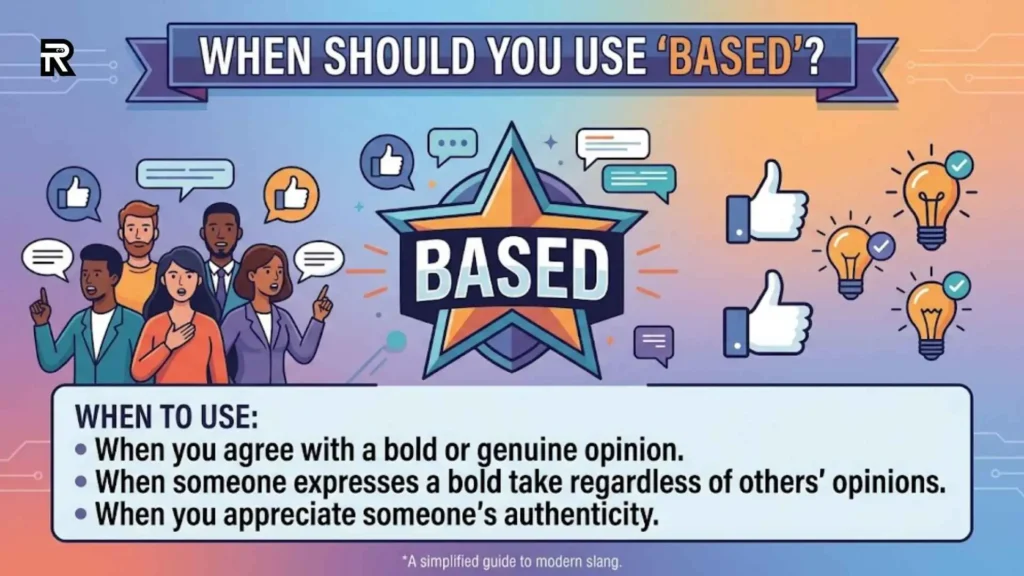
Use based when you’re participating in an informal conversation where internet slang feels natural.
Good situations include:
- social media comments
- meme communities
- gaming chats
- group chats
- casual messaging
- online forums
- conversations with friends
It works especially well when you want a short reaction to a confident or unconventional statement.
When Should You Avoid “Based”?
Avoid it when clarity and formality matter more than casual tone.
That includes:
- academic assignments
- business writing
- formal emails
- legal documents
- professional reports
- client communications
- serious workplace discussions
There’s nothing wrong with slang. The issue is audience and context.
A phrase that sounds natural in a Discord server can sound out of place in a business email.
Frequently Asked Questions About Based Meaning Slang
What does based mean in slang?
Based is internet slang that usually expresses approval, respect, or admiration for a person, opinion, action, or attitude. It often suggests that someone is being bold, authentic, independent, or unapologetic.
What does based mean in text?
In texting, based usually means “I approve,” “I respect that,” or “I agree with that.” The exact meaning depends on the surrounding conversation.
What does based mean when texting?
When texting, based often works as a short approving reaction. It can praise an opinion, decision, joke, or personal choice.
What does based mean on TikTok?
On TikTok, based usually appears in comments to show approval of a confident, bold, unusual, or controversial statement. It can also be used jokingly or sarcastically.
What does based mean on Instagram?
On Instagram, based has essentially the same core meaning. Users may post it under Reels, memes, or opinions they respect or support.
What does based mean on Reddit?
On Reddit, based can mean agreement or admiration for an opinion, especially one that seems confident or unconventional. The exact meaning can vary between communities.
What does based mean on Discord?
On Discord, people commonly use based as a quick reaction in casual chats, gaming communities, meme channels, and friend groups.
Is based a compliment?
Usually, yes. Based generally acts as a compliment because it expresses approval, respect, or admiration. However, people can also use it sarcastically.
Does based mean I agree?
Not necessarily. It can mean agreement, but it can also mean that you respect someone’s confidence or willingness to express an unpopular opinion.
Can based be sarcastic?
Yes. Based can be sarcastic, ironic, or humorous. Context, punctuation, exaggeration, and the relationship between speakers can reveal the intended meaning.
Is based offensive?
The word itself isn’t inherently offensive. However, some communities have used it in political or extremist contexts. Always consider what statement is being praised and who is using the term.
Is based safe to use at work?
It’s better to avoid based in formal workplace communication because it’s casual internet slang. Use clearer phrases such as “I agree” or “That’s a strong point.”
Why did based become popular?
The modern slang sense is strongly associated with Lil B, who reclaimed the older negative term and connected it with being yourself, positivity, and not fearing other people’s opinions. Internet communities later broadened the term into a general expression of approval.
What is the origin of based slang?
The older slang history is associated with basehead, a derogatory term related to freebase cocaine. Lil B later reclaimed “based” and gave it a positive meaning centered on authenticity and independence.
What is the difference between based and valid?
Valid usually means that something is reasonable, legitimate, or understandable. Based often adds approval or admiration for the person’s stance, especially when it seems bold or unapologetic.
What is the difference between based and W?
W usually means something is a win or positive outcome. Based more often praises a person’s opinion, attitude, decision, or authenticity. The two can overlap.
What is the difference between based and facts?
Facts generally signals agreement that something is true. Based can express approval even when the statement is an opinion rather than a factual claim.
What is the difference between based and real?
Real often means “relatable” or “I feel that.” Based more commonly means “I respect or approve of that.”
Final Takeaway: The Simple Based Meaning
The simplest based meaning slang definition is approval for something seen as bold, authentic, confident, or unapologetic.
When someone replies “based” to your message, they may mean “I agree,” but they could also be saying, “I respect that,” “That’s a strong take,” or “I like that you don’t care what other people think.”
The word has a fascinating history. Its older negative association changed dramatically after Lil B reclaimed it and connected it with positivity, individuality, and self-expression. Internet communities then reshaped the term again, giving it broader meanings across memes, social media, gaming, forums, and everyday digital communication.
Today, context remains the key. Based can be sincere, playful, exaggerated, ironic, or sarcastic. It isn’t automatically a statement that something is objectively true. Think of it as a compact online stamp of approval whose exact shade depends on the conversation.

Edward Whitmore is a British author, researcher, and public speaker with a strong interest in language, philosophy, and lifelong learning. Born in York, England, he discovered his love for books and linguistics during his school years and later turned that passion into a successful writing career. His books focus on helping readers understand the deeper meaning of words, ideas, and communication through clear explanations and well-researched content. Edward regularly contributes to educational projects and enjoys sharing his knowledge through workshops and articles. In his free time, he visits historical landmarks, collects vintage books, and studies the development of the English language.
Books:
- Beyond the Dictionary
- The Meaning Behind Every Word
 Charlotte Pembroke
 Oliver Harrington