
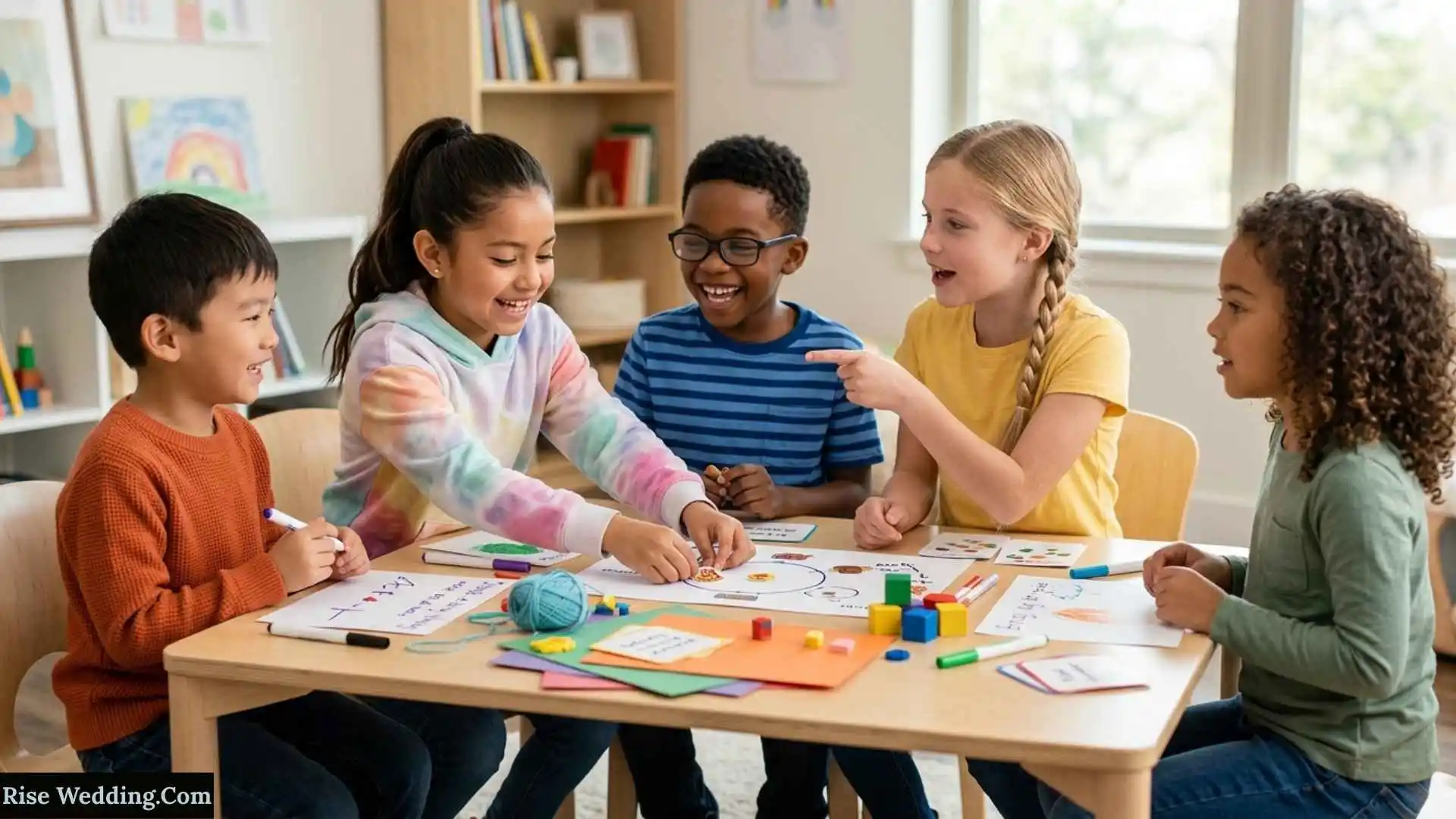
Finding the right icebreakers for kids can make a new classroom, birthday party, summer camp, youth group, sports team, or after-school program feel comfortable much faster. The best activities do more than fill a few minutes. They give children a natural reason to talk, laugh, cooperate, learn names, discover shared interests, and participate without feeling pressured.
An effective kids’ icebreaker should match the children’s age, group size, energy level, setting, and comfort level. A five-minute name game may be perfect for a kindergarten classroom, while older children may respond better to a funny challenge, partner discussion, scavenger hunt, or team-building activity.
This guide provides 135+ icebreaker ideas for kids, including classroom games, no-prep activities, funny questions, movement games, activities for shy children, party ideas, camp activities, team-building challenges, virtual options, and age-specific recommendations. You’ll also learn how to choose the right activity, avoid common mistakes, and make icebreakers more inclusive.
What Are Icebreakers for Kids?
Icebreakers for kids are short games, questions, or interactive activities that help children become more comfortable with one another and participate in a new or unfamiliar group.
They are commonly used in classrooms, summer camps, birthday parties, youth programs, clubs, sports teams, community groups, and online activities.
A good icebreaker removes some of the awkwardness of meeting new people by giving children a shared task or conversation starter. Instead of asking a child to come up with something to say on their own, the activity provides a clear starting point.
Iowa State University Extension and Outreach describes icebreakers and group games for kindergarten through sixth grade as activities that can help students become more comfortable working closely with others and begin understanding what helps a team work together.
Quick Answer: What Is the Best Icebreaker for Kids?
There is no single best icebreaker for every child or group. Name-and-action games, partner interviews, Would You Rather questions, common-ground activities, scavenger hunts, drawing games, and cooperative challenges are among the most flexible choices.
Choose based on your goal:
| Your Goal | Good Icebreaker Choices |
| Learn names | Name and Action, Name Toss |
| Start conversations | Partner Interview, Would You Rather |
| Help shy children participate | Drawing, Partner Games, Choice Cards |
| Increase energy | Freeze Dance, Move If…, Animal Walk |
| Build teamwork | Tower Challenge, Group Puzzle |
| Fill 5 minutes | Quick Questions, Simon Says |
| Welcome a new class | Human Bingo, Common Ground |
| Birthday party | Treasure Hunt, Charades |
| Summer camp | Camp Bingo, Team Challenge |
| Online group | Polls, Show-and-Tell, Chat Questions |
The goal is not to make children perform. It is to create an easy opportunity for connection.
Why Are Icebreakers Important for Kids?
A new group can feel uncomfortable, especially when children do not know one another. A structured activity gives them something to focus on besides the awkwardness of a first meeting.
Indiana University’s teaching guidance explains that well-chosen icebreakers can help create a supportive class environment, build community, reduce awkwardness around group work, and help instructors understand students’ interests and perspectives.
For children, these activities can also provide opportunities to practice communication, listening, cooperation, creativity, and social interaction.
Icebreakers Help Children Find Common Ground
A simple question such as “What’s your favorite animal?” can reveal that two children both love dolphins.
That shared interest gives them something to talk about.
This is one reason low-pressure activities can work better than demanding formal introductions. Edutopia’s recent classroom guidance emphasizes creating natural opportunities for conversation and connection rather than putting students on the spot with traditional introductions.
Icebreakers Can Support Teamwork
Some activities require children to solve a problem together rather than compete against one another.
For example, a group might need to build a paper tower, complete a puzzle, or create a story together.
Iowa State University Extension’s youth activities include group games designed around teamwork, listening, positive attention, respect, creativity, and recognizing different strengths within a team.
Icebreakers Can Make Participation Less Intimidating
Not every child enjoys standing in front of a group.
A child may happily answer a question to one partner but become uncomfortable speaking to 25 classmates.
That is why a good facilitator should provide different participation formats, including:
- Pairs
- Small groups
- Written answers
- Drawings
- Movement
- Voting
- Cards
- Optional public sharing
The objective is connection, not performance.
How to Choose the Right Icebreaker for Kids

Before choosing an activity, consider the situation rather than simply picking the most popular game.
Consider the Children’s Age
Young children usually benefit from short instructions, movement, repetition, and imagination.
Older children can handle more complicated rules, discussion, creative challenges, and problem-solving.
A useful starting point is:
Ages 4–6: movement, animals, colors, songs, drawing, simple choices
Ages 7–9: scavenger hunts, bingo, common ground, partner questions, simple challenges
Ages 10–12: team challenges, creative questions, mystery games, problem-solving
Teens: opinion questions, collaborative challenges, discussions, creative competitions, and less childish activities
Consider Group Size
A game that works beautifully with eight children may become chaotic with 50.
For small groups, use:
- Circle games
- Partner interviews
- Storytelling
- Name games
- Group discussions
For large groups, use:
- Small teams
- Stations
- Four Corners
- Human Bingo
- Group challenges
- Rotating partners
Consider Your Available Time
2–5 minutes: Choose a quick question, name game, or movement prompt.
5–10 minutes: Try partner interviews, bingo, common ground, or a short team activity.
10–20 minutes: Use scavenger hunts, creative challenges, or cooperative games.
20+ minutes: Use multi-round activities, team challenges, or several connected icebreakers.
Consider the Group’s Energy
If children are restless after sitting for an hour, another sitting activity may not help.
Choose:
- Freeze Dance
- Animal Walk
- Move If…
- Four Corners
- Silent Line-Up
If the group is already energetic, use something calmer:
- Drawing
- Partner Questions
- Mystery Bag
- Story Building
- Question Cards
Consider the Purpose
Ask yourself:
Do I want children to learn names?
→ Use a name-based activity.
Do I want them to talk?
→ Use partner questions.
Do I want teamwork?
→ Use a cooperative challenge.
Do I want movement?
→ Use an active game.
Do I want creativity?
→ Use drawing, storytelling, or invention activities.
Do I want children to relax?
→ Use low-pressure humor and simple choices.
75+ Best Icebreakers for Kids
The following activities are organized by purpose so you can quickly find one that fits your group.
Easy Icebreaker Games for Kids
1. Name and Action
Each child says their name and adds a simple movement.
For example:
“I’m Noah!”
Noah pretends to shoot a basketball.
The group repeats the name and movement.
This is especially useful when children need to learn names quickly. A current Edutopia classroom resource recommends a similar name-and-action activity as a simple way to help students connect.
2. Name Toss
Stand in a circle.
One child says another participant’s name and gently tosses a soft ball toward them.
The receiver says another person’s name and continues.
For younger children, allow them to ask for help if they forget a name.
3. Favorite Things Circle
Choose one easy category:
- Favorite animal
- Favorite food
- Favorite color
- Favorite sport
- Favorite game
- Favorite book
Each child gives a short answer.
4. Two Truths and a Silly Lie
Each child shares three statements.
Two are true and one is made up.
For younger children, call it “Two Truths and a Silly Lie” to keep the activity playful.
5. Find Your Match
Prepare pairs of cards such as:
- Sun / Moon
- Salt / Pepper
- Cat / Mouse
- Peanut Butter / Jelly
- Lock / Key
Give each child one card.
Children walk around asking questions until they find their matching partner.
6. Animal Introductions
Children introduce themselves using an animal.
“I’m Lily, and my animal is a penguin.”
They can imitate the animal if they want.
7. Mystery Object
Place safe objects in a bag.
A child chooses one without looking and describes it.
The group guesses what it is.
8. Friendship Web
Children stand or sit in a circle.
One child holds a ball of yarn, answers a question, and passes the yarn to another child while keeping hold of their section.
Continue until a web forms.
The final web provides a visual reminder that everyone is connected to the group.
9. Birthday Line-Up
Ask children to organize themselves by birth month.
For older children, make it a communication challenge by asking them to complete the task with limited talking.
Always offer a normal verbal version if that better suits the group.
10. Silent Shapes
Ask children to work together to form:
- A circle
- Triangle
- Star
- Letter
- Number
The goal is cooperation, not speed.
Funny Icebreakers for Kids
Humor can quickly reduce awkwardness, but funny activities should never depend on embarrassing or mocking a child.
11. Silly Superpower
Ask:
“What useless superpower would you choose?”
Examples:
- Finding lost socks
- Always getting the perfect cereal-to-milk ratio
- Knowing when someone has chocolate
- Making pencils never break
12. Would You Rather?
Ask playful questions such as:
- Would you rather fly or become invisible?
- Would you rather have a pet dragon or dinosaur?
- Would you rather live underwater or in space?
- Would you rather talk to animals or robots?
- Would you rather have super speed or super strength?
Children can vote by raising hands or moving to different sides of the room.
13. Mistaken Invention
Put children into small groups.
Give them five minutes to invent something ridiculous.
They must create:
- A product name
- What it does
- Who needs it
- A funny slogan
14. Funny Job Titles
Ask:
“If your favorite hobby were a real job, what would your job title be?”
A child who loves drawing could become:
“Chief Doodle Officer.”
15. Animal Teacher
Ask:
“If an animal became your teacher for one day, which animal would you choose?”
Then ask:
“What would that animal teach?”
16. Backward Day
Ask children:
“If tomorrow were Backward Day, what would you do differently?”
This encourages imagination without requiring personal information.
17. Invent a Holiday
Each child invents a new holiday.
They decide:
- What it celebrates
- When it happens
- What people eat
- What people do
Icebreakers for Kids in the Classroom
Classroom activities should be easy to supervise and should support the environment you’re trying to create.
18. Classroom Scavenger Hunt
Create prompts such as:
- Find someone who likes drawing.
- Find someone who plays a sport.
- Find someone who likes the same animal as you.
- Find someone who enjoys reading.
- Find someone who likes the same type of music.
Children walk around and talk to classmates.
19. Partner Interview
Pair students and provide three questions:
- What’s your favorite hobby?
- What’s something you’re good at?
- What would you like to learn?
Partners can introduce one another afterward, but public sharing should be optional.
20. Question of the Day
Put one interesting question on the board.
Examples:
“If you could visit any fictional world, where would you go?”
“What invention would make school more fun?”
Students can answer verbally, in writing, or with a partner.
21. About-Me Drawing
Ask students to draw three things that represent them.
They might choose:
- A favorite food
- A hobby
- An animal
Then let them explain their drawing to a partner.
22. Common Ground
Place children into groups of four or five.
Give them three minutes to discover things everyone has in common.
Possible answers:
“We all like pizza.”
“We all like soccer.”
“We all enjoy drawing.”
Avoid requiring children to reveal sensitive family or personal information.
23. Four Corners
Assign an answer to each corner.
For example:
Corner 1: Dogs
Corner 2: Cats
Corner 3: Both
Corner 4: Neither
Ask another question and repeat.
This works particularly well when you want children moving while talking.
24. Who’s Here?
Read harmless statements such as:
“If you like reading, step forward.”
“If you like drawing, step forward.”
“If you like playing outside, step forward.”
Students can quickly see what they share with classmates.
25. My Favorite Thing
Each child writes or draws one favorite thing.
Collect the answers and read them anonymously.
The class can guess who wrote each one.
No-Prep Icebreakers for Kids
Sometimes you need an activity immediately. These require little or no preparation.
26. Simon Says
Use familiar movements.
Add names when appropriate:
“Simon says, Maya, touch your shoulders.”
27. Twenty Questions
Think of a familiar animal, object, or fictional character.
Children ask yes-or-no questions until they identify it.
Iowa State Extension includes 20 Questions among its quick activities that can be used as icebreakers or brain breaks.
28. Mirror Me
Put children into pairs.
One child makes slow movements while the other copies them.
Switch roles.
29. Clap Pattern
Create a simple rhythm.
Children copy it.
Then let volunteers create their own patterns.
30. One-Word Story
Start with:
“Yesterday…”
Each child adds one word.
The story becomes increasingly unpredictable and funny.
31. Move If…
Call out statements:
“Move if you like pizza.”
“Move if you have a favorite sport.”
“Move if you like drawing.”
Children move or use a seated response.
32. Rock, Paper, Scissors Tournament
Children pair up and play.
Instead of eliminating children, winners can simply move around and meet new partners.
This keeps everyone involved.
33. Name Rhythm
Say a child’s name with a simple clap.
The group repeats it.
Continue around the circle.
Active Icebreakers for Kids
Movement can help when children need energy or when the setting allows them to move safely.
34. Freeze Dance
Play music.
Children dance.
Stop the music and everyone freezes.
Give optional themes:
- Robot
- Superhero
- Statue
- Animal
35. Animal Walk
Call out an animal.
Children imitate its movement within their own safe space.
Try:
- Penguin
- Frog
- Turtle
- Crab
- Elephant
36. Four Corners
Use four answer choices.
Children move to their preferred answer.
Then allow them to briefly discuss why they chose it.
37. Human Shape Challenge
Give children a letter, number, or shape.
They work together to create it with their bodies.
38. Copycat Leader
One child becomes the leader.
Everyone copies their safe movements.
Change leaders every 30–60 seconds.
39. Follow the Beat
Create a simple rhythm using clapping or tapping.
Children follow.
Increase complexity gradually.
40. Movement Name Game
Each child says their name and creates one safe movement.
Everyone repeats it.
This combines name learning with physical activity.
Cooperative Icebreakers for Kids

Cooperative activities can be particularly useful when your goal is teamwork rather than winning.
The University of Minnesota Extension maintains a youth resource specifically covering icebreakers, team challenges, and group games.
41. Build the Tallest Paper Tower
Give teams:
- Paper
- Index cards
- Optional tape
Set a short time limit.
The goal is to create the tallest stable structure.
42. Team Drawing
One child starts a drawing.
After 30 seconds, they pass it to another child.
Continue until everyone contributes.
Reveal the final picture at the end.
43. Puzzle Partners
Give each child a puzzle piece.
Children must find classmates whose pieces connect.
The finished puzzle represents the group working together.
44. Group Story
One child begins a story.
Each participant adds one sentence.
Encourage unusual but appropriate ideas.
45. Paper Bridge Challenge
Small teams receive paper and optional tape.
Their goal is to create a bridge that can support a lightweight object.
The focus should be on communication and creative problem-solving.
46. Team Logo
Groups design a logo representing their team.
They explain what each part means.
47. Common Goal Challenge
Give the group a simple task that requires everyone to contribute.
For example:
“Create a poster showing five things that make a great team.”
48. Cooperative Sorting
Give teams cards containing objects, animals, foods, or activities.
Ask them to create categories.
There can be more than one correct answer.
The discussion is part of the activity.
Icebreakers for Shy Kids
Some children need a lower-pressure entry point.
A recent Edutopia resource specifically recommends alternatives such as note cards or sharing fewer details when introducing a partner feels overwhelming. The stated goal is connection rather than performance.
49. Partner First
Let children answer questions with one partner before asking for volunteers to share with the larger group.
50. Draw Your Answer
Ask:
“What’s your favorite thing to do?”
Children draw instead of speaking.
51. Emoji Check-In
Provide emoji cards or draw simple faces.
Ask children to choose the one that matches how they feel.
52. Choice Cards
Give children two or three possible answers.
They can hold up a card rather than speaking.
53. Question Jar
Put safe, fun questions into a jar.
Children choose one and answer it with a partner.
54. Write and Share
Children write one interesting fact about themselves.
They can choose whether to share it publicly.
55. Buddy Introduction
Pair children.
Each partner learns one comfortable fact about the other.
If the child does not want to speak publicly, the teacher can simply thank them for participating.
Icebreakers for Summer Camp
Camps often bring together children who have never met.
56. Camp Bingo
Create squares such as:
- Likes swimming
- Has a pet
- Loves pizza
- Likes drawing
- Enjoys camping
- Likes a particular sport
Children find people who match each square.
57. Camp Team Name
Groups create:
- A team name
- A symbol
- A short slogan
Cheering should remain optional.
58. Cabin Common Ground
Ask groups to find five things everyone shares.
Then ask:
“What was the most surprising thing you discovered?”
59. Camp Adventure Questions
Ask:
- What camp activity are you excited about?
- What outdoor activity do you enjoy?
- What would your dream campsite look like?
- What animal would make a funny camp mascot?
60. Camp Story Circle
Start a story with:
“We were walking through the woods when…”
Each child adds a sentence.
Icebreakers for Kids’ Parties
Party icebreakers should feel like entertainment rather than schoolwork.
61. Favorite Thing Hunt
Children find someone who shares their favorite:
- Color
- Food
- Animal
- Game
62. Mystery Character
Give each child a fictional character or animal.
They ask yes-or-no questions to discover who they are.
63. Party Charades
Use easy categories:
- Animals
- Sports
- Foods
- Actions
- Fictional characters
Keep participation voluntary.
64. Treasure Hunt Teams
Create simple clues that encourage children to work together.
Make sure the route is safe and easy to supervise.
65. Balloon Questions
Place questions on paper slips and attach them to balloons or put them in a container.
Children select one and answer.
Use paper cards instead if balloons aren’t suitable for the setting.
Icebreakers for Older Kids and Teens
Older children may reject activities that feel too young.
66. Unpopular Opinion
Ask for harmless opinions such as:
“Is pineapple good on pizza?”
“What’s the best school lunch?”
Make it clear that disagreement is part of the game.
67. Ranking Challenge
Give teams five items and ask them to rank them.
Example:
“Rank these superpowers from most useful to least useful.”
Groups must explain their choices.
68. Impossible Choice
Ask unusual questions:
“Would you rather explore Mars or the deepest ocean?”
69. One-Minute Pitch
Give students a silly product.
They have one minute to convince the group to buy it.
70. Three Things in Common
Pairs have two minutes to discover three things they both like.
The challenge is to avoid obvious answers such as “We are both students.”
71. Mystery Question
Give everyone an unusual question.
Examples:
- What would your autobiography be called?
- What fictional world would you live in?
- What invention should exist?
- What skill would you instantly learn?
Virtual Icebreakers for Kids
Online groups need activities that work through a screen.
72. Camera Scavenger Hunt
Ask children to find a safe household object that matches a category.
For example:
“Find something blue.”
Give everyone a chance to show it.
Do not require children to reveal private parts of their home.
73. Online Would You Rather
Use chat, polls, or verbal responses.
74. Show and Tell
Children show an optional object and explain why they chose it.
75. Virtual Drawing Challenge
Give everyone the same prompt.
For example:
“Draw an alien’s dream house.”
After two minutes, children can show their drawings.
76. Emoji Poll
Ask children to choose an emoji representing their current mood or favorite activity.
Indiana University’s guidance notes that online icebreakers can use chat, small-group rooms, polls, or discussion spaces to encourage participation.
Best Icebreakers by Age
Choosing an activity based on age can prevent the game from feeling either too difficult or too childish.
| Age Group | Best Activity Types | Good Examples |
| Ages 4–6 | Movement and imagination | Animal Walk, Name Action |
| Ages 7–9 | Simple games and discovery | Bingo, Common Ground |
| Ages 10–12 | Challenges and humor | Team Challenges, Would You Rather |
| Teens | Conversation and creativity | Ranking, Mystery Questions |
| Mixed ages | Flexible partner activities | Scavenger Hunt, Drawing |
The exact age range is less important than the group’s maturity, interests, abilities, and comfort level.
How to Run an Icebreaker Successfully

A great game can fail if it is poorly introduced.
Explain Before You Start
Keep instructions short.
For a new activity, explain:
- What participants need to do.
- Where they should go.
- How long they have.
- What happens when time ends.
Then demonstrate one example.
Start With Low Pressure
Don’t begin with a question that requires children to reveal something personal.
Start with:
“What’s your favorite animal?”
Then move toward more creative questions if the group becomes comfortable.
Let the Facilitator Participate
Teachers, camp counselors, coaches, and youth leaders can participate when appropriate.
Recent classroom guidance from Edutopia recommends that teachers participate in certain activities to help establish a warm, safe, playful atmosphere.
Use Pairs Before Whole-Group Sharing
This is especially useful for shy children.
A useful progression is:
Individual thinking → Partner → Small group → Whole group
Not every activity needs to reach the final stage.
Keep Activities Moving
If an icebreaker is supposed to take five minutes, avoid adding ten extra minutes of explanations.
Short, clear rounds usually work better than complicated rules.
Common Mistakes to Avoid
Forcing Children to Speak
Not every child wants to perform in front of a group.
Offer alternatives.
Asking Sensitive Questions
Avoid questions about:
- Family finances
- Private family circumstances
- Health
- Personal fears
- Trauma
- Other sensitive topics
Keep questions light unless the activity is being led by a qualified professional for a specific purpose.
Making Everything Competitive
Competition can energize some children but discourage others.
If your goal is connection, cooperation may be a better choice.
Using Complicated Rules
Children should spend more time playing than remembering instructions.
Ignoring Accessibility
Check whether everyone can participate.
Consider alternatives for children who:
- Cannot comfortably run
- Use mobility aids
- Have communication differences
- Prefer not to speak publicly
- Find loud environments difficult
An accessible icebreaker can often offer both active and seated participation.
Eliminating Children
When a child is “out,” they stop participating.
Whenever possible, use games where everyone remains involved.
Making Children the Joke
Never design an icebreaker around embarrassment.
The activity should make children laugh with one another, not at one another.
A Simple Icebreaker Decision Tree
Use this framework when you need to choose an activity quickly.
Are the children meeting for the first time?
↓
Yes → Choose a name game or simple partner activity.
No → Choose a creative, funny, or cooperative challenge.
Do they have lots of energy?
↓
Yes → Use movement, Four Corners, Freeze Dance, or Animal Walk.
No → Use questions, drawing, storytelling, or partner activities.
Are many children shy?
↓
Yes → Start with pairs, drawing, cards, or silent choices.
No → Whole-group games can work well.
Is the group very large?
↓
Yes → Divide children into teams or stations.
No → Circle games and partner activities are easier.
Is teamwork the goal?
↓
Yes → Choose a cooperative building, puzzle, or creative challenge.
No → Use a get-to-know-you question or fun game.
Icebreaker Preparation Checklist
Before starting, quickly check:
- Is the activity suitable for the children’s ages?
- Can everyone participate?
- Are the instructions easy to understand?
- Do I need materials?
- Is there enough space?
- Is the activity safe?
- Could a child feel embarrassed?
- Is competition actually necessary?
- Do shy children have another way to participate?
- Do I know how I will end the activity?
- Does the activity match my goal?
If most answers are yes, you’re ready to begin.
How to Make Kids’ Icebreakers More Inclusive
The strongest icebreakers do not require every child to participate in exactly the same way.
Offer Different Ways to Respond
Children can:
- Speak
- Draw
- Write
- Point
- Vote
- Move
- Work with a partner
- Use a card
Avoid Forced Performance
Participation should not depend on being loud, funny, athletic, or confident.
Keep Choices Open-Ended
Instead of requiring a single “correct” answer, let children choose.
For example:
“If you could have any animal as a mascot, what would you choose?”
There is no wrong answer.
Use Cooperative Goals
A shared goal can help children interact without turning classmates into opponents.
Give Children Time
Some children need a few moments to think before responding.
A short pause can make an activity much more accessible.
Frequently Asked Questions About Icebreakers for Kids
What is a good icebreaker for kids?
A good icebreaker is simple, age-appropriate, low pressure, and easy for everyone to join. Name and Action, Would You Rather, Human Bingo, Common Ground, partner interviews, and drawing activities are flexible choices for many groups.
What are quick icebreakers for kids?
Quick options include Name and Action, Simon Says, Would You Rather, Favorite Things, Move If…, Emoji Check-In, and simple partner questions. Most can be completed in a few minutes.
What are good icebreakers for shy kids?
Partner activities, drawing games, choice cards, question jars, emoji check-ins, and small-group discussions work well. They allow children to participate without requiring them to speak in front of everyone.
What is the best classroom icebreaker?
The best classroom icebreaker depends on the age and purpose of the class. Name games are useful for learning names, while Common Ground, partner interviews, scavenger hunts, and collaborative challenges can help students connect.
What are fun icebreakers for elementary students?
Elementary students often enjoy animal games, movement activities, Human Bingo, drawing challenges, scavenger hunts, Would You Rather questions, storytelling, and simple team-building activities.
How long should an icebreaker for kids last?
A quick icebreaker can take two to five minutes. More involved activities may take 10 to 20 minutes. The younger the children, the more useful short and clearly structured rounds tend to be.
Should kids’ icebreakers be competitive?
They can be, but competition is not required. If the main goal is friendship, inclusion, or teamwork, a cooperative activity may be a better fit.
How do you make an icebreaker less awkward?
Start with a simple task rather than a personal question. Use pairs or small groups before asking children to speak publicly, demonstrate the activity first, and let the facilitator participate.
What icebreaker works for a large group of kids?
Human Bingo, Four Corners, team challenges, scavenger hunts, and station-based activities are good choices for large groups. Divide children into smaller teams when a whole-group activity becomes difficult to manage.
What are good icebreakers for a kids’ birthday party?
Treasure hunts, mystery characters, party charades, favorite-things hunts, silly questions, and team challenges can work well. Keep activities playful and avoid making guests perform individually unless they want to.
What are good icebreakers for summer camp?
Camp Bingo, team-name challenges, common-ground activities, camp stories, outdoor question games, and cooperative challenges are useful because they encourage children to meet people outside their usual friend groups.
Can icebreakers be used online with kids?
Yes. Online groups can use polls, chat questions, virtual scavenger hunts, drawing challenges, show-and-tell, and small breakout-room conversations. Make sure children do not have to reveal private information about their homes.
What should you avoid in an icebreaker for children?
Avoid forced personal sharing, embarrassing questions, unsafe physical activities, complicated instructions, excessive competition, elimination games, and activities that prevent children with different abilities or communication styles from participating.
Conclusion
The best icebreakers for kids are not necessarily the loudest, funniest, or most complicated games. They are activities that give children a comfortable reason to interact.
Choose your activity according to age, group size, setting, energy level, available time, and purpose. Use name games when children need to learn who is who, questions when you want conversation, movement games when energy is high, and cooperative challenges when teamwork is the goal.
Most importantly, remember that children participate differently. One child may love standing in the center of a circle, while another may prefer drawing an answer or talking quietly with a partner. Giving children choices can make the experience more welcoming and meaningful.
A well-run icebreaker can be a small activity with a big effect: children learn names, discover common interests, practice cooperation, and begin to feel that they belong.
