Have you ever received a message containing “IIRC” and wondered what those four letters mean? You might see them in a text conversation, a Reddit discussion, a Discord chat, or a comment on social media. Although the abbreviation looks confusing at first, its meaning is simple once you understand the context.
IIRC stands for “If I Recall Correctly” or “If I Remember Correctly.” People use this common internet abbreviation when sharing information they believe is accurate but cannot completely confirm from memory. For example, “IIRC, the meeting starts at 10 AM” means the speaker remembers that time but may need to double-check it.
Understanding IIRC meaning in text helps you interpret messages, respond naturally, and avoid misunderstandings during online conversations. Below, you’ll learn what IIRC stands for, how to use it, what it means on social media, and how it differs from abbreviations such as AFAIK, IMO, and IMHO.
What Does IIRC Mean?
IIRC means “If I Recall Correctly.” It can also stand for “If I Remember Correctly.” Both expressions communicate essentially the same idea: the speaker is relying on memory rather than claiming complete certainty.
According to the Oxford Learner’s Dictionaries, people use IIRC on social media, in text messages, and in emails to indicate that they believe something is correct. Cambridge also recognizes it as a written abbreviation for “if I remember correctly.”
In everyday language, IIRC is a way to say, “This is what I remember, but I might not have every detail right.”
Consider this example:
Person A: When is the school meeting?
Person B: IIRC, it’s scheduled for Thursday morning.
Person B remembers the meeting being scheduled for Thursday. However, they aren’t promising that the information is definitely correct.
What Is the Full Form of IIRC?
The two common expansions are:
- IIRC — If I Recall Correctly
- IIRC — If I Remember Correctly
The word recall means to bring something back into your mind. Remember has a similar meaning in this context. Therefore, both versions work naturally in ordinary conversations.
You don’t need to memorize two separate definitions. When someone writes IIRC, they usually want to qualify a statement based on their recollection.
Is IIRC an Acronym or an Abbreviation?
IIRC is an internet abbreviation, more specifically an initialism. It uses the first letters of the words in a longer phrase.
Strictly speaking, an acronym is usually pronounced as a word, while an initialism is spoken letter by letter. IIRC is generally pronounced by saying the individual letters.
Although people sometimes call it an IIRC acronym, the more precise linguistic term is initialism. Both terms may appear in casual discussions about internet slang.
What Does IIRC Mean in Simple English?
In simple English, IIRC means:
- “If I remember right.”
- “As far as I remember.”
- “If my memory is correct.”
- “I think this is right, but I could be mistaken.”
For example, “IIRC, we met last summer” means the speaker remembers meeting you last summer but isn’t completely certain about the timing.
The important distinction is that IIRC doesn’t automatically mean someone has no idea what they’re talking about. It simply signals that their statement comes from memory.
What Does IIRC Mean in Text Messages?
The IIRC meaning in text messages is the same as its standard definition. People use it when discussing plans, dates, events, previous conversations, or information they remember.
Text messages often favor short expressions because people want to communicate quickly. Instead of typing “If I remember correctly,” someone can write IIRC and convey the same basic message in four letters.
Here are a few examples:
Example 1: Making plans
Alex: What time are we meeting tomorrow?
Jordan: IIRC, we’re meeting at 6 PM.
Jordan remembers the meeting time but may need to check the original message.
Example 2: Talking about a movie
Sam: Was that movie released in 2022?
Taylor: IIRC, it came out in 2021.
Taylor is sharing a recollection rather than presenting the release year as verified information.
Example 3: Remembering a conversation
Mia: Did I tell you about my new job?
Lena: IIRC, you mentioned it last week!
Lena thinks Mia already shared the news.
Why Do People Use IIRC in Messages?
People use IIRC for several practical reasons:
- To acknowledge imperfect memory: The speaker recognizes that a remembered detail might be inaccurate.
- To avoid sounding overly certain: It leaves room for correction without requiring a long explanation.
- To communicate efficiently: Four letters replace a longer phrase.
- To encourage verification: The recipient understands that the information may need checking.
- To keep the conversation natural: It fits the informal tone of many digital conversations.
For example, if your friend asks which restaurant you visited last month, you might remember the name but not the exact location. Adding IIRC communicates that distinction.
However, the abbreviation doesn’t make an incorrect statement accurate. If a detail matters, checking the original source is still the best approach.
What Does IIRC Mean on Social Media?
The IIRC meaning on social media remains “If I Recall Correctly” or “If I Remember Correctly.” Its purpose doesn’t change when you move from private messages to public discussions.
People use it to discuss previous events, recall information, correct details, and contribute to conversations when they aren’t entirely certain about a fact.
IIRC on Reddit
Reddit discussions often involve detailed conversations about technology, entertainment, hobbies, news, and personal experiences. IIRC can help someone distinguish a remembered detail from a verified fact.
For example:
“IIRC, the original version of that feature was released before the redesign.”
The writer believes this is accurate but signals that they are relying on memory.
In a technical subreddit, a user might write:
“IIRC, you can change that setting under Preferences, but check the current documentation.”
This wording is useful because software interfaces change over time. A remembered instruction may no longer match the latest version.
IIRC on Discord
On Discord, IIRC can appear in gaming servers, study groups, hobby communities, and private chats.
For example:
“IIRC, the event starts at 8 PM UTC.”
The sender recalls the event time but leaves room for someone to correct it.
It can also appear in conversations about game updates, server rules, previous announcements, or shared plans.
IIRC on Facebook and X
On Facebook, someone might use IIRC in a group discussion about a local event or a previous post.
On X, formerly Twitter, it may appear in a reply when someone recalls an announcement or responds to a discussion.
For example:
“IIRC, the original announcement mentioned a September launch.”
The abbreviation helps qualify the statement without taking up much space.
IIRC on WhatsApp, Instagram, and TikTok
People can use IIRC in WhatsApp messages, Instagram direct messages, and TikTok comments. The meaning remains consistent across these platforms.
Examples include:
- WhatsApp: “IIRC, your appointment is on Friday.”
- Instagram: “IIRC, you shared that photo last summer.”
- TikTok: “IIRC, this trend started before the new update.”
These are illustrative examples, not claims about how frequently the abbreviation appears on each platform.
The key point is simple: IIRC has a consistent meaning across digital communication platforms. The surrounding conversation determines what the person is recalling.
How to Use IIRC Correctly
Knowing the definition is only half the job. To use IIRC naturally, you should understand where it fits in a sentence and when it helps clarify your meaning.
You can place IIRC at the beginning, in the middle, or at the end of a sentence. The best position depends on the tone and flow of your message.
Using IIRC at the Beginning of a Sentence
Starting a sentence with IIRC is common in informal written communication.
Examples:
- “IIRC, the meeting starts at 9 AM.”
- “IIRC, she moved to Chicago last year.”
- “IIRC, the assignment is due next Friday.”
- “IIRC, we already discussed this problem.”
When IIRC introduces the sentence, a comma usually separates it from the rest of the statement.
This structure makes the qualification clear immediately. Readers know that the information comes from the writer’s recollection.
Using IIRC at the End of a Sentence
You can also place IIRC at the end of a statement.
Examples:
- “The store closes at 8 PM, IIRC.”
- “That feature arrived in the previous update, IIRC.”
- “We met at the library last semester, IIRC.”
This structure allows you to state the information first and qualify it afterward.
It often sounds natural in casual messages and online discussions. The meaning stays the same, although the sentence may feel slightly more conversational.
Using IIRC in the Middle of a Sentence
IIRC can appear in the middle when you want to qualify one particular detail.
Examples:
- “The conference, IIRC, takes place every October.”
- “She joined the team in 2023, IIRC, after completing her training.”
This placement can interrupt the flow if you use it too often. For most everyday messages, putting IIRC at the beginning or end is simpler.
When Should You Use IIRC?
Use IIRC when you’re sharing information that you remember but haven’t recently verified.
It works particularly well when discussing:
- Dates and schedules.
- Previous conversations.
- Movie, book, or game details.
- Earlier software updates.
- Past events and experiences.
- Information from online discussions.
- Plans that someone mentioned earlier.
For example, if a friend asks when you last visited a particular restaurant, you could reply, “IIRC, we went there in March.”
That response communicates your best recollection without pretending that your memory is perfect.
When Should You Avoid IIRC?
IIRC isn’t suitable for every situation. Some information requires greater accuracy than a casual memory-based statement can provide.
Avoid relying on IIRC alone when communicating:
- Medical instructions or dosage information.
- Legal requirements or deadlines.
- Financial figures and payment terms.
- Safety procedures.
- Official company policies.
- Contractual obligations.
- Important travel or appointment details.
For example, writing “IIRC, the filing deadline is Friday” may be insufficient when missing that deadline could have serious consequences.
Instead, check the relevant document or official source before communicating the answer.
A useful rule: Use IIRC to describe what you remember, not to replace fact-checking when accuracy matters.
IIRC Meaning: Real Examples in Everyday Conversations
The easiest way to understand an internet abbreviation is to see how people use it in different situations. The following examples show how IIRC can fit into everyday conversations, work messages, online discussions, and personal chats.
| Situation | Example | What It Communicates |
| School | “IIRC, the exam starts at 9 AM.” | The student remembers the exam time but hasn’t confirmed it. |
| Work | “IIRC, the client requested two changes.” | The employee recalls the client’s instructions. |
| Friends | “IIRC, you said you were moving next month.” | The speaker remembers an earlier conversation. |
| Entertainment | “That actor appeared in the sequel too, IIRC.” | The speaker recalls a movie detail. |
| Gaming | “IIRC, the next mission unlocks after level 10.” | The player shares a remembered game mechanic. |
| Travel | “IIRC, the bus leaves from Gate 4.” | The traveler recalls the departure location. |
| Technology | “IIRC, that option is available in Settings.” | The user remembers where to find a feature. |
| Social plans | “IIRC, dinner was planned for Saturday.” | The sender recalls the agreed date. |
These examples illustrate an important point: IIRC doesn’t change the underlying information. It changes how confidently the speaker presents it.
IIRC in a Casual Conversation
Imagine that your friend asks whether a coffee shop closes at 10 PM. You visited it recently, but you can’t remember the exact closing time.
You could reply:
“IIRC, it closes at 10 PM, but you should check before heading out.”
This response is helpful because it gives your friend a starting point while making the uncertainty clear.
IIRC in a Work Chat
Suppose a colleague asks when the team agreed to deliver a project draft.
You remember that the deadline was Friday, but you haven’t checked the project management system.
You might write:
“IIRC, we agreed on Friday. I’ll check the project notes to confirm.”
The message communicates your recollection while showing that you intend to verify the deadline.
IIRC in an Online Discussion
Imagine someone asks when a particular software feature first appeared.
You remember seeing it in an earlier release, but you don’t know the exact version.
You could say:
“IIRC, it appeared in an earlier release. The changelog should confirm the version.”
This approach is especially useful in technical discussions, where details can change between updates.
How Do You Respond When Someone Says IIRC?
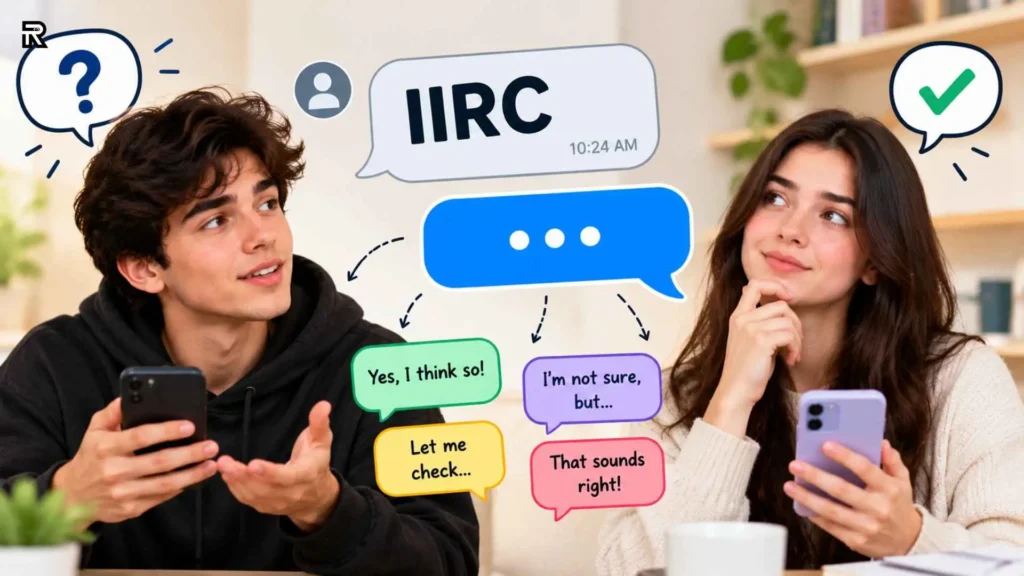
Your response should depend on whether you agree with the person’s recollection, remember something different, or need to check the information.
You don’t need a special phrase every time someone uses IIRC. A straightforward answer usually works best.
When You Agree With Their Recollection
If the information matches what you remember, respond naturally.
Examples include:
- “Yes, that’s right.”
- “Correct! That’s what I remember too.”
- “Yep, I think that’s the date.”
- “You’re right. We discussed that last week.”
- “That sounds right to me.”
For example:
Alex: IIRC, the appointment is at 3 PM.
Jamie: Yes, that’s right. I have it on my calendar.
This exchange confirms the information without making the conversation unnecessarily complicated.
When Their Recollection Is Incorrect
If you know the person has remembered something incorrectly, correct the detail politely.
You could say:
- “Almost, but I think it was Thursday.”
- “I checked the announcement, and it says Friday.”
- “Not quite. The meeting starts at 11 AM.”
- “I think that happened in 2024, not 2023.”
For example:
Alex: IIRC, the deadline is Monday.
Jamie: I checked the email. It’s actually due Tuesday.
The response corrects the information without criticizing the person for making an honest mistake.
When You Aren’t Sure Either
Sometimes both people have incomplete information. In that case, there’s no reason to pretend otherwise.
Try these responses:
- “I’m not sure either. Let’s check.”
- “That sounds familiar, but I could be wrong.”
- “I think so, although we should confirm.”
- “Let’s look at the original message.”
- “I’ll check the calendar and let you know.”
The best response acknowledges uncertainty and identifies a practical next step.
Is IIRC Rude?
No. IIRC is generally a neutral, informal abbreviation rather than a rude expression. It tells the reader that someone is relying on memory and may not have every detail correct.
However, the surrounding words and tone can affect how a message sounds. Even a neutral abbreviation can appear dismissive when someone uses it in a sarcastic or argumentative statement.
Consider these examples:
Neutral usage:
“IIRC, the instructions are in the first email.”
The speaker is simply recalling where the instructions appeared.
Potentially sarcastic usage:
“IIRC, I already explained this yesterday.”
Depending on the relationship and context, this message might suggest frustration because the speaker believes the topic has already been discussed.
The abbreviation itself isn’t the problem. The wording and situation influence the tone.
Does IIRC Mean Someone Is Unsure?
IIRC indicates that the speaker is qualifying their recollection. It doesn’t necessarily mean they lack confidence in everything they’re saying.
For example, someone might clearly remember attending a meeting but forget whether it happened on Tuesday or Wednesday. They can use IIRC to signal uncertainty about the date without doubting that the meeting took place.
There are three useful distinctions:
- Imperfect memory: The speaker remembers something but may have forgotten a detail.
- Incomplete knowledge: The speaker doesn’t know every relevant fact.
- Verified information: The speaker has checked a reliable source.
IIRC mainly relates to the first category. It can overlap with the second, but it doesn’t automatically establish that the information is wrong.
Is IIRC Formal or Informal?
IIRC is primarily an informal abbreviation used in digital communication. It can fit naturally in conversations with friends, online communities, and familiar coworkers.
However, it may be unsuitable for formal reports, official letters, academic assignments, or documents that require precise language.
Instead of writing:
“IIRC, the policy changed in January.”
A more formal alternative would be:
“According to the policy notice, the change took effect in January.”
Use the second version only after checking the notice. Formal wording should improve clarity, not disguise uncertainty.
IIRC vs. AFAIK, IMO, IMHO, and Other Abbreviations
IIRC belongs to a broader group of internet slang and abbreviations that help people express ideas quickly. However, these expressions don’t all mean the same thing.
Understanding the differences helps you choose the correct abbreviation for each situation.
| Abbreviation | Full Form | Meaning and Typical Use |
| IIRC | If I Recall Correctly | Qualifies information remembered from the past. |
| AFAIK | As Far As I Know | Qualifies information based on current knowledge. |
| IMO | In My Opinion | Introduces a personal opinion. |
| IMHO | In My Humble Opinion | Introduces an opinion, often with a modest tone. |
| CMIIW | Correct Me If I’m Wrong | Invites someone to correct a possible mistake. |
| FYI | For Your Information | Shares information for someone’s awareness. |
| TBH | To Be Honest | Signals candidness or a frank statement. |
| TBF | To Be Fair | Introduces a balancing point or fair consideration. |
| IDC | I Don’t Care | Expresses a lack of concern or interest. |
| ICYMI | In Case You Missed It | Highlights information someone might have missed. |
| LOL | Laughing Out Loud | Expresses laughter or a lighthearted reaction. |
| BRB | Be Right Back | Indicates a brief absence from a conversation. |
These are related common texting abbreviations, but they serve different communication purposes.
IIRC vs. AFAIK
The difference between IIRC and AFAIK is the basis of the statement.
- IIRC means the speaker is relying on memory.
- AFAIK means the statement reflects what the speaker currently knows.
For example:
“IIRC, the company announced the change last spring.”
The speaker remembers a previous announcement.
“AFAIK, the company hasn’t announced another change.”
The speaker is describing their current understanding.
Neither abbreviation guarantees accuracy. Both leave room for missing or incorrect information.
IIRC vs. IMO
IMO stands for “In My Opinion.” People use it to introduce a personal judgment rather than a remembered fact.
For example:
“IMO, this is the easiest way to solve the problem.”
The speaker is expressing an opinion about the solution.
Compare that with:
“IIRC, this was the method we used last time.”
The second statement concerns a recollection of a previous event.
The key difference: IIRC qualifies memory, while IMO identifies an opinion.
IIRC vs. IMHO
IMHO stands for “In My Humble Opinion.” It serves a similar purpose to IMO, although its tone may sound more modest or playful depending on the context.
For example:
- “IIRC, the original deadline was June 15.”
- “IMHO, the revised deadline is more reasonable.”
The first statement recalls a date. The second evaluates whether a deadline is reasonable.
IIRC vs. CMIIW
CMIIW means “Correct Me If I’m Wrong.” It explicitly invites other people to point out a mistake.
For example:
“CMIIW, but I think the office closes at 5 PM.”
The speaker is asking others to correct the statement if necessary.
By contrast:
“IIRC, the office closes at 5 PM.”
The speaker simply signals that the information comes from memory.
These expressions can appear together, but using both is often unnecessary unless the context calls for extra clarification.
IIRC vs. FYI
FYI means “For Your Information.” It introduces information that someone may find useful.
For example:
“FYI, the meeting has moved to Thursday.”
The message shares an update. It doesn’t necessarily express uncertainty.
IIRC would fit a different situation:
“IIRC, the meeting was originally scheduled for Wednesday.”
Here, the sender recalls an earlier arrangement rather than simply sharing a confirmed update.
IIRC vs. TBH and TBF
TBH means “To Be Honest,” while TBF means “To Be Fair.”
TBH often introduces a candid opinion or admission:
“TBH, I forgot to send the message.”
TBF introduces a balancing point:
“TBF, the team received the instructions late.”
IIRC has a different function because it concerns the accuracy of a recollection.
Choosing the right abbreviation makes your message easier to understand and prevents unnecessary ambiguity.
Can You Use IIRC in Professional Emails and Workplace Chats?
Yes, you can use IIRC in some workplace conversations, but the audience and importance of the information matter.
In a relaxed team chat, the abbreviation may feel natural. Coworkers who regularly use internet shorthand will often understand it without difficulty.
For example:
“IIRC, the client wanted the revised design by Friday. I’ll check the project notes.”
This message communicates a recollection and offers a way to verify it.
When IIRC Works at Work
IIRC can be suitable for:
- Informal Slack conversations.
- Microsoft Teams messages between familiar colleagues.
- Internal discussions about previous meetings.
- Casual project conversations.
- Noncritical questions about earlier decisions.
The abbreviation is most useful when everyone understands the shorthand and the message doesn’t require a formal record.
When You Should Write the Full Phrase
Avoid relying on IIRC when writing to unfamiliar clients, senior stakeholders who expect formal language, or recipients who may not recognize internet abbreviations.
Instead of writing:
“IIRC, the payment was due last Monday.”
You could write:
“I believe the payment was due last Monday, but I’ll verify the invoice.”
For important matters, go one step further and check the invoice before stating the deadline.
Is IIRC Appropriate in Formal Emails?
Generally, spelling out your meaning is better in formal emails. You can write “If I remember correctly,” “According to the earlier email,” or “Based on my recollection,” depending on the situation.
Use phrases that match the evidence available to you.
- Based on my recollection: You are relying on memory.
- According to the earlier email: You have checked the email.
- The records indicate: You have reviewed relevant records.
- I will verify the details: You have not yet confirmed the information.
This distinction matters because readers may treat workplace messages as records of decisions, deadlines, or commitments.
Is IIRC Still Used Online?
IIRC remains a recognized internet abbreviation. Major dictionaries, including Cambridge and Oxford Learner’s Dictionaries, include it as a term used in digital communication.
People can encounter it in text messages, emails, online forums, social media discussions, and collaborative chats.
However, recognition doesn’t mean everyone uses it. Familiarity depends on the community, the conversation, and the individual’s communication habits.
Some people prefer short forms such as IIRC because they save typing time. Others prefer complete phrases because they find abbreviations unclear or unnecessarily casual.
Why Do People Continue Using IIRC?
Several practical reasons explain why this abbreviation remains useful:
- It communicates a longer phrase in four letters.
- It signals that a statement comes from memory.
- It fits the style of informal online discussions.
- It allows people to qualify claims without writing lengthy disclaimers.
- It can help distinguish remembered details from verified facts.
Still, clarity matters more than brevity. If your recipient doesn’t recognize IIRC, spelling out the phrase is the better choice.
What Is the Origin of IIRC?
IIRC developed as part of the broader use of shorthand in digital communication. Online communities have long used initialisms to make written conversations faster and more compact.
Early internet communication included discussion systems such as Usenet and Internet Relay Chat (IRC). These systems supported text-based exchanges in which users often relied on abbreviations, conventional expressions, and community-specific terminology.
Internet Relay Chat dates to 1988, according to the historical overview of IRC. However, the existence of IRC doesn’t prove that IIRC originated there or that a particular person coined the abbreviation.
How Internet Shorthand Developed
Several communication environments encouraged the use of shortened expressions:
- Online discussion groups: Participants used familiar abbreviations while exchanging ideas.
- Text-based chat rooms: Shorter messages helped conversations move quickly.
- Internet forums: Users developed shared conventions for responding to posts.
- Instant messaging: People adopted shorthand for everyday exchanges.
- Social media: Short expressions remained useful in comments, replies, and direct messages.
IIRC fits this pattern because its full form expresses a common idea: a person remembers something but recognizes that memory can be imperfect.
Is There a Confirmed Date for the First Use of IIRC?
A reliable, universally accepted first-use date isn’t established by the dictionary definitions cited here. It would be misleading to assign the abbreviation a precise origin date without a verifiable historical record.
The important distinction is between the history of online shorthand generally and the documented first use of one particular abbreviation.
For an everyday reader, the practical takeaway is straightforward: IIRC is an established internet initialism, not a newly invented expression tied to one social media platform.
Frequently Asked Questions About IIRC Meaning
What Does IIRC Stand For?
IIRC stands for “If I Recall Correctly” or “If I Remember Correctly.” It indicates that someone is sharing information based on memory and may not remember every detail accurately.
Is IIRC Rude?
No, IIRC is generally neutral and informal. However, a message such as “IIRC, I already told you that” may sound irritated or sarcastic depending on the context.
Is IIRC the Same as AFAIK?
No. IIRC means “If I Recall Correctly,” while AFAIK means “As Far As I Know.” IIRC focuses on remembered information, whereas AFAIK qualifies a statement based on the speaker’s current knowledge.
Can I Use IIRC in Work Emails?
You can use IIRC in casual workplace emails or internal chats when the recipient understands the abbreviation. For formal emails, official records, and important deadlines, use clear wording and verify the relevant information.
Who Uses IIRC Most Often?
IIRC appears among people who are familiar with internet shorthand, including participants in online forums, messaging groups, and social media discussions. There isn’t enough evidence here to identify one age group or demographic as its primary user.
Does IIRC Mean Someone Is Unsure?
It indicates that the person is relying on memory and acknowledges the possibility of a mistake. It doesn’t necessarily mean they lack confidence in the entire statement or have no supporting knowledge.
Is IIRC Still Used?
Yes, IIRC remains a recognized abbreviation in digital communication. However, how frequently people use it varies across communities and individual communication styles.
What Does IIRC Mean in Slang?
In internet slang, IIRC means “If I Recall Correctly” or “If I Remember Correctly.” It is a shorthand expression used to qualify a statement based on memory.
What Is the Difference Between IIRC and IMO?
IIRC qualifies a recollection, while IMO stands for “In My Opinion” and introduces a personal viewpoint. For example, IIRC can introduce a remembered release date, while IMO can introduce an opinion about the movie.
Can IIRC Appear at the End of a Sentence?
Yes. For example, “The update arrived last month, IIRC.” You can also place IIRC at the beginning of a sentence, usually followed by a comma.
Conclusion: What IIRC Means in Everyday Communication
The IIRC meaning is simple: “If I Recall Correctly” or “If I Remember Correctly.” This internet abbreviation helps people share information from memory while acknowledging that a detail might be wrong.
You can use IIRC in text messages, online discussions, social media comments, and casual workplace chats. It can make a conversation more concise without pretending that every remembered fact is certain.
Remember that IIRC doesn’t replace fact-checking. When dates, deadlines, money, or safety matter, verify the information before relying on it. Used appropriately, this small abbreviation makes your messages clearer, more natural, and more honest about what you remember.

Oliver Harrington is a British author and language researcher known for his engaging writing on the meanings of words, communication, and personal growth. Born in Oxford, England, he developed a passion for literature and etymology at an early age, later studying English Literature before pursuing a full-time writing career. His work combines historical research with practical insights, making complex language concepts easy for readers to understand. Over the years, he has contributed to educational publications, spoken at literary events, and inspired thousands of readers with his thoughtful approach to language. When he is not writing, Oliver enjoys exploring historic libraries, travelling across the British countryside, and researching the origins of English expressions.
Books:
- The Language of Meaning
- Words That Shaped the World
 Edward Whitmore
 Charlotte Pembroke