
Starting a meeting with the right icebreakers for work can make a big difference when coworkers are quiet, new team members are joining, or a remote group needs a quick way to connect. But not every icebreaker works for every workplace. A five-minute team meeting needs something very different from a new-employee workshop or a full team-building session.
This guide gives you practical workplace icebreakers for meetings, remote teams, new employees, large groups, managers, and team-building events. You’ll find quick questions, fun games, professional prompts, decision guides, examples, common mistakes, and tips for choosing an activity without making the meeting feel forced.
The goal is simple: help you choose an activity that gets people talking without wasting time or creating unnecessary awkwardness.
Quick Answer: What Are Icebreakers for Work?
Icebreakers for work are short questions, games, discussions, or activities that help coworkers start conversations, become more comfortable with one another, and participate in a meeting or group activity.
They can be as simple as asking everyone a light question or as structured as a small-group challenge. The best workplace icebreaker depends on the group size, relationship between participants, available time, meeting format, and purpose.
An effective icebreaker should make participation easier—not make employees feel pressured to perform or share private information.
Key Takeaways
- Use a quick question when you have only a few minutes.
- Choose a professional prompt for formal meetings.
- Use games such as This or That when the atmosphere is casual.
- Try breakout-room activities for remote teams.
- Use polls and chat prompts for large groups.
- Partner activities work well when coworkers do not know each other.
- Avoid questions that are too personal or uncomfortable.
- Explain the purpose and instructions before starting.
- Keep the activity shorter than the main meeting unless team building is the primary goal.
- Rotate activities instead of repeating the same game every week.
- The strongest icebreaker often connects naturally to the meeting agenda.
Funny Icebreakers for Work
Funny icebreakers for work can make a team feel more relaxed, especially at the beginning of a meeting, training session, or team event. The best workplace humor is light, inclusive, and easy for everyone to understand.
Try asking employees a playful question such as, “If your job came with a warning label, what would it say?” Another option is to give everyone an imaginary workplace superpower, such as the ability to finish emails instantly or make meetings end in five minutes.
The goal is to create a few laughs and encourage conversation without putting anyone on the spot. Avoid jokes about appearance, personal relationships, salary, or other sensitive subjects.
5-Minute Icebreakers for Work
5-minute icebreakers for work are perfect when you want to build connection without taking too much time away from the day’s tasks. A good five-minute activity should require little or no preparation and allow everyone to participate.
One simple option is “This or That.” Give employees quick choices such as coffee or tea, early start or late start, office or remote work, and email or phone calls. Participants can answer by raising a hand, using reactions, or moving to different sides of the room.
Another option is a rapid question round where each person answers one short, non-personal question. These activities can add energy to a meeting while keeping the schedule on track.
Icebreaker Questions for Work
Icebreaker questions for work are an easy way to start conversations without needing a complicated game. The best questions are open enough to reveal personality but comfortable enough for coworkers to answer.
Examples include:
- What skill would you instantly learn if you could?
- What is your favorite way to spend a free afternoon?
- What is one small thing that makes your workday better?
- If you could work from anywhere for a week, where would you go?
- What is a hobby you would like to spend more time doing?
For professional settings, avoid questions that require employees to discuss private finances, relationships, health, politics, or other sensitive subjects.
Virtual Icebreakers for Work
Virtual icebreakers for work help remote and hybrid teams connect when they cannot interact face-to-face. Since online meetings can feel formal, a short interactive activity can make the conversation more natural.
A virtual “Show and Tell” is a simple choice. Ask each participant to pick an ordinary object within reach and explain why they find it useful or interesting. Another option is a quick poll about food, hobbies, travel, or weekend activities.
You can also place employees into breakout rooms for a few minutes with one conversation prompt. Keep virtual icebreakers short and easy to join so participants do not feel overwhelmed before the actual meeting begins.
Funny Icebreaker Games for Meetings
Funny icebreaker games for meetings can add energy to an otherwise routine work session. They work particularly well when employees are meeting for brainstorming, planning, or collaboration.
“Meeting Superpower” is an easy game. Ask everyone to invent a superpower that would make meetings better. Answers might include instantly knowing who has the answer, making presentations finish themselves, or teleporting directly to the coffee machine.
Another option is “Ridiculous Solutions.” Give the group a harmless workplace problem and ask them to come up with the funniest possible solution before discussing a serious solution. The contrast can create laughter while encouraging creative thinking.
5-Minute Icebreakers for Virtual Meetings
5-minute icebreakers for virtual meetings should be fast, interactive, and easy to run through a video platform. Avoid activities that require lengthy explanations or complicated technology.
A quick “Chat Storm” works well. Ask everyone to type an answer to a question in the meeting chat but wait until the host says “go” before sending it. Questions can include favorite breakfast, dream travel destination, or a skill they would like to learn.
Another idea is “Guess the Workspace.” Each participant shares one harmless clue about something near their desk, and everyone tries to guess what it is. Short activities like these can help remote meetings begin with conversation rather than silence.
Online Icebreakers for Work
Online icebreakers for work give remote employees a chance to interact beyond the usual agenda and task discussions. They can be run through video calls, chat platforms, polls, or collaborative boards.
Try “Two-Word Check-In,” where each employee describes their current mood or week using only two words. For a more playful activity, ask participants to find a GIF or emoji that represents their week and briefly explain their choice.
Another effective activity is a virtual common-ground challenge. Put employees into small groups and ask them to discover three things they all have in common. This encourages conversation without requiring deeply personal introductions.
Team Building Icebreakers for Work
Team building icebreakers for work combine introductions with cooperation. They are especially useful when employees need to improve communication or work with colleagues from different departments.
A simple activity is the “Common Ground Challenge.” Divide employees into small teams and give them a few minutes to discover as many shared interests or experiences as possible. The team with the most appropriate common connections can share them with everyone.
For a more problem-solving-focused activity, give each team a simple workplace scenario and ask them to create a solution together. The activity can reveal communication styles and encourage employees to listen to different ideas.
Team Icebreakers for Work
Team icebreakers for work help coworkers become more comfortable communicating with one another. They can be used with established teams as well as groups that have recently been brought together.
“Three Things About Me” is a straightforward option. Each person shares three interesting facts, and the rest of the team can ask one follow-up question.
For teams that already know one another, use something less predictable. Ask everyone to choose a fictional character who represents their working style and explain the choice. This can create humor while encouraging people to think about their own strengths and personalities.
Good Icebreakers for Work
Good icebreakers for work should be easy to understand, inclusive, reasonably short, and appropriate for the workplace. The activity should help people interact rather than create unnecessary pressure.
Conversation questions are useful for small groups, while quick games are better when you want more energy. For a new team, choose an introduction activity. For an established team, use a challenge that reveals new things about coworkers.
Before selecting an icebreaker, consider the group size, meeting purpose, available time, workplace culture, and whether people are meeting in person or online.
Christmas Icebreakers for Work
Christmas icebreakers for work can bring a festive atmosphere to office parties, team meetings, and end-of-year gatherings. Keep the activities optional and inclusive, particularly in workplaces with employees from different backgrounds and traditions.
Try a festive “Would You Rather?” with questions such as choosing between decorating a tree or wrapping presents, or spending a winter weekend indoors or outdoors.
Another idea is “Holiday Favorites,” where employees share a favorite seasonal food, movie, activity, or tradition. A light Christmas-themed trivia round can also work well when the group enjoys friendly competition.
Thanksgiving Icebreakers for Work
Thanksgiving icebreakers for work can encourage gratitude and positive conversation during seasonal team gatherings. The questions should remain workplace-appropriate and should not pressure employees to discuss family matters.
Ask each person to name one work-related thing they appreciated during the year. They could mention a helpful colleague, a useful lesson, a successful project, or a positive team experience.
For something more playful, use “Thanksgiving This or That,” with choices involving favorite foods and seasonal activities. The activity can be completed in just a few minutes while giving coworkers an opportunity to discover shared preferences.
Holiday Icebreakers for Work
Holiday icebreakers for work can be adapted for office parties, team celebrations, end-of-year meetings, or seasonal events. Because not everyone celebrates the same holidays, neutral wording can make the activity more inclusive.
“Holiday Favorites” is an easy option. Participants can share a favorite seasonal meal, winter activity, movie, song, or way to relax during time off.
You can also organize a quick holiday-themed guessing game or ask employees to create a humorous “holiday survival tip.” The best activities focus on shared fun rather than assuming everyone follows the same traditions.
Unique Icebreakers for Work
Unique icebreakers for work can be useful when a team has already played the usual introduction games. A less predictable activity can encourage people to think creatively and reveal something new about themselves.
Try “Invent a Product for Your Team.” Give employees a few minutes to design an imaginary product that would solve an everyday workplace problem. They then present the idea in 30 seconds.
Another unusual option is “Future Headline.” Ask employees to imagine a positive headline about their team one year from now. They create a short headline and explain what would need to happen for it to become true.
Zoom Icebreakers for Work
Zoom icebreakers for work are designed specifically for video meetings where employees may be joining from different locations. Use features such as chat, reactions, polls, or breakout rooms to make participation easier.
“Background Story” is one option. Ask participants to choose a virtual background that represents a place they would like to visit or an interest they have, then explain it briefly.
You can also run a rapid-fire question round where everyone answers in the chat. For larger meetings, a poll can be more manageable because participants can respond simultaneously without interrupting one another.
Icebreaker Ideas for Work
Icebreaker ideas for work can range from simple conversation starters to collaborative challenges. The best choice depends on what you want to accomplish.
For introductions, use Two Truths and a Lie or Three Things About Me. For quick meetings, use This or That or a one-question check-in. For team building, use Common Ground or a short problem-solving challenge. For remote teams, use virtual scavenger hunts, polls, or breakout-room questions.
Having several formats available allows you to choose an activity based on the team’s energy level instead of relying on the same game every time.
Best Corporate Icebreakers
The best corporate icebreakers are professional without being boring. They should encourage communication, respect different personalities, and fit naturally into business meetings, workshops, conferences, and team events.
A strong corporate option is “Common Ground,” where small groups identify shared interests or experiences. Another is “One-Minute Introduction,” where participants answer a specific prompt instead of giving a long professional biography.
For larger corporate events, polls, quick challenges, and table-based activities are often easier to manage than games that require every person to speak individually. The best activity is the one that supports the event’s objective while keeping participation comfortable.
Work Icebreakers
Work icebreakers are short activities that help colleagues communicate, relax, and build stronger working relationships. They can be used during regular meetings, onboarding, training, team-building sessions, office parties, or virtual calls.
A good work icebreaker does not need to be elaborate. One interesting question, a two-minute partner discussion, or a quick team challenge can be enough to change the atmosphere.
When choosing an activity, think about the people involved first. A game that works brilliantly for a group of close coworkers may not be appropriate for new employees or a formal corporate audience. Keep participation voluntary where appropriate, avoid sensitive topics, and make the instructions simple.
Why Icebreakers Matter in the Workplace
A meeting can begin with silence, especially when participants work remotely or come from different departments. An appropriate opening activity gives people a simple reason to participate before the main discussion begins.
Icebreakers can be useful for:
- Introducing new coworkers
- Starting remote meetings
- Welcoming new employees
- Beginning workshops
- Creating conversation between departments
- Helping teams discover common interests
- Energizing a long meeting
- Transitioning into a collaborative discussion
However, an icebreaker is not automatically useful simply because it is entertaining. Its value depends on whether it fits the situation.
When Should You Use a Workplace Icebreaker?
Consider an icebreaker when:
- People are meeting for the first time.
- The team has recently changed.
- Participants need to interact with people outside their normal group.
- The meeting involves brainstorming or collaboration.
- The event is designed for team building.
- The group appears disconnected or hesitant to participate.
You may not need one when the meeting is highly time-sensitive, the participants already know each other well, or the activity has no connection to the meeting’s purpose.
What Makes an Icebreaker Effective?
A strong workplace icebreaker is usually:
- Easy to understand
- Quick to complete
- Appropriate for the workplace
- Low pressure
- Relevant to the group
- Easy to adapt
- Useful for starting conversation
For example, “What is one skill you’d like to learn this year?” is usually easier to answer than a question requiring someone to reveal something deeply personal.
How to Choose the Right Icebreaker
The best activity depends on the situation. Instead of searching for one “perfect” game, match the format to your actual goal.
| Situation | Best type | Why it works |
| 1–5 minute meeting | Quick question | Minimal time |
| New team | Partner introduction | Builds familiarity |
| Remote meeting | Chat or poll | Everyone can participate online |
| Large group | Poll or chat storm | Scales easily |
| Small team | Conversation game | Allows deeper interaction |
| Formal meeting | Professional prompt | Keeps the tone appropriate |
| Casual meeting | Fun question | Creates energy |
| Workshop | Topic-related prompt | Connects to the agenda |
| Team-building event | Group challenge | Encourages cooperation |
| New employees | Common-ground activity | Creates connections |
Decision Guide for Choosing an Icebreaker
Do you have less than five minutes?
→ Use a one-word check-in, quick question, poll, or This-or-That prompt.
Do people not know each other?
→ Use partner introductions or a common-ground activity.
Is the meeting online?
→ Use chat, reactions, polls, or breakout rooms.
Is the group large?
→ Avoid asking every person to speak individually. Use a poll or simultaneous chat response.
Is the purpose team building?
→ Choose a collaborative challenge instead of a simple question.
Is the meeting formal?
→ Choose a professional question related to communication, goals, learning, or teamwork.
25 Quick Icebreakers for Work Meetings
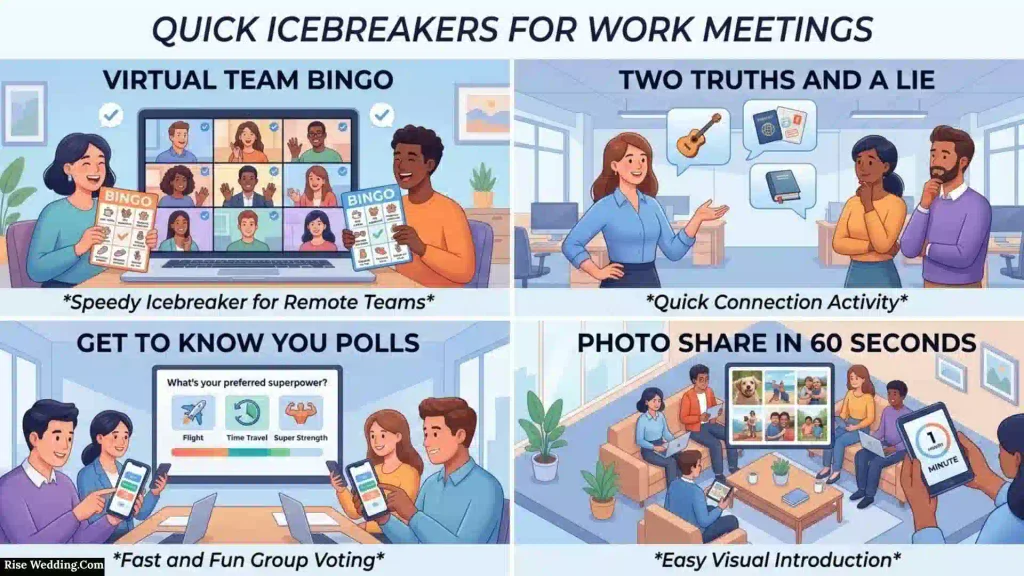
When time is limited, you do not need a complicated activity. One good question can be enough.
- What is one thing you’re looking forward to this week?
- What helps you have a productive workday?
- What is one skill you’d like to improve?
- Are you more productive in the morning or afternoon?
- What is one hobby you enjoy?
- What is something interesting you learned recently?
- What is your favorite way to spend a day off?
- What is one place you’d like to visit?
- What is one small thing that makes your day better?
- What is one activity you wish you had more time for?
- What is a book or movie you would recommend?
- What is one thing you are curious about right now?
- What is your favorite season?
- What is one useful skill everyone should learn?
- What is one word that describes your week?
- What helps you stay focused?
- What is one goal you are working toward?
- What is your favorite way to recharge?
- What is one subject you could discuss for hours?
- What is something you would like to learn from a coworker?
- What is one thing that makes teamwork easier?
- What is your favorite type of weekend activity?
- What is one habit that helps you stay organized?
- What is something you recently discovered?
- What is one thing that made you smile this week?
How to Run a Five-Minute Icebreaker
Try this simple format:
Minute 1: Ask the question.
Minute 2: Give everyone time to think.
Minutes 3–4: Let participants answer.
Minute 5: Connect the answers to the meeting.
For a large group, ask everyone to post their response in the chat at the same time. This avoids a long round-robin session.
20 Fun Icebreakers for Work
Fun activities can add energy to a meeting, particularly when the team already has a comfortable relationship.
This or That
Give participants two choices and ask them to select one.
Examples:
- Coffee or tea?
- Mountains or beach?
- Morning or evening?
- Books or movies?
- Summer or winter?
- Working alone or brainstorming together?
People can respond by speaking, typing in chat, or using reactions.
Would You Rather?
Give the team two harmless hypothetical choices.
For example:
Would you rather have an extra hour every morning or an extra hour every evening?
Ask a few volunteers why they chose their answer.
Two Truths and a Lie
Each person shares three statements. Two are true, while one is fictional. Other participants try to identify the fictional statement.
This is best for small groups where people have enough time to interact.
One-Word Check-In
Ask:
“What is one word describing your current energy level?”
Participants can answer verbally or in chat.
Finish the Sentence
Give everyone a sentence starter such as:
“A perfect day off for me includes…”
Participants complete it with a short answer.
Common Ground Challenge
Divide the team into pairs or small groups.
Give them two minutes to discover three harmless things they have in common.
The goal is conversation, not competition.
Guess the Majority
Ask a question and have everyone predict what most of the team will choose.
For example:
“Which do you think most people here prefer: working early or working later?”
Reveal the actual result afterward.
Quick Category Challenge
Choose a category and ask people to name items within it.
Examples:
- Office supplies
- Favorite foods
- Weekend activities
- Travel destinations
- Useful technology
Desk Object Story
Ask participants to choose an appropriate object nearby and explain in one sentence why they find it useful.
Team Soundtrack
Ask:
“What song would you choose as the unofficial soundtrack for a productive day?”
Participants only need to name a song; playing music is unnecessary.
Icebreakers for New Teams
New teams benefit from activities that help people learn about each other without demanding personal disclosure.
Partner Introductions
Pair participants and give them two questions:
- What is something you enjoy outside work?
- What is one thing you hope to contribute to this team?
Each participant then introduces their partner.
This can feel easier than asking everyone to give a formal speech about themselves.
Find Three Things in Common
Put people into small groups and ask them to find three non-sensitive things they share.
The discoveries might involve hobbies, food preferences, work interests, or other everyday topics.
Strengths Round
Ask:
“What is one strength you bring to a team?”
Answers might include organization, creativity, listening, research, communication, or problem-solving.
This can also lead into a useful conversation about how the team works together.
What Do You Want to Learn?
Ask new teammates:
“What is one thing you’d like to learn from someone on this team?”
This creates a natural opening for knowledge sharing.
Icebreakers for Remote Work Teams
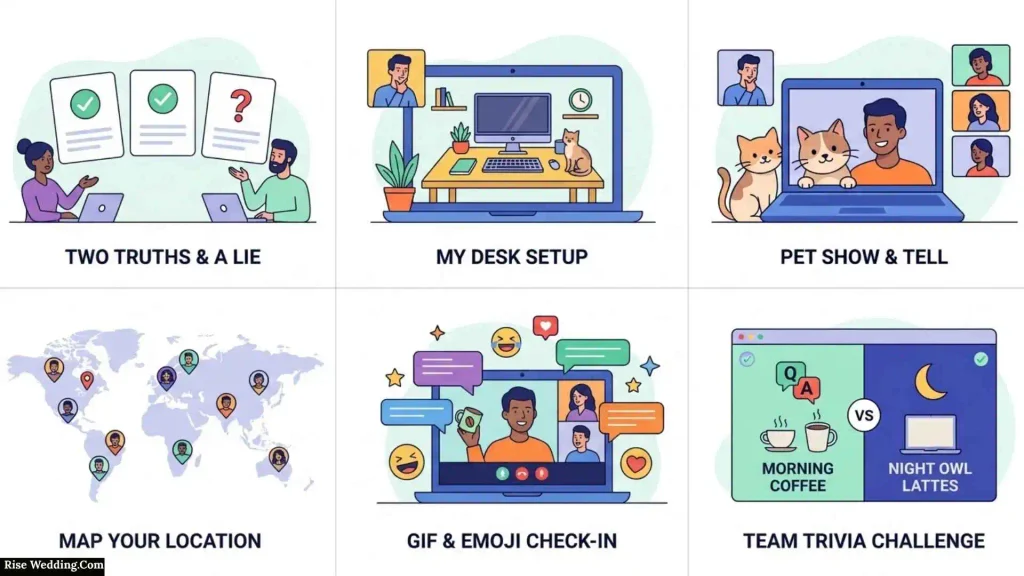
Remote teams need activities that work through digital communication rather than depending on everyone being in one physical location.
Chat Storm
Ask one question and instruct everyone to send their answer at the same time.
For example:
“Describe your ideal weekend in three words.”
The simultaneous responses create immediate interaction.
Virtual Show and Tell
Invite participants to show or describe an appropriate object nearby.
Keep the activity optional so employees do not feel pressured to display their homes or private surroundings.
Virtual Scavenger Hunt
Give participants a simple prompt:
“Find something nearby that you use every day.”
Give them a short amount of time to return with the item.
Online Poll
Use a meeting poll to ask an easy question.
For example:
Which helps you start a productive day?
- A clear task list
- Quiet time
- A team conversation
- A short break
- Coffee or tea
The result can become a short conversation starter.
Virtual Common Ground
Use breakout rooms and ask small groups to discover three things they have in common.
Bring everyone back together and ask each group to share one discovery.
Icebreakers for Large Groups
Large meetings require a different approach. If 50 people each spend one minute answering, the activity alone can consume nearly an hour.
Instead, use simultaneous participation.
Poll Icebreaker
Ask everyone to vote on a simple question.
The results can provide an instant snapshot of the group.
Chat Wall
Give everyone a prompt and ask them to respond in the chat.
Example:
“What is one word that describes great teamwork?”
The facilitator can then highlight a few interesting responses.
Reaction Vote
Offer two or three choices and ask participants to use available reactions.
This works particularly well when you want to create energy without starting a long conversation.
Breakout Question
Divide participants into small groups and give them one specific question.
Make the task clear:
“Discuss for five minutes and choose one idea to share with everyone.”
A defined outcome keeps breakout conversations focused.
Professional Icebreakers for Work
A professional icebreaker does not have to be boring. The goal is simply to keep the activity suitable for the environment.
Try questions such as:
- What is one professional skill you’d like to develop?
- What helps you stay focused during a busy day?
- What is one useful lesson you’ve learned at work?
- What makes a team communicate effectively?
- What is one thing that makes meetings more useful?
- What is one work habit that helps you stay organized?
- What is something you’d like to learn from your teammates?
Topic-Based Icebreakers
The most useful professional icebreakers often connect directly to the meeting.
For a meeting about communication:
“What is one thing that makes workplace communication easier?”
For a planning session:
“What helps you turn a large goal into manageable tasks?”
For a brainstorming meeting:
“What helps you generate new ideas?”
This approach creates a smooth transition between the opening activity and the actual agenda.
Icebreakers for New Employees
A new employee may not feel comfortable speaking at length in front of an entire department.
Start with a low-pressure prompt:
“Tell us your name, role, and one thing you’re hoping to learn during your first few weeks.”
For larger groups, let new employees discuss the question with one partner first.
Another option is:
“What is one skill or interest you’d be happy to share with the team?”
This helps create connections without making the introduction feel like an interview.
Team-Building Icebreakers
Team-building activities should encourage people to interact, solve problems, or discover shared interests.
Build a Shared Story
One participant starts with a fictional sentence.
Each person adds another sentence.
For a remote team, participants can contribute through the chat.
Group Ranking Challenge
Give a team several harmless items and ask them to rank them according to a specific criterion.
For example:
“Rank these five things from most useful to least useful during a busy workday.”
The discussion about different choices becomes the activity.
Solve a Simple Team Problem
Give participants a hypothetical challenge.
For example:
“Your team has one hour to organize a welcome event with limited resources. What are your first three priorities?”
The goal is to discuss, negotiate, and reach a shared answer.
Icebreakers for Managers and Leaders
Managers should avoid turning every icebreaker into a performance exercise.
Useful leadership prompts include:
- What is one thing that would make our meetings better?
- What is one thing our team should continue doing?
- What helps you collaborate effectively?
- What is one process you think we could simplify?
- What is one thing you would like to learn from the team?
These questions can produce useful feedback, but managers should not use every social activity to collect performance information.
Sometimes the best leadership decision is simply allowing employees to relax and connect.
Workplace Icebreakers to Avoid
An activity can be technically successful while still making people uncomfortable. Workplace appropriateness matters.
Avoid Highly Personal Questions
Do not pressure coworkers to discuss private subjects such as:
- Finances
- Relationships
- Health
- Family circumstances
- Personal beliefs
- Other sensitive information
Participants should be able to answer without revealing information they prefer to keep private.
Avoid Forced Embarrassment
Avoid activities that require employees to perform, confess something uncomfortable, or become the unwilling center of attention.
A good icebreaker creates an invitation to participate rather than a demand to entertain the group.
Avoid Excessively Long Activities
If your meeting has a 30-minute agenda, spending 15 minutes on an unrelated game may reduce the value of the meeting.
Avoid Poor Cultural Fit
A game that works for a casual creative team may not work for a formal client meeting.
Consider the team’s:
- Communication style
- Culture
- Familiarity
- Meeting purpose
- Group size
- Online or in-person format
Common Mistakes When Using Icebreakers
Even a good activity can fail if it is poorly introduced.
Choosing the Most Popular Game
Popularity does not guarantee suitability.
Better approach: Choose the activity based on the people and purpose.
Making Everyone Give a Long Answer
Long answers make a simple activity feel exhausting.
Better approach: Set a short response limit.
Starting Without Instructions
People may not know whether they should speak, type, vote, or move into groups.
Better approach: Explain exactly what participants need to do before starting.
Making Participation Mandatory
Some people are naturally more comfortable speaking than others.
Better approach: Provide reasonable alternatives such as chat, reactions, pairs, or passing when appropriate.
Repeating the Same Activity
Even a fun activity becomes predictable if used every week.
Better approach: Rotate between questions, polls, games, paired conversations, and collaborative activities.
Forgetting the Meeting’s Purpose
An unrelated game can feel like wasted time.
Better approach: When possible, connect the opening question to the meeting topic.
How to Make Icebreakers Less Awkward
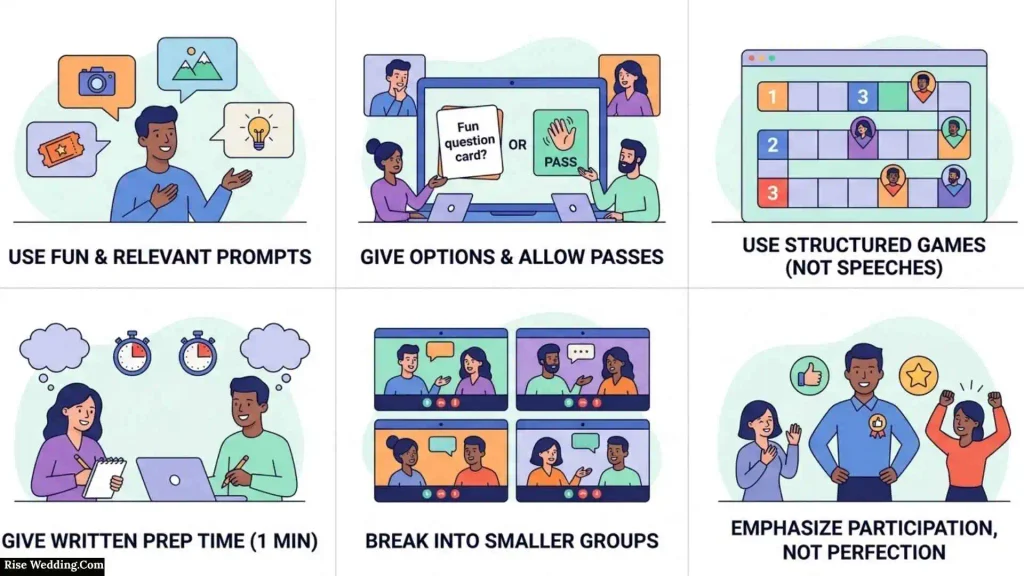
The facilitator plays a major role in setting the tone.
Explain Why You Are Doing It
Instead of simply saying, “Let’s play a game,” explain the purpose.
For example:
“We’ll spend two minutes on this question so everyone has a chance to say hello before we start.”
This makes the activity feel more intentional.
Give People Time to Think
Do not immediately call on someone after asking a question.
Give participants a short moment to prepare their response.
Keep Instructions Short
A good rule is:
Explain → Demonstrate → Start
If the activity takes longer to explain than to perform, it may be too complicated for a regular meeting.
Let the Leader Go First
If appropriate, the facilitator can answer first.
This shows participants the expected level of detail and can make the activity feel less intimidating.
Icebreaker Formats: Which One Is Best?
Different formats solve different problems.
| Format | Best for | Main advantage | Potential drawback |
| Question | Small teams | Easy to run | Can become repetitive |
| Poll | Large teams | Fast participation | Limited discussion |
| Chat prompt | Remote teams | Everyone can answer | Less personal |
| Pair discussion | New teams | Deeper connection | Requires more time |
| Breakout room | Large remote groups | Small-group conversation | Needs coordination |
| Game | Casual teams | High energy | May not suit formal settings |
| Challenge | Team building | Encourages collaboration | Takes longer |
There is no universally best format. The right choice is the one that supports the meeting’s goal.
A Practical Icebreaker Checklist
Before starting, ask yourself:
- Does this activity have a clear purpose?
- Can participants understand it quickly?
- Does it fit the meeting length?
- Is it appropriate for the workplace?
- Can people participate without revealing private information?
- Does it work for the group size?
- Is it suitable for remote or in-person participation?
- Have I explained the instructions clearly?
- Is there an easy way to transition into the agenda?
- Have we used this activity too recently?
If most answers are yes, you probably have a suitable activity.
How to Build Your Own Workplace Icebreaker
You do not always need a ready-made game. You can create an activity around the meeting itself.
Step 1: Identify the Goal
Decide whether you want to:
- Create energy
- Introduce people
- Encourage conversation
- Build trust
- Prepare people for collaboration
- Introduce the meeting topic
Step 2: Choose the Participation Format
Select:
- Verbal answers
- Chat
- Poll
- Reactions
- Pairs
- Small groups
Step 3: Set a Time Limit
A clear limit prevents the activity from taking over the meeting.
Step 4: Keep the Question Accessible
Participants should not need special knowledge or preparation.
Step 5: Connect It to the Agenda
When appropriate, use the responses as a bridge into the main discussion.
Example: Turning an Icebreaker Into a Useful Meeting Opener
Imagine you’re leading a meeting about improving team communication.
A weak opening might be an unrelated game that has nothing to do with communication.
A stronger approach would be:
Question: “What is one thing that makes communication easier for you?”
Participation: Everyone answers in the chat.
Follow-up: The facilitator highlights three common themes.
Transition: “Those three themes give us a useful starting point for today’s discussion.”
The activity now has a clear purpose: it gets people participating while preparing them for the subject of the meeting.
Frequently Asked Questions About Icebreakers for Work
What are the best icebreakers for work?
The best option depends on the situation. Quick questions work well for short meetings, polls are useful for large groups, partner activities help new teams connect, and collaborative challenges are better suited to team-building sessions.
What is a good five-minute work icebreaker?
A one-word check-in, This-or-That question, quick poll, or chat prompt can usually fit into five minutes. Keep answers short and move directly into the meeting afterward.
What are fun icebreakers for work meetings?
Popular formats include Two Truths and a Lie, Would You Rather, This or That, common-ground challenges, category games, and light conversation questions.
What are good icebreakers for a new team?
Partner introductions, common-ground activities, strengths questions, and “what do you want to learn?” prompts can help new teammates become familiar with one another.
What are good icebreakers for remote teams?
Remote-friendly choices include chat storms, online polls, virtual show and tell, virtual scavenger hunts, reaction votes, and breakout-room discussions.
How do you make a work icebreaker less awkward?
Keep the activity simple, explain its purpose, avoid overly personal questions, give people time to think, and allow different ways to participate.
Should every work meeting have an icebreaker?
No. An icebreaker should add value. If a meeting is very short or participants already communicate comfortably, starting directly with the agenda may be more effective.
How long should a workplace icebreaker last?
The ideal length depends on the meeting. A quick question may take only a few minutes, while a structured team-building exercise can take much longer. The activity should fit the meeting’s purpose and available time.
Are icebreakers appropriate for formal business meetings?
They can be, provided they are brief and professional. Topic-related questions, polls, and simple introductions are generally easier to fit into formal settings than highly playful games.
What should you avoid asking in a workplace icebreaker?
Avoid questions that pressure people to disclose private, sensitive, embarrassing, or uncomfortable information. Keep participation respectful and appropriate to the professional environment.
Final Takeaway
The most effective icebreakers for work are not necessarily the funniest or most complicated. They are the activities that fit the people, purpose, format, and time available. A one-minute question can be more useful than a 20-minute game if the team simply needs an easy way to start talking.
Before your next meeting, ask three things: Who is participating? How much time do we have? What should this activity accomplish? Those answers will usually point you toward the right format.
For content creators, the same principle applies to search optimization: satisfy the person’s actual need instead of writing only for a keyword. Google states that its systems aim to prioritize helpful, reliable, people-first content, and its guidance encourages content that provides substantial value and original information.

Charlotte Pembroke is a British writer and cultural commentator who specialises in the history and evolution of the English language. Raised in Cambridge, England, she built a career around making language and communication more accessible to everyday readers through informative and engaging books. Her writing blends historical facts with modern examples, helping readers appreciate the stories behind common words and phrases. Charlotte has written for educational magazines, participated in literary conferences, and continues to research how language influences society and culture. Outside her professional work, she enjoys reading classic novels, visiting museums, and mentoring aspiring writers.
Books:
- The Hidden Stories of English Words
- Understanding Meaning in Modern Language
 Oliver Harrington
 Edward Whitmore
[…] Quick Activities for Better Teams 83+ Icebreakers for Team Meetings: Easy Questions to Try 75+ Icebreakers for Work: Fun Ideas for Better Team Bonding 71+ Zoom Icebreakers: Quick Games for Work and School 51+ Icebreakers: Best Questions to Break […]
[…] Also Check This Post: 75+ Icebreakers for Work: Fun Ideas for Better Team Bonding […]