
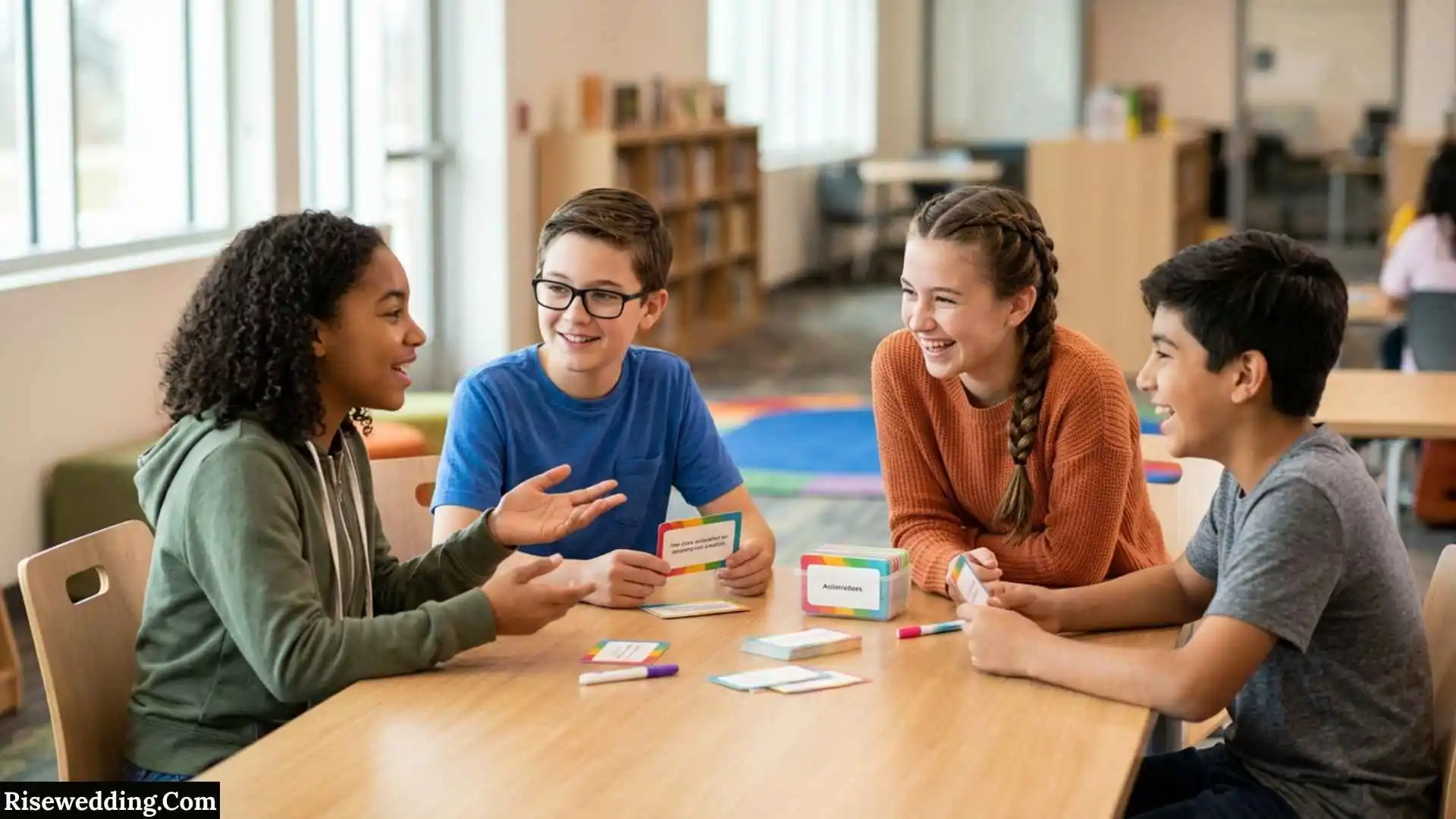
The first day of middle school can be exciting, but it can also feel awkward. Students are meeting new classmates, adjusting to new teachers, and figuring out where they fit in. That is why the right icebreakers for middle schoolers can make a classroom feel comfortable without making students feel childish.
Middle school students are old enough to notice when an activity feels forced. A simple “stand up and tell everyone three things about yourself” may make some students uncomfortable, while a short challenge, mystery game, opinion question, or partner activity can start natural conversations.
This guide includes middle school icebreakers for the first day of school, classroom community building, new groups, advisory periods, after-break activities, and quick five-minute openings. You will also find activities for shy students, large classes, students who already know one another, no-prep situations, and teachers who want icebreakers that connect naturally to academic learning.
Quick Answer: What Are the Best Icebreakers for Middle Schoolers?
The best middle school icebreakers are usually low-pressure, age-appropriate, interactive, and easy to understand. Activities such as Two Truths and a Lie, Would You Rather, Find Someone Who, Four Corners, Common Ground, Partner Interviews, Mystery Challenges, and Team Problem-Solving can help students interact without making the activity feel too childish.
Here are some strong choices by purpose:
| Goal | Recommended Icebreaker |
| Learn names | Name + Action |
| Start class calmly | Question of the Day |
| Get students talking | Partner Interview |
| Help students meet new people | Find Someone Who |
| Get students moving | Four Corners |
| Build teamwork | Tower Challenge |
| Include quiet students | Silent Conversation |
| Create laughter | Would You Rather |
| Encourage creativity | Build a Class Story |
| Learn about interests | Common Ground |
| Fill five minutes | This or That |
| Connect to academics | Mystery Word |
| Welcome a new student | Buddy Challenge |
| Reconnect after a break | Three Things I Did |
| Challenge older middle schoolers | Logic or Escape-Style Challenge |
What Is an Icebreaker for Middle School Students?
An icebreaker is a short activity designed to make interaction easier when students are unfamiliar with one another or need to reconnect.
In middle school, an icebreaker can serve several purposes:
- Learning classmates’ names
- Starting conversations
- Finding shared interests
- Practicing communication
- Building classroom routines
- Encouraging cooperation
- Helping students feel included
- Introducing a new group
- Creating a positive classroom atmosphere
An icebreaker does not have to be loud, silly, or embarrassing.
For middle schoolers, the best activities often feel more like a challenge, conversation starter, creative task, or game than a traditional introduction exercise.
Why Do Middle School Icebreakers Matter?
Middle school is a period when peer relationships become particularly important to students’ everyday school experience. Creating opportunities for students to interact positively can support a sense of connection and belonging.
The CDC explains that school connectedness includes students feeling cared for, supported, valued, and that they belong at school. It also reports that students who feel connected to peers tend to show greater school engagement.
This does not mean that playing one icebreaker automatically creates a strong classroom community. A healthy classroom depends on many things, including teacher support, clear routines, positive peer interactions, and an environment where students feel respected.
Icebreakers are simply one practical tool.
They Give Students a Reason to Talk
A student may want to meet classmates but have no idea how to start a conversation.
A simple prompt solves that problem:
“Find someone who prefers summer to winter.”
Now the student has a natural reason to approach someone.
They Reduce the Pressure of Introductions
Instead of putting every student on the spot, a teacher can use pairs, small groups, movement, written responses, or anonymous answers.
That gives students different ways to participate.
They Help Teachers Observe Classroom Dynamics
A well-run activity can also show a teacher who naturally works together, who stays isolated, who dominates conversations, and who may need a little extra support joining a group.
The CDC recommends that educators pay attention to classroom social dynamics and create opportunities for students who may be isolated to develop positive peer connections.
What Makes a Good Icebreaker for Middle Schoolers?

Middle school students are between childhood and adolescence, so age-appropriate design matters.
Make It Fun Without Making It Babyish
A fifth-grade-style game may not work for an eighth grader.
Instead of asking students to make animal noises, consider:
- Mystery challenges
- Opinion games
- Team puzzles
- Creative competitions
- Conversation cards
- Logic challenges
- Scenario questions
- Collaborative activities
The activity can still be playful without feeling immature.
Keep the First Activity Low Risk
The first activity should not require students to reveal embarrassing stories or personal information.
Good prompts include:
- Favorite movie
- Favorite food
- Dream travel destination
- Best school subject
- Favorite hobby
- Fictional superpower
- Music preference
- Preferred season
Give Students Something to Do
Talking for ten minutes can feel awkward.
Give students a task.
For example:
“You have three minutes to discover four things everyone in your group has in common.”
Now the conversation has a purpose.
Use Structure
Current teacher guidance on middle and high school icebreakers emphasizes activities that create authentic opportunities for connection while maintaining structure, emotional safety, and classroom calm.
A useful formula is:
Clear instructions → short activity → interaction → quick reflection → smooth transition
40+ Icebreakers for Middle Schoolers
The following activities are designed for grades roughly 6–8, but you can adjust the difficulty for your students.
1. Two Truths and a Lie
Each student writes three statements about themselves.
Two statements are true, and one is false.
For example:
- I have visited three cities.
- I can play chess.
- I have met a famous actor.
Partners or small groups try to identify the lie.
Time: 10–15 minutes
Materials: Paper or digital form
Middle school variation: Give students a category such as hobbies, unusual skills, school experiences, or imaginary achievements.
2. Would You Rather?
Give students two interesting choices.
Examples:
- Would you rather travel into the future or the past?
- Would you rather have unlimited books or unlimited movies?
- Would you rather be able to fly or become invisible?
- Would you rather live by the ocean or in the mountains?
After choosing, students explain their answer to a partner.
Teacher tip: The explanation is more valuable than the choice. It gives students something to discuss.
3. Find Someone Who
Give students a list of statements.
Examples:
- Find someone who likes the same sport as you.
- Find someone who has a pet.
- Find someone who enjoys drawing.
- Find someone who likes science.
- Find someone who has read a book you like.
- Find someone who prefers summer.
Students move around the room and talk to different classmates.
Best for: Classes where students need to meet people outside their existing friend groups.
4. Common Ground
Place students in groups of three or four.
Give them five minutes to discover five things they all have in common.
They might discover:
“We all like action movies.”
“We all prefer summer.”
“We all enjoy playing games.”
The goal is not to find unusual facts. It is to practice listening and discovering connections.
5. Four Corners
Label four corners of the classroom with four choices.
For example:
Books | Movies | Games | Sports
Ask students which they prefer.
Students move to the appropriate corner and discuss why they chose it.
You can repeat the activity with:
- Favorite school subject
- Ideal vacation
- Favorite season
- Music preference
- Morning or night
- Working alone or in a group
6. Partner Interview
Give students three to five questions.
For example:
- What’s something you enjoy doing?
- What’s one school subject you like?
- What is one skill you’d like to learn?
- What’s a place you’d like to visit?
Students interview a partner and then introduce that person to another pair.
This is less intimidating than asking students to give a speech to the entire class.
7. Name + Action
Students say their names and choose a simple action.
The group repeats both.
For example:
“I’m Sara,” followed by a small wave.
The class responds:
“Hi, Sara!”
This activity works especially well when the teacher is also learning everyone’s names.
8. This or That
Give students quick choices.
Examples:
- Tea or soda?
- Summer or winter?
- Books or movies?
- City or countryside?
- Cats or dogs?
- Early morning or late night?
Students can vote by raising hands or moving to different sides of the room.
9. Mystery Object
Place an unfamiliar object inside a bag.
Students cannot see it.
They ask questions or use clues to figure out what it is.
For an academic version, use an object connected to the current subject.
10. Silent Line-Up
Challenge students to organize themselves without talking.
Possible categories:
- Birthday
- First-name alphabetically
- Number of letters in first name
- Distance traveled to school
- Number of siblings
Afterward, discuss how students communicated without speaking.
Best for: Grades 7–8 and team-building sessions.
11. Human Bingo
Create a bingo sheet with statements such as:
- Likes science
- Has a pet
- Enjoys reading
- Plays a sport
- Likes cooking
- Enjoys video games
- Has learned another language
Students find classmates who match different squares.
Important: Avoid prompts that assume particular family structures, financial experiences, vacations, possessions, or personal circumstances.
12. The Question Wall
Write several questions on the board.
Examples:
- What skill would you like to master?
- If you could instantly learn one language, which would it be?
- What fictional world would you visit?
- What’s one thing that always makes you laugh?
Students choose one question and discuss it with a partner.
13. Would You Rather Debate
Take Would You Rather one step further.
Give students a choice and ask them to defend it.
Example:
“Would you rather have the ability to fly or breathe underwater?”
Students choose a side and provide one reason.
This turns a simple icebreaker into a communication activity.
14. Speed Chat
Students sit or stand in pairs.
Give them one question and 60 seconds to discuss it.
Then change partners.
Possible questions:
- Favorite hobby?
- Dream destination?
- Best movie you’ve seen?
- Favorite school subject?
- What skill would you like to learn?
Keep the questions light.
15. Common Interests Challenge
Put students into groups.
Give them five minutes to find as many shared interests as possible.
The group with the longest list can share three examples.
The focus should be on discovery rather than winning.
16. Mystery Person
Ask each student to write three interesting but non-sensitive facts about themselves.
Collect the papers.
Read one anonymously.
The class tries to guess who wrote it.
For larger classes, have students guess only within small groups.
17. Emoji Introduction
Ask students to choose three emojis that represent their personality, interests, or current mood.
They explain their choices to a partner.
For example:
🎮 📚 ⚽
The student might explain that they enjoy gaming, reading, and football.
18. Picture Prompt
Display an unusual or interesting picture.
Ask students:
“What do you think is happening here?”
Students discuss their interpretations with a partner.
There does not need to be one correct answer.
This can also lead naturally into writing or speaking practice.
19. Class Playlist
Ask students to suggest songs that fit a particular theme, while following school policies.
Possible themes:
- A song that motivates you
- A song that makes you happy
- A song that reminds you of summer
- A song you would play during a road trip
The teacher can create a class list without requiring students to reveal personal information.
20. Favorite Book, Movie, or Game
Students choose one form of entertainment they enjoy.
They explain:
- What it is
- Why they like it
- Who might enjoy it
This is particularly effective with students who dislike traditional introduction games.
21. Classroom Superpower
Ask:
“If you could have one superpower that only worked inside school, what would it be?”
Examples:
- Instantly understand math
- Finish homework in seconds
- Remember every book
- Speak every language
- Freeze time during tests
Students discuss their choice with a partner.
22. The One-Minute Challenge
Give students a simple challenge that must be completed in 60 seconds.
Examples:
- Create the longest paper chain.
- Build the tallest cup structure.
- Find ten things the group has in common.
- Create a team logo.
- Arrange objects by size.
The goal is to create quick cooperation.
23. Build a Team Logo
Place students in groups.
Give each group five minutes to create:
- A team name
- A symbol
- A slogan
Then each group briefly presents its creation.
This is useful when students will continue working together during the school year.
24. Mystery Word
Choose a word connected to the current lesson.
Give clues one at a time.
For example:
“I am found in a cell.”
“I contain genetic material.”
“I am often described as the control center.”
Answer: nucleus.
This allows an icebreaker to become a vocabulary review.
25. Guess the Teacher
Give students three clues about the teacher.
For example:
“I have traveled to two countries.”
“My favorite subject was science.”
“I once played an instrument.”
Students guess which statements are true.
This also helps the teacher participate rather than making students do all the sharing.
26. Classmate Connections
Give each student a card with a question.
They must find someone who gives a similar answer.
Example:
“What’s one place you’d like to visit?”
Students find classmates who selected the same type of destination and discuss why.
27. Secret Identity
One student chooses an animal, celebrity, fictional character, object, or profession.
Classmates ask yes-or-no questions.
For example:
“Are you a real person?”
“Are you connected to sports?”
“Are you alive?”
The class continues until someone solves it.
28. Three Things in Common
Put students into groups of three.
They have three minutes to discover three things all members share.
For older students, add a rule:
At least one similarity must not involve school, food, or sports.
This forces more creative conversation.
29. Create a Class Story
Start with a sentence:
“When we arrived at school on Monday morning, something was very different.”
Each group adds a few sentences.
Groups then combine their ideas into one story.
This works particularly well for English language arts classes.
30. Would You Rather Write?
Some students prefer writing to speaking.
Give students a Would You Rather question.
Ask them to write:
- Their choice
- One reason
- One sentence responding to the opposite side
Students can share with a partner if they want.
31. Speed Sketch
Give students one minute to draw something related to a prompt.
Examples:
- Dream vacation
- Favorite hobby
- Future career
- Favorite animal
- Ideal weekend
Students then compare drawings with a partner.
32. Team Puzzle
Give small groups a puzzle or problem to solve.
The task can be academic or simply logical.
Afterward ask:
“How did your group decide what to do first?”
The reflection is often more useful than the final answer.
33. Ranking Challenge
Give groups five items to rank.
Examples:
Rank these school supplies from most useful to least useful.
Or:
Rank these fictional superpowers from best to worst.
Students must agree on one final list.
This naturally creates discussion because students have to explain their reasoning.
34. Desert Island Choices
Tell students:
“You are stuck on an island. You may choose five items from this list.”
Give them ten possible objects.
Students must agree as a group.
This activity combines conversation, negotiation, and decision-making.
35. Two-Minute Debate
Give students a harmless topic:
- Homework should be shorter.
- School should start later.
- Pizza is better than burgers.
- Group work is better than individual work.
- Summer is better than winter.
Students discuss both sides in pairs.
Make it clear that the goal is practicing ideas, not attacking classmates.
36. Find the Pattern
Give students a sequence, puzzle, or visual pattern.
Groups work together to identify the rule.
Afterward ask different groups to explain their thinking.
This is useful when you want an icebreaker that feels more academic.
37. Student Choice Icebreaker
Give students three activity choices:
A: Partner questions
B: Drawing prompt
C: Team challenge
Students choose one.
Giving students some control can make participation feel more comfortable.
CASEL highlights student voice, agency, supportive classroom structures, and opportunities for students to participate in meaningful ways as parts of a strong classroom environment.
38. New Student Buddy Challenge
Pair a new student with a welcoming classmate.
Give them a simple challenge:
Find three things you both like.
Then give them a second task:
Find one thing that is different about you.
This prevents the new student from being treated as someone who must give a public introduction.
39. The Question Chair
Place a chair at the front of the room.
A volunteer sits down and chooses a light question from a prepared list.
Examples:
- What hobby would you like to try?
- What fictional world would you visit?
- What food could you eat every week?
- What subject would you teach if you were the teacher?
Make participation voluntary.
40. Classroom Escape Challenge
Create a short series of puzzles.
Students work in small teams to solve clues.
The final answer reveals a word, number, or classroom message.
You do not need a complicated escape room. Three or four connected puzzles can be enough.
Best for: Grades 7–8, advisory periods, and classes that enjoy problem-solving.
Best First-Day Icebreakers for Middle School

The first day requires a little more care than a normal classroom activity.
Students may already feel self-conscious, so begin with low-pressure participation.
Start With Individual Thinking
Give students a question they can answer privately.
Example:
“What is one thing you hope to learn this year?”
They can write it down.
Move to Partner Conversation
Then ask them to discuss the answer with one classmate.
Finish With a Small Group
Place students into groups of three or four and give them a simple shared task.
This creates a gradual progression:
Individual → Pair → Small Group → Whole Class
This is often more comfortable than immediately asking every student to speak to the entire room.
Current educator resources similarly emphasize low-stakes activities that help students connect while establishing classroom expectations and emotional safety.
Best 5-Minute Icebreakers for Middle School
When you have only a few minutes, choose an activity that requires almost no preparation.
Quick Options
- This or That
- Would You Rather
- One-Minute Sketch
- Emoji Introduction
- Question of the Day
- Common Ground
- Mystery Question
- Four Corners
- Name + Action
- Classroom Superpower
A five-minute activity can also be used as a transition between lessons.
Icebreakers for Middle Schoolers Who Already Know Each Other
This is an important situation that teachers sometimes overlook.
If students have been classmates for years, asking:
“What’s your favorite color?”
may not teach them anything new.
Instead, use prompts that reveal less obvious interests.
Try Questions Like:
- What skill would you like to learn?
- What place would you like to visit?
- What is something you could teach someone else?
- What fictional world would you live in?
- What is one invention you wish existed?
- What is one school rule you would change?
- What is something you have recently become interested in?
The goal is to uncover new information, not repeat facts students already know.
Icebreakers for Shy Middle School Students
Not every student enjoys attention.
Some may be quiet because they are nervous, introverted, new to the school, still developing language skills, or simply more comfortable observing before participating.
Use Partner Activities
A pair is often less intimidating than a whole-class discussion.
Try:
- Partner Interview
- Would You Rather
- Draw and Share
- Two-Minute Conversation
- Common Ground
Offer Written Alternatives
Allow students to write their answer before speaking.
This gives them time to organize their thoughts.
Avoid Forced Performance
Do not require a nervous student to sing, act, dance, or tell an embarrassing story.
A successful icebreaker should create an invitation to participate, not a social test.
Use Small Groups
Groups of three or four can give quieter students more opportunities to speak than a large group of 25–30 students.
Icebreakers for Large Middle School Classes
Large classes can become noisy quickly.
Choose activities where many students participate simultaneously.
Good Options
- Four Corners
- Human Bingo
- Find Someone Who
- Silent Line-Up
- Ranking Challenge
- Would You Rather
- Team Puzzle
Avoid Long Introduction Circles
If 30 students each speak for two minutes, the activity can consume an entire class period.
Instead, use:
Think → Pair → Share
The CDC specifically recommends Think-Pair-Share as a way to create opportunities for students to learn about one another through peer interaction.
No-Prep Icebreakers for Middle School
If the bell rings and you have no materials ready, use:
- Would You Rather
- This or That
- Common Ground
- Four Corners
- Two Truths and a Lie
- Silent Line-Up
- Classroom Superpower
- Three Things in Common
- Question of the Day
- Build a Class Story
These require little or no preparation.
Indoor Icebreakers for Middle School
Indoor activities are especially useful when students need movement but cannot go outside.
Try:
- Four Corners
- Silent Line-Up
- Speed Chat
- Find Someone Who
- Mystery Challenge
- Ranking Challenge
- Team Puzzle
- Would You Rather Move
For movement activities, establish expectations first:
Walk, don’t run.
Stay in the assigned area.
Freeze when the signal is given.
This keeps the activity energetic without allowing the room to become chaotic.
Icebreakers for Advisory and Homeroom
Advisory periods often focus on relationships, reflection, organization, and student support.
Use slightly deeper but still low-risk questions.
Examples:
- What is one goal for this semester?
- What helps you learn best?
- What is one skill you want to improve?
- What makes a classroom feel welcoming?
- What is one thing you wish teachers understood about students?
- What is one positive change you’d like to make this year?
Give students the option to pass on questions that feel too personal.
Icebreakers That Connect to Academic Learning
One of the best ways to make an icebreaker more useful is to connect it with the lesson.
English Language Arts
Use:
- Build a Class Story
- Picture Prediction
- Two-Minute Debate
- Favorite Book Share
- Mystery Word
Mathematics
Use:
- Find the Pattern
- Ranking Challenge
- Logic Puzzle
- Number Line-Up
- Estimation Challenge
Science
Use:
- Mystery Object
- Science Would You Rather
- Mystery Word
- Classification Challenge
- Picture Prediction
Social Studies
Use:
- Historical Figure Guessing
- Map Challenge
- Ranking Historical Events
- Opinion Corners
- Community Problem-Solving
CASEL notes that classroom-based social and emotional learning can be integrated with academic subjects and supported through cooperative and project-based learning.
A Better Way to Choose an Icebreaker
Instead of asking, “Which game is most fun?”, ask:
What does my class need right now?
If Students Don’t Know Each Other
Choose:
→ Find Someone Who
→ Partner Interview
→ Human Bingo
If Students Are Nervous
Choose:
→ This or That
→ Written Would You Rather
→ Draw and Share
If Students Have Too Much Energy
Choose:
→ Four Corners
→ Silent Line-Up
→ Movement Choice Game
If Students Already Know Each Other
Choose:
→ Ranking Challenge
→ Mystery Person
→ Common Interests Challenge
If You Need Teamwork
Choose:
→ Team Puzzle
→ Tower Challenge
→ Desert Island Choices
If You Need a Calm Start
Choose:
→ Question Wall
→ Emoji Introduction
→ Individual Reflection + Partner Share
If You Want Academic Practice
Choose:
→ Mystery Word
→ Find the Pattern
→ Picture Prompt
→ Build a Class Story
Icebreaker Comparison Table
| Activity | Time | Movement | Group Size | Preparation | Best For |
| Would You Rather | 5–10 min | Low | Whole class | None | Quick discussion |
| Find Someone Who | 10–15 min | High | Whole class | Low | Meeting classmates |
| Partner Interview | 10–15 min | Low | Pairs | Low | Conversation |
| Four Corners | 5–10 min | High | Whole class | Low | Energetic classes |
| Common Ground | 5–10 min | Low | 3–4 | None | Connection |
| Human Bingo | 10–20 min | High | Whole class | Medium | Social interaction |
| Mystery Person | 10–15 min | Low | Whole class | Low | Curiosity |
| Team Puzzle | 10–20 min | Low | 3–5 | Medium | Teamwork |
| Silent Line-Up | 5–10 min | Medium | Whole class | None | Communication |
| Ranking Challenge | 10–15 min | Low | 3–5 | Low | Discussion |
| Build a Class Story | 10–15 min | Low | Whole class | None | Creativity |
| Escape Challenge | 15–30 min | Medium | 3–5 | Medium–High | Problem-solving |
How to Run an Icebreaker Successfully
The activity itself is only half the job. Teacher facilitation can determine whether the room feels organized or awkward.
Explain the Purpose
Tell students what they are doing and why.
For example:
“We’re going to discover three things our group has in common.”
That is clearer than:
“Okay, everyone, let’s play a game.”
Model the First Round
Demonstrate the activity with one student.
Middle schoolers generally understand quickly when they can see an example.
Set the Time Limit
Say:
“You have three minutes.”
Then give a halfway warning.
This prevents students from wondering when the activity will end.
Establish Movement Expectations
If students will move around, explain:
- Where they can go
- Whether walking is required
- How they should find partners
- What signal means stop
- Where they return afterward
End With a Transition
High-energy activities can make the next lesson difficult if students do not have time to settle.
Use a predictable routine:
Stop → Return → Sit → Breathe → Begin lesson
Common Mistakes Teachers Make With Middle School Icebreakers
Using Activities That Feel Too Young
Middle school students can quickly reject an activity if it feels designed for small children.
Better approach: Use humor, mystery, choices, challenges, and meaningful discussion.
Making Students Reveal Too Much
Avoid asking students about private family matters, finances, relationships, health, trauma, or other sensitive experiences.
Better approach: Use hobbies, preferences, interests, goals, and imaginary scenarios.
Putting Students on the Spot
A student who dislikes public speaking should not have to perform alone simply because it is an icebreaker.
Better approach: Start with partners or small groups.
Making Everything Competitive
Competition can energize a class, but it is not always necessary.
If the purpose is connection, cooperation may be more useful than choosing a winner.
Ignoring Existing Friend Groups
Students naturally sit and talk with their friends.
If you want broader interaction, deliberately structure pairs or groups.
The CDC recommends creating opportunities for students to interact, collaborate, and develop relationships while paying attention to students who may be socially isolated.
Forgetting the Transition
A game that ends with students shouting and moving around can make a quiet lesson difficult to start.
Plan the transition before beginning.
How to Make Icebreakers More Inclusive
A good classroom activity should give students multiple ways to participate.
Offer Different Response Methods
Students might:
- Speak
- Write
- Draw
- Move
- Vote
- Work with a partner
- Work in a small group
Avoid Assumptions
Not every student:
- Has siblings
- Owns a pet
- Travels
- Plays sports
- Has the same family structure
- Celebrates the same events
- Has access to the same technology
Design questions so students can answer without having to explain private circumstances.
Give Students Some Choice
Choice can reduce pressure.
For example:
“Choose one of these three questions to answer.”
This is often better than requiring everyone to answer the same personal question.
CASEL emphasizes supportive classroom climates, student voice, agency, identity-affirming practices, and structures that help students feel emotionally safe and part of a learning community.
How Often Should You Use Middle School Icebreakers?

You do not need a large icebreaker every day.
Use one when it has a purpose.
Good opportunities include:
- First day of school
- First week of school
- New semester
- New class
- New group project
- After summer break
- After a long school break
- Welcoming a new student
- Advisory period
- Before cooperative learning
- When classroom energy needs a reset
The activity should support the classroom rather than take time away from learning without a reason.
A 5-Day First-Week Icebreaker Plan
You can use a gradual approach during the first week.
Day 1: Low-Pressure Introduction
Use:
This or That
Students make simple choices and briefly discuss them.
Day 2: Partner Connection
Use:
Partner Interview
Students learn several things about one classmate.
Day 3: Broader Interaction
Use:
Find Someone Who
Students interact with several classmates.
Day 4: Teamwork
Use:
Team Puzzle or Tower Challenge
Students practice cooperation.
Day 5: Classroom Community
Use:
Common Ground
Students identify shared interests and discuss what makes a good classroom community.
This sequence gradually increases interaction instead of forcing students into a high-pressure activity on the first morning.
A Teacher’s Icebreaker Planning Checklist
Before starting an activity, ask:
- What is the purpose?
- Is this appropriate for grades 6–8?
- How much time do I have?
- How many students are participating?
- Will students work alone, in pairs, or groups?
- Does the activity require materials?
- Can quiet students participate comfortably?
- Are any questions too personal?
- Do students need movement rules?
- What will I do if the activity finishes early?
- How will I transition afterward?
- Can I connect it to the lesson?
- Does the activity encourage positive interaction rather than embarrassment?
If the answers make sense, you are much more likely to choose an activity that fits your class.
Frequently Asked Questions About Icebreakers for Middle Schoolers
What is a good icebreaker for middle school students?
Good options include Would You Rather, Find Someone Who, Common Ground, Partner Interviews, Four Corners, Human Bingo, Mystery Person, and Team Challenges. The best choice depends on class size, student confidence, time, and the purpose of the activity.
What is a fun icebreaker for middle schoolers?
Mystery games, Would You Rather, ranking challenges, team puzzles, Four Corners, and classroom superpower questions are usually easy to adapt for middle school students without making them feel too young.
What is a five-minute icebreaker for middle school?
Try This or That, Would You Rather, Four Corners, Question of the Day, Emoji Introduction, or Common Ground. These require little preparation and can fit into a short class opening.
What are good first-day icebreakers for middle school?
Start with low-pressure activities such as This or That, Partner Interviews, Find Someone Who, Common Ground, or Human Bingo. Avoid making every student give a long introduction in front of the entire class.
How do you make middle school icebreakers less awkward?
Use short activities with a clear task. Let students talk to partners or small groups before speaking publicly, avoid overly personal questions, and choose challenges or topics that feel appropriate for their age.
What are good icebreakers for shy middle school students?
Partner interviews, written Would You Rather questions, drawing prompts, small-group challenges, and Common Ground activities can work well. Give students alternatives to public speaking whenever possible.
What are good icebreakers when students already know each other?
Use activities that uncover new information. Ranking Challenges, Mystery Person, Common Interests Challenge, Classroom Superpower, and unusual hypothetical questions can help students learn something they did not already know.
How long should a middle school icebreaker last?
Many activities work well in 5–15 minutes, although team challenges and escape-style activities may take longer. The ideal length depends on the purpose and the amount of class time available.
Should middle school icebreakers be competitive?
Not necessarily. Competition can make some activities exciting, but collaboration may be more appropriate when your main goal is relationship building. Choose the format based on what you want students to practice.
What should teachers avoid in middle school icebreakers?
Avoid embarrassing challenges, forced performances, invasive personal questions, unsafe movement, stereotypes, and activities that repeatedly leave quieter students out.
Can icebreakers be used after the first day of school?
Yes. They can be useful after school breaks, before group projects, when welcoming new students, at the beginning of a new semester, or whenever students need a structured opportunity to interact.
How can I use an icebreaker in an academic class?
Connect the activity to your subject. Use mystery vocabulary in English or science, pattern challenges in mathematics, historical guessing games in social studies, and creative storytelling in language arts.
What is the best icebreaker for a large middle school class?
Activities with simultaneous participation work well. Try Four Corners, Find Someone Who, Human Bingo, Would You Rather, Silent Line-Up, or ranking challenges in small groups.
How can an icebreaker help build classroom community?
An icebreaker can create structured opportunities for students to communicate, discover common interests, cooperate, and interact with classmates outside their usual social groups. It works best as part of a broader classroom environment built around respect, supportive relationships, clear expectations, and student participation.
Final Thoughts
The best icebreakers for middle schoolers are not necessarily the loudest or funniest games. They are activities that give students a comfortable reason to interact while respecting their age, personality, and social comfort.
Start small. Use simple choices, partner conversations, mysteries, creative challenges, or teamwork activities. As students become more comfortable, you can introduce larger group challenges and more meaningful discussions.
Most importantly, do not treat an icebreaker as a magic solution for classroom relationships. A strong classroom community develops through repeated positive interactions, supportive teacher-student relationships, clear routines, cooperation, and opportunities for students to feel heard and included. The CDC and CASEL both emphasize these broader elements of connection and supportive classroom environments.
Choose the activity based on what your students need today, not simply on what looks popular online. That small change can turn an awkward first-day exercise into a useful part of classroom culture.
