Looking for icebreakers that actually help people start talking? The right activity can make a first meeting, classroom, team session, workshop, or social gathering feel more comfortable without turning the moment into an awkward performance. But there is no single “best” icebreaker. A question that works for two new friends may be a poor choice for a formal workplace meeting or a large class.
This guide covers the full topic: what icebreakers are, why they work, how they differ from team-building activities and energizers, which questions and games fit different situations, how to use them online, what mistakes to avoid, and how to choose an activity in seconds. The recommendations are designed around the reader’s actual goal of starting useful, comfortable interaction rather than simply producing a long list of prompts.
Quick Answer: What Are Icebreakers?
Icebreakers are short questions, games, or activities that help people become more comfortable interacting with one another, especially when they are unfamiliar or a group is just getting started.
They can be as simple as asking, “What is one hobby you enjoy?” or as structured as a small-group activity where participants discover three things they have in common.
Universities describe icebreakers as low-stakes activities that can encourage interaction, conversation, participation, and a sense of community. In educational settings, they can also introduce a course topic or help instructors understand their students.
The key is purpose. A good icebreaker should make the next part of the interaction easier, not simply consume time.
Key Takeaways
- An icebreaker can be a question, game, introduction exercise, or short group activity.
- The best choice depends on group size, familiarity, setting, time, and purpose.
- Conversation starters and icebreakers overlap, but an icebreaker is often more structured.
- Team-building activities usually focus more on cooperation and group development.
- Energizers are primarily designed to raise energy or attention.
- Good icebreakers are usually simple, low-pressure, inclusive, and relevant.
- Personal questions should be appropriate for the relationship and setting.
- Pair and small-group activities can make participation easier for people who dislike speaking to a whole room.
- Classroom icebreakers can support community and participation when they are connected to the learning environment.
- A successful activity should lead naturally into the main conversation, lesson, meeting, or event.
What Does “Icebreaker” Mean?
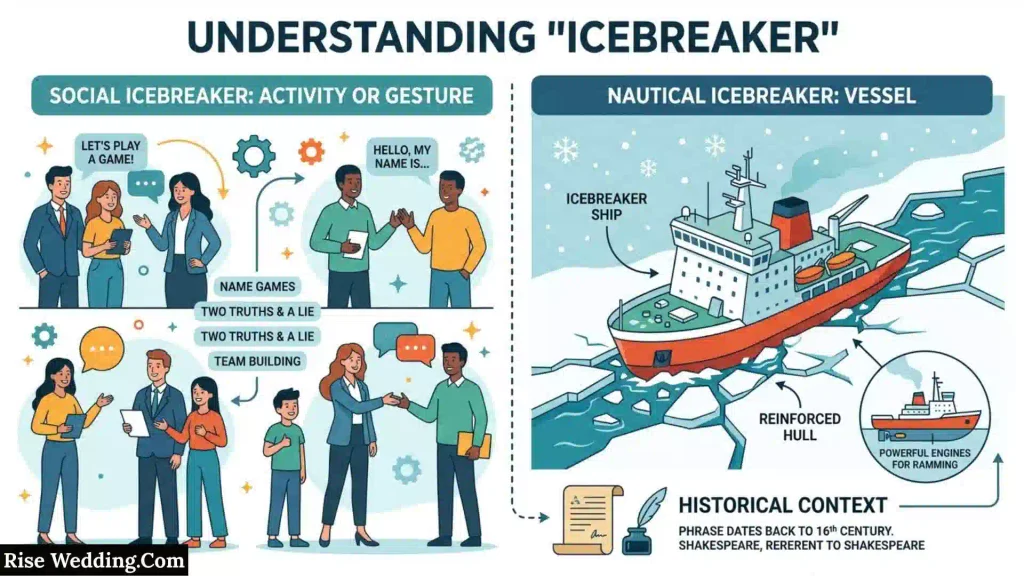
An icebreaker is an activity or prompt intended to reduce the initial awkwardness that can occur when people meet or begin working together.
The phrase is connected to the expression “break the ice.” UC San Diego’s student leadership materials explain the metaphor through icebreaking ships: just as an icebreaker ship clears a path, a social icebreaker can help clear the way for conversation and interaction. The resource distinguishes icebreakers from team-building activities and energizers while noting that some activities can serve more than one purpose.
What Is the Main Purpose?
The central purpose is to create an easy first step.
Imagine a room with 20 people who have never met. If the facilitator says, “Talk to someone,” participants may hesitate because they do not know what to say. If the facilitator asks everyone to pair up and answer one simple question, the first step is already defined.
That small change can make the interaction feel more manageable.
Are Icebreakers Only for Strangers?
No.
They are particularly useful when people are unfamiliar with each other, but they can also help established groups reconnect, welcome new members, introduce a new subject, or change the energy of a session.
The University of Illinois Springfield notes that icebreaker activities can be used not only for introductions but also for topic transitions, preparation, prior-knowledge activities, and energizing participants.
Icebreakers vs. Conversation Starters vs. Team Building vs. Energizers
These terms are related, but using them as exact synonyms can make it harder to choose the right activity.
| Type | Main purpose | Typical example | Best used when |
| Icebreaker | Help people begin interacting | “Find someone who shares your hobby” | A group is new or needs an easy start |
| Conversation starter | Begin a natural conversation | “What do you enjoy doing?” | Two or a few people are talking |
| Team-building activity | Improve cooperation or group dynamics | Solve a shared challenge | People already have some group familiarity |
| Energizer | Raise energy and attention | Quick movement or voting game | A group feels tired or passive |
| Warm-up activity | Prepare people for participation | Short topic-related prompt | A class, workshop, or discussion is beginning |
UC San Diego and other university resources make a similar distinction: icebreakers generally introduce people and encourage familiarity, while team-building focuses more on developing group cohesion and energizers are intended to increase energy.
Why the Difference Matters
Suppose a newly formed project team meets for the first time.
A question such as “What is your favorite weekend activity?” can help people learn something about each other. That is an icebreaker.
Later, the same team might complete a problem-solving exercise that requires planning and cooperation. That is closer to team building.
If the team has just returned from lunch and everyone looks tired, a two-minute movement activity may be an energizer.
Choose the activity based on the problem you are trying to solve.
How to Choose the Right Icebreaker
Before picking a game from a list, identify five things:
- Who is participating?
- How many people are there?
- How well do they know one another?
- How much time is available?
- What should happen after the activity?
This approach is more reliable than searching for a “best icebreaker” because the best choice changes with the situation.
A 30-Second Decision Tree
Do participants barely know each other?
→ Use a simple introduction or preference question.
Do they know each other but need to reconnect?
→ Use a shared-interest or recent-experience prompt.
Is the group very large?
→ Use pairs, trios, voting, or movement-based choices rather than individual speeches.
Is the setting formal?
→ Choose a professional, low-pressure question.
Is this a classroom?
→ Connect the activity to the course or students’ learning experience.
Is everyone online?
→ Use chat, polls, breakout rooms, or short verbal prompts.
Is the group tired?
→ Use an energizing activity instead of a quiet introduction.
Do you only have two or three minutes?
→ Use one question, one vote, or one quick pair discussion.
This is also consistent with guidance from the University of Florida, which recommends icebreakers that allow people to participate, teach participants something about those around them, and remain quick.
25 Easy Icebreaker Questions
Simple questions are useful because they require almost no preparation.
- What is something you enjoy doing in your free time?
- What is your favorite way to spend a weekend?
- What hobby would you like to try?
- What kind of music do you enjoy?
- What is a book, movie, or show you would recommend?
- What is your favorite season?
- Would you rather visit the mountains or the beach?
- What is one skill you would like to learn?
- What is your favorite type of food?
- What activity helps you relax?
- What is something you are interested in learning more about?
- What is your favorite way to spend a free afternoon?
- What is one place you would like to visit?
- Are you more productive in the morning or evening?
- What is a game you enjoy?
- What subject could you talk about for a long time?
- What is one thing that always makes you smile?
- What is something you enjoyed learning recently?
- What is your favorite holiday or celebration?
- What is one skill you already have that you value?
- What kind of weather do you enjoy most?
- What is your favorite type of book?
- What is one activity you would like to do more often?
- What is a small thing that can make your day better?
- If you could instantly learn one new skill, what would you choose?
Why These Questions Are Safer Choices
Most of these prompts focus on preferences, interests, and everyday experiences. That gives participants control over how much they want to share.
A useful rule is:
Start with information people can comfortably choose to share, then let the conversation become deeper naturally.
You generally do not need a highly personal question to create a meaningful conversation.
25 Funny Icebreaker Questions
Playful questions can make an introduction less formal without putting someone in an embarrassing situation.
- If you could have one unusual but harmless talent, what would it be?
- If your day had a theme song, what would it sound like?
- Would you rather explore space or the deepest ocean?
- If you could instantly master one game, which would you choose?
- Which fictional character would be interesting to meet?
- If animals could talk, which would be the funniest?
- Would you rather always sing or always whisper?
- If you opened a restaurant, what would you serve?
- What would your imaginary superhero name be?
- If you could rename Monday, what would you call it?
- Would you rather live in a treehouse or a houseboat?
- If you invented a new school subject, what would it teach?
- What ordinary thing are you surprisingly good at?
- If you could take one snack on a long journey, what would it be?
- Would you rather play every musical instrument or speak every language?
- If your favorite fictional character gave you advice, what might they say?
- What would your ideal theme park include?
- If you could visit any fictional world, where would you go?
- Would you rather have unlimited books or unlimited movies?
- What would you name a helpful household robot?
- If you had to create a new holiday, what would people celebrate?
- What completely ordinary object would you make much more interesting?
- If you could give your hometown a new nickname, what would it be?
- Would you rather always have perfect weather or always have your favorite food available?
- If your week were a movie, what genre would it be?
The goal is not to force people to perform. A playful prompt works best when participants can answer briefly and build on the response if they want.
20 Icebreaker Games for Groups
A structured game can be useful when a group needs more interaction than a single question provides.
Two Truths and a Lie
Each participant shares three statements about themselves. Two are true and one is fictional. The group tries to identify the fictional statement.
This works because people learn small, memorable details about one another while the guessing element gives the conversation a clear structure.
Best for: small or medium groups.
Avoid when: the group is very formal or participants may feel uncomfortable sharing personal information.
This or That
Give participants two choices:
- Books or movies?
- Summer or winter?
- Sweet or savory?
- City or countryside?
- Morning or evening?
They choose one and can explain why.
Best for: large groups, classrooms, online meetings.
Why it works: everyone can participate quickly without needing a long introduction.
Would You Rather?
Present two hypothetical choices and ask participants to pick one.
For example:
Would you rather explore a new country or learn a completely new skill?
The explanation is often more valuable than the choice because it gives the next person something to respond to.
Find Someone Who
Prepare a list of harmless characteristics or interests. Participants find people who match different items.
Examples:
- Someone who likes the same sport
- Someone who plays an instrument
- Someone who enjoys drawing
- Someone who has visited another city
- Someone who likes the same type of food
Best for: groups that can comfortably move around.
Common Ground
Divide participants into small groups and ask them to find three things everyone has in common.
The activity shifts attention from individual introductions to shared interests.
Best for: new teams, student groups, clubs, and workshops.
Partner Interview
Give participants two or three questions. Each person interviews a partner and then introduces that person to the group.
Indiana University specifically recommends paired interview formats as a way to reduce the awkwardness of introductions and help students learn about one another.
Silent Line-Up
Ask participants to arrange themselves according to a simple characteristic, such as birth month, without speaking.
Once they are arranged, check the result.
This combines communication, observation, and light problem solving.
Question Bowl
Put simple questions into a bowl. Each person selects one and answers it.
This is especially useful when the facilitator wants variety without preparing a complicated game.
One-Word Check-In
Ask everyone to give one word describing their current mood, expectation, or goal for the session.
This is useful when time is limited.
Group Story
One person starts a fictional story with one sentence. Each participant adds another sentence.
This works better with groups that are already reasonably comfortable with playful activities.
Icebreakers for Students and Classrooms
Classroom icebreakers should do more than entertain. They can help students meet one another, encourage participation, create a sense of community, and sometimes introduce the course itself.
Brown University’s Sheridan Center describes classroom icebreakers as low-stakes activities that encourage students to interact and talk with each other. It also notes that they can help create community and focus students’ attention on material covered during class.
First-Day Class Icebreaker
A practical format is:
- Put students into pairs.
- Give each pair three simple questions.
- Allow a few minutes for conversation.
- Ask students to introduce their partner.
- Connect one or two answers to the course.
For example, in an English class, ask:
- What type of writing do you enjoy?
- What is a story you remember?
- What would you like to become better at this year?
The activity introduces students while also giving the teacher useful context.
Subject-Based Icebreakers
The strongest classroom activities often connect to the subject.
Science: “What scientific question have you always wondered about?”
History: “Which historical period would you like to learn more about?”
English: “What type of story keeps your attention?”
Computer science: “What technology do you use every day, and why is it useful?”
This creates a smoother transition from social interaction to academic work.
Why Classroom Context Matters
Arizona State University explains that icebreakers can help students become active members of the class and establish a feeling of community. Its guidance also notes that activities can be adapted for adult learners and used beyond the first days of a course.
That means an icebreaker does not have to disappear after the first class. A short question can also be used later when students need to reconnect, begin a new topic, or prepare for discussion.
Icebreakers for Work and Professional Teams
Professional settings require more judgment. A workplace icebreaker should feel relevant rather than childish or intrusive.
Good options include:
- “What is one skill you would like to develop?”
- “What helps you have a productive workday?”
- “What is something useful you learned recently?”
- “What part of your current work do you enjoy most?”
- “What is one goal you are looking forward to?”
The University of Florida’s guidance for adult icebreakers emphasizes quick, low- or no-cost activities that help people get to know one another and build rapport in a low-stakes environment.
New Team Example
Imagine six people joining a project team for the first time.
Instead of asking everyone for a long personal introduction, the facilitator could ask:
“What is one strength you bring to a team?”
Participants answer in pairs, then each person introduces their partner.
This accomplishes three things:
- People learn names.
- Participants discover useful information.
- The question naturally leads toward collaboration.
Established Team Example
For a team that already knows each other, repeating basic introductions may feel pointless.
A better prompt might be:
“What is one thing that would make our next project easier?”
Now the activity creates conversation that can feed directly into the meeting.
Icebreakers for Large Groups
Large groups require a different design because asking every participant to speak individually can consume too much time.
Better Formats for Large Groups
Use:
- Pair discussions
- Small groups of three or four
- Hand-raising votes
- Chat responses
- Four-corner choices
- Quick “this or that” questions
- Partner interviews
Ohio State University describes a classroom activity in which students identify shared interests through questions and movement, demonstrating how a larger group can participate without relying on long individual introductions.
Large-Group Example
Ask:
“Which would you rather spend a free day doing: exploring a city, relaxing outdoors, learning something new, or watching movies?”
Assign four areas or simply collect votes.
Then ask participants to speak briefly with someone who chose the same option.
The activity moves from easy choice → shared interest → conversation.
Icebreakers for Small Groups
Small groups give you more room for discussion.
Useful options include:
- Two Truths and a Lie
- Common Ground
- Partner interviews
- Group storytelling
- Topic-based questions
- Shared-interest discussions
With four or five people, a single strong question can be enough.
For example:
“What is something you would like to learn this year?”
Each person answers, and the group can naturally discover overlapping interests.
Icebreakers for Online Meetings
Virtual groups have one major challenge: silence can feel even more noticeable online.
The solution is to use activities that require a simple digital action.
Chat Icebreaker
Ask:
“Type one word describing what you hope to get from today’s session.”
Everyone can respond at roughly the same time.
Virtual Poll
Ask a quick preference question such as:
“Which would you choose for a free afternoon: reading, gaming, sports, or exploring somewhere new?”
Breakout Pair
Put participants into pairs and give them two questions. After a few minutes, return to the main room and ask for one interesting discovery.
Online Course Example
Vanderbilt University describes online icebreakers as low-stakes activities that can help create community and social presence. It also notes that such activities can be used during a course rather than only at the beginning.
The important lesson is to keep virtual activities simple. Participants should not need to learn complicated software just to answer an introductory question.
Icebreakers for New Friends and Casual Conversations
Not every situation requires a formal game.
If you are meeting someone new, a natural conversation starter may be better.
Try:
- What do you usually do for fun?
- What kind of music do you like?
- What hobbies are you into?
- What is something you would like to learn?
- What kind of places do you enjoy visiting?
- What is a subject you could talk about for hours?
The Follow-Up Technique
The strongest conversation often comes from the second question, not the first.
For example:
You: “What do you like doing in your free time?”
Them: “I like drawing.”
You: “What do you usually like to draw?”
That feels more natural than immediately jumping to an unrelated question.
A useful conversation pattern is:
Question → Listen → Notice an interesting detail → Follow up
This is more effective than treating an icebreaker like a checklist.
How Long Should an Icebreaker Last?
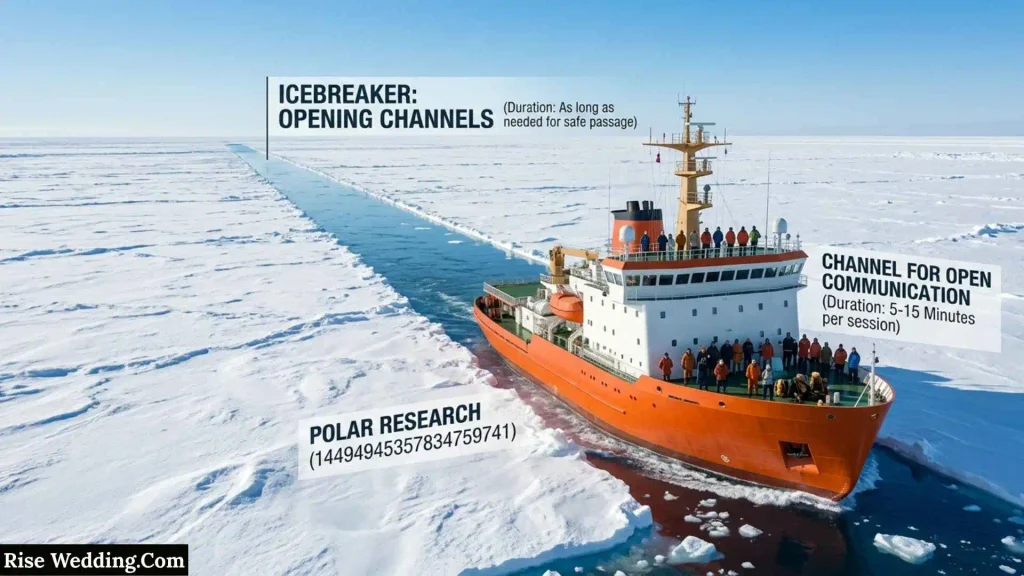
There is no universal time limit.
A two-person conversation may need no formal time limit at all. A classroom activity may take several minutes. A large meeting may need something much shorter.
Arizona State University provides examples of classroom icebreakers that are designed for short periods, while other educational resources emphasize choosing activities according to the goals and time available.
The practical rule is:
The icebreaker should be long enough to create interaction but short enough that participants still want to move on.
If the activity starts competing with the actual purpose of the meeting, lesson, or event, shorten it.
How to Make Icebreakers Inclusive and Comfortable
Not everyone enjoys traditional icebreakers. Some people are naturally talkative, while others prefer to observe before participating.
The University of Michigan specifically notes that not all students enjoy icebreakers and recommends considering space limitations and disabilities that could affect participation.
Give People a Low-Pressure Option
A participant may prefer writing an answer, chatting with a partner, or responding in an online chat instead of speaking to the entire room.
Avoid Sensitive Questions
Avoid making participants disclose information about:
- Family problems
- Money
- Health
- Private relationships
- Personal trauma
- Other sensitive matters
A good icebreaker should open conversation, not force disclosure.
Consider Physical Accessibility
Movement-based activities are not automatically suitable for everyone.
If an activity requires participants to move around the room, provide another way to participate.
Explain Why You Are Doing It
People are more likely to accept an activity when they understand its purpose.
Instead of saying:
“We’re going to play a game.”
Try:
“We’ll spend three minutes finding two shared interests so everyone has an easy conversation partner for today’s workshop.”
That small explanation gives the activity meaning.
Common Icebreaker Mistakes
Mistake 1: Choosing a Popular Activity Without Considering the Group
An activity that works for college students may not suit a formal workplace meeting.
Better approach: match the tone to the audience.
Mistake 2: Making the Activity Too Personal
People may shut down when a supposedly casual activity asks for private information.
Better approach: start with hobbies, preferences, interests, and harmless experiences.
Mistake 3: Giving Complicated Instructions
If participants need a long explanation, the activity creates more friction than it removes.
Better approach: explain the goal, demonstrate one example, then start.
Mistake 4: Making Everyone Speak to the Whole Room
This can create unnecessary pressure.
Better approach: begin with pairs or small groups.
Mistake 5: Ignoring Time
A ten-minute activity inside a fifteen-minute meeting is not an effective icebreaker.
Better approach: decide the maximum time before starting.
Mistake 6: Forgetting the Transition
The activity ends, and everyone simply sits there waiting for the next thing.
Better approach: connect one answer or observation to the next part of the session.
Mistake 7: Using an Icebreaker When You Do Not Need One
Sometimes a group is already comfortable and simply needs to get started.
The University of Michigan notes that some participants may see icebreakers as unnecessary, so facilitators should be clear about their purpose.
A Practical Formula for Creating Your Own Icebreaker
You do not need to copy an existing game. You can build one from scratch using four steps.
Step 1: Define the Goal
Ask:
What should participants be able to do after this activity?
Possible answers:
- Know names
- Find shared interests
- Begin talking
- Prepare for a lesson
- Introduce a meeting topic
- Increase energy
Step 2: Choose the Lowest-Pressure Format
Start with:
- A question
- A pair discussion
- A simple vote
- A small-group task
Only add complexity if the group needs it.
Step 3: Make the Prompt Specific
Instead of:
“Tell us about yourself.”
Try:
“What is one hobby you would like to spend more time on?”
Specific prompts are easier to answer.
Step 4: Build the Transition
End with a reason for the activity.
For example:
“Several people mentioned learning new skills, which connects directly to today’s discussion about professional development.”
Now the icebreaker has a clear function.
The Best Icebreaker Formula for Different Situations
| Situation | Recommended format | Example |
| Two new people | Conversation starter | “What do you enjoy doing?” |
| First classroom meeting | Partner interview | “What would you like to learn?” |
| Large class | Quick vote | “Which activity do you prefer?” |
| New workplace team | Strength question | “What do you bring to a team?” |
| Existing team | Shared challenge | “What could make our next project easier?” |
| Online meeting | Chat or poll | “One word for your goal today?” |
| Workshop | Topic-related prompt | “What do you already know about this?” |
| Tired group | Energizer | Quick movement or voting activity |
| Social gathering | Playful question | “Would you rather…?” |
The table highlights an important principle: the activity should serve the situation, not the other way around.
When You Should Skip an Icebreaker
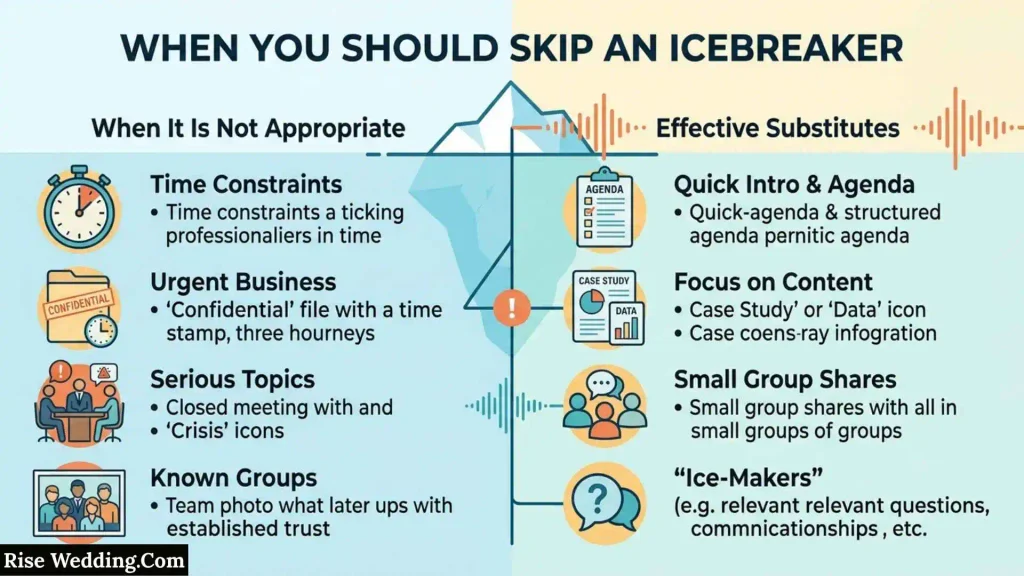
Sometimes the best icebreaker is no icebreaker.
Skip it when:
- Participants already know each other well.
- The meeting has almost no time available.
- The activity has no clear purpose.
- The group is uncomfortable with forced participation.
- The subject requires immediate attention.
- A direct conversation would work better.
For example, if a project team has met every week for six months and has a ten-minute agenda, spending five minutes asking basic introductory questions is unlikely to add much value.
The better choice may be to begin with one useful question directly related to the work.
Expert Tips for Better Results
Make the First Question Easy
The first question should have a low mental and social cost.
“What’s your favorite hobby?” is easier to answer than “Tell us about a major challenge that shaped who you are.”
Let Conversation Grow Naturally
Do not rush through ten questions. One interesting answer can create five minutes of useful conversation.
Use Pair Work Strategically
Pairs reduce the audience size and can make introductions less intimidating.
Match Energy to the Room
A quiet group does not automatically need a loud game. Sometimes a calm question works better.
Use Relevance as a Filter
Ask yourself:
“Will this activity make the next part of the session better?”
If the answer is no, choose something else.
End Before It Becomes Repetitive
A successful activity does not need to use every possible question. Stop when the purpose has been achieved.
What Makes an Icebreaker Actually Effective?
An effective icebreaker usually has five characteristics:
- Clear purpose — participants understand why they are doing it.
- Low pressure — people can participate without oversharing.
- Simple instructions — the activity is easy to understand.
- Relevant interaction — people learn something useful or interesting.
- Good timing — it does not take over the main event.
The University of Florida identifies similar qualities for effective adult icebreakers: participants should be able to take part, the activity should help them learn about those around them, and it should be quick.
That is a better standard than simply asking whether an activity is “fun.”
Frequently Asked Questions About Icebreakers
What is a good icebreaker for people who do not know each other?
Start with a simple question about hobbies, interests, preferences, or everyday activities. Pair interviews and “Find Someone Who” activities can also work because they provide participants with a clear reason to speak.
What is the easiest icebreaker?
A single low-pressure question is usually the easiest. For example: “What is one hobby you enjoy?” It requires no materials, complicated instructions, or special setup.
What are the best icebreakers for adults?
For adults, choose activities that respect the setting and avoid unnecessary personal disclosure. Common-ground questions, partner interviews, professional strengths, and shared-interest activities can work well.
What are good icebreakers for students?
Partner introductions, subject-related questions, This or That, Common Ground, and short group activities are useful options. Classroom guidance from Brown, Indiana University, and other universities emphasizes low-stakes interaction and community building.
What are good icebreakers for a new team?
Use a question that helps team members learn something useful about each other, such as a skill, interest, preferred working style, or goal. Keep the activity short and connect it to the team’s purpose.
What are good virtual icebreakers?
Chat prompts, quick polls, partner breakout conversations, and short introduction questions are easy to adapt to online meetings and classes. Vanderbilt University recommends low-stakes activities that support connection and social presence in online learning.
How do you break the ice without being awkward?
Use a specific, easy question instead of asking someone to “tell us about yourself.” Give people a clear task, start with pairs when appropriate, and avoid forcing anyone to share sensitive information.
What is the difference between an icebreaker and a team-building activity?
An icebreaker generally helps people begin interacting and become familiar with one another. Team-building activities usually focus more on cooperation, group dynamics, or solving a shared challenge. The two can overlap.
How long should an icebreaker take?
It depends on the setting. A quick question may take one or two minutes, while a classroom or workshop activity may take longer. The activity should be long enough to achieve its purpose without taking over the main event.
Can an icebreaker be used after the first meeting?
Yes. Icebreakers are not limited to first meetings. They can welcome new members, reconnect an existing group, introduce a new topic, or refresh participation later in a course or project.
What should you avoid in an icebreaker?
Avoid unnecessarily personal questions, complicated rules, activities that exclude participants, excessive competition, and anything that takes much longer than its purpose justifies.
Do icebreakers actually help groups?
They can help create opportunities for interaction and familiarity, especially when they are appropriate to the group and used intentionally. Penn State’s team-science toolkit describes icebreakers as a way to help team members become comfortable with each other and begin building connections.
Is every group activity an icebreaker?
No. Some activities are better described as team-building exercises, energizers, warm-ups, or learning activities. Their purposes may overlap, but the distinction helps facilitators select an appropriate format.
Final Takeaway
The best icebreakers are not necessarily the loudest, funniest, or most complicated activities. They are the ones that solve a real social problem: how to help people take the first step toward talking, participating, or working together.
Before choosing an activity, consider who is participating, how many people are present, how familiar they are with one another, how much time you have, and what you want to happen next. A simple question may be perfect for two people, while a classroom may benefit from partner interviews and a large meeting may need a quick vote or small-group activity.
If you are creating content about icebreakers for search, the same principle applies: serve the reader first. Google says its systems are designed to prioritize helpful, reliable, people-first content and encourages original information that provides substantial value beyond simply rewriting other sources.
The strongest resource is therefore not the page that repeats “icebreakers” the most. It is the page that helps a reader quickly understand which activity to use, why it fits, how to run it, and what to do if the first idea is not right for the group.

Edward Whitmore is a British author, researcher, and public speaker with a strong interest in language, philosophy, and lifelong learning. Born in York, England, he discovered his love for books and linguistics during his school years and later turned that passion into a successful writing career. His books focus on helping readers understand the deeper meaning of words, ideas, and communication through clear explanations and well-researched content. Edward regularly contributes to educational projects and enjoys sharing his knowledge through workshops and articles. In his free time, he visits historical landmarks, collects vintage books, and studies the development of the English language.
Books:
- Beyond the Dictionary
- The Meaning Behind Every Word
 Oliver Harrington