
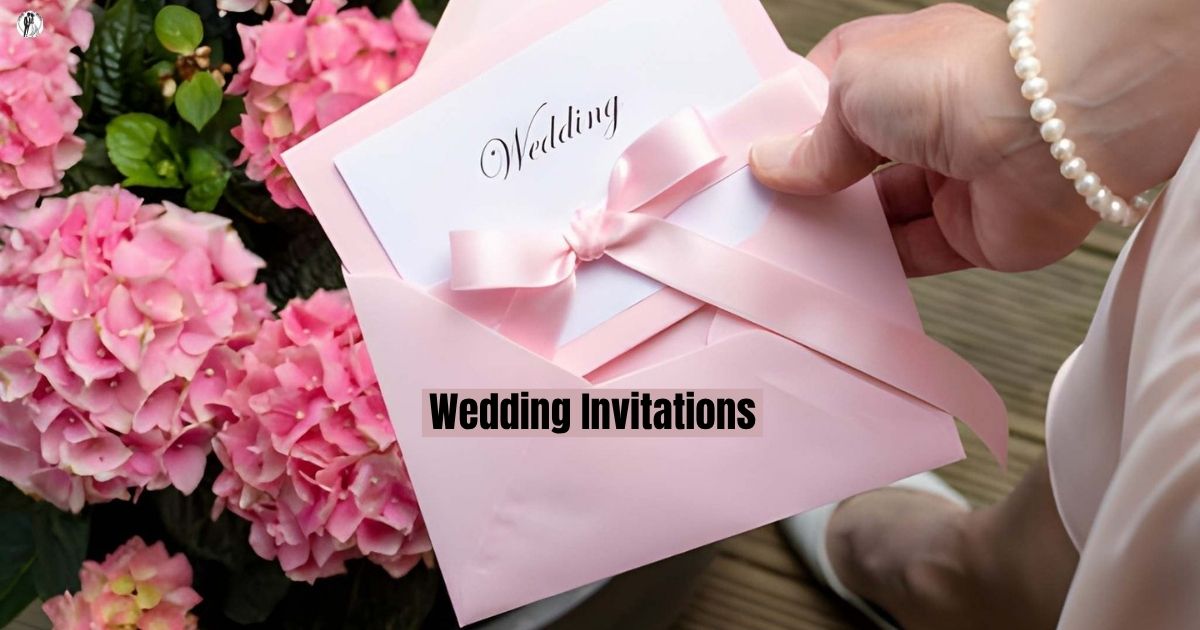
Everything You Need to Know Types, Wording, Printing, Timing, Etiquette & Trends
Wedding invitations are the very first glimpse your guests get into your big day. Before they see the venue, the flowers, or the dress they hold your invitation in their hands. And that single piece of paper (or screen) sets the entire tone. It tells people how formal the event will be, how much care went into the planning, and just how special this celebration is going to be.
Think about it this way: your invitation is the opening scene of your wedding story. It arrives in the mail, gets opened at the kitchen table, and gives someone their very first feeling about what your wedding day will look and feel like. That is a lot of power for one little card. And that is exactly why getting your wedding invitations right matters more than most couples realize.
Whether you are looking for romantic calligraphy wedding invitations, fun passport wedding invitations for a destination event, elegant vellum wedding invitations with translucent overlays, or even bilingual Spanish wedding invitations for a multicultural family the options today are truly endless. Add to that the rising world of digital invitations, eco-friendly stationery, and personalized illustration suites, and the wedding invitation landscape in 2025 is richer and more exciting than ever before.
In this complete, research-backed guide, we cover everything: the different styles and when to use them, what to write, how to address envelopes properly, the best printing methods, the latest trends, when to send wedding invitations, how much they cost, and every practical tip that will help your invitations stand out from the very first moment they are received.Let us get into it.
What Are Wedding Invitations? (And Why They Still Matter in 2025)
A wedding invitation is a formal card or message sent to guests to announce and invite them to a wedding ceremony and reception. But to call it just a card would be a serious undersell. Your invitation is a keepsake. Many couples and guests hold on to them for years, even decades, after the wedding itself.
In today’s digital world, you might wonder whether physical wedding invitations are still necessary. The answer is an unqualified yes and here is why:
- They set the formality and tone of your event before guests even arrive
- They provide guests with all essential details in one beautifully presented place
- Physical invitations feel personal and intentional something a text message or casual WhatsApp message simply cannot replicate
- They serve as a keepsake that guests often treasure long after the wedding day
- They signal to guests that this is a real, considered event not a casual gathering
- They give your stationery suite a cohesive, branded feel that carries across your entire wedding
That said, digital wedding invitations are also a growing and genuinely practical option in 2025. They are eco-friendly, budget-friendly, allow instant RSVP tracking, and can incorporate interactive elements like embedded videos and live maps. The right format depends entirely on the style of your wedding, your budget, and your guest list.
Many couples in 2025 are also choosing a hybrid approach: digital save-the-dates followed by physical formal invitations. This gets the word out early without the postage cost, then delivers the tactile experience guests love when it truly counts.
Types of Wedding Invitations: Styles, Themes and Aesthetics
The style of your wedding invitation should match the overall vibe of your wedding. A black-tie ballroom event deserves a very different invitation than a casual backyard barbecue. Here is a comprehensive breakdown of the most popular types couples are choosing right now:
| Style | Best For | Key Features |
| Classic / Formal | Traditional church or ballroom weddings | Ivory cardstock, serif fonts, letterpress printing |
| Calligraphy Wedding Invitations | Elegant and luxury weddings | Hand-lettered scripts, gold foil, wax seals |
| Vellum Wedding Invitations | Modern, romantic, editorial weddings | Translucent overlay paper, layered design |
| Passport Wedding Invitations | Destination and travel-theme weddings | Booklet style, travel stamps, map inserts |
| Floral / Botanical | Garden, outdoor, bohemian weddings | Watercolor flowers, greenery, soft palettes |
| Minimalist / Modern | Clean aesthetic, contemporary couples | White space, simple fonts, geometric accents |
| Spanish Wedding Invitations | Multicultural or Latino heritage weddings | Bilingual wording, floral motifs, warm colors |
| Arch-Shaped / Die-Cut | Artistic, editorial, fashion-forward couples | Unique silhouette, stands out in the post |
| Photo Invitations | Casual and modern celebrations | Engagement photo as the focal point |
| Digital Invitations | Budget-conscious or eco-friendly couples | Sent by email/WhatsApp, instant RSVP |
| Boxed Suite | Ultra-luxury, high-end weddings | Premium box packaging, multiple enclosures |
| Seed Paper Invitations | Eco-conscious, nature-loving couples | Plantable paper embedded with wildflower seeds |
Calligraphy Wedding Invitations
Calligraphy has made a powerful comeback in wedding stationery and it shows absolutely no signs of slowing down. From traditional Copperplate and Spencerian scripts to loose, modern brush lettering calligraphy adds a timeless, personal touch that no computer font can fully replicate. There is a warmth and humanity to hand-lettered words that resonates deeply with guests.
Many couples choose calligraphy wedding invitations for both the main card and the envelope addressing, creating a completely cohesive luxury feel throughout the entire suite. When your guest receives an envelope addressed in beautiful calligraphy ink, they already feel special before they have even opened it.
Popular calligraphy styles right now include:
- Modern Script flowing, romantic, slightly casual and expressive
- Copperplate & Spencerian traditional, structured, highly formal
- Brush Calligraphy relaxed, expressive, perfect for boho and rustic themes
- Minimalist Fine-Line delicate strokes with generous white space
- Metallic Calligraphy gold, rose gold, copper, and silver inks for a luxury shimmer
Vellum Wedding Invitations
Vellum wedding invitations use a semi-translucent paper that creates a dreamy, layered aesthetic that looks incredible in photographs and feels extraordinary in your hands. Vellum is most commonly used as a jacket or overlay that wraps around the main invitation card, giving it an editorial, high-fashion look that has taken over wedding Instagram in recent years.
Vellum pairs beautifully with florals printed underneath (visible through the overlay), gold foil printing on the vellum itself, and wax seals holding the jacket closed. The combination creates a truly luxury unboxing experience.
If you want your invitation suite to feel like it belongs on the cover of a wedding magazine, vellum is your answer. It is soft to the touch, elegant in appearance, and photographs extraordinarily well making it a favourite among couples who think about every detail of their wedding aesthetic.
Passport Wedding Invitations
Passport wedding invitations are a creative and delightful choice for destination weddings. Designed to look like a genuine passport booklet, they typically include a boarding pass for the ceremony, detailed information about the venue and location, accommodation suggestions, packing tips, and even a map of the destination.
These are especially popular for weddings in Mexico, Greece, Italy, the Maldives, or any international destination. The booklet format gives couples significantly more space to include all the travel logistics, hotel block information, and itinerary details that destination wedding guests genuinely need all wrapped up in a format that guests actually want to keep.
Guests love them. They are conversation starters at work, on planes, and at family dinners. They build genuine excitement for your event long before it happens.
What to Include in Wedding Invitations: The Complete Checklist
Every wedding invitation, regardless of style or formality, must include certain core pieces of information. Think of these as the absolute non-negotiables the things your guests need to know before they can do anything else:
- Host Line Who is formally hosting and inviting guests (parents, the couple, or “together with their families”)
- Names of the Couple Full names, typically bride listed first in traditional format
- Date of the Wedding Spelled out fully for formal invitations (e.g., Saturday, the Fourteenth of June, Two Thousand Twenty-Five)
- Time of the Ceremony Written out in formal invites (e.g., “at four o’clock in the afternoon”)
- Venue Name and Full Address Include city and state for out-of-town guests; full address for destination weddings
- Reception Details Either printed on the main card or included on a separate reception card
- RSVP Instructions Card, link, email, or QR code with a clearly stated deadline date
- Dress Code Optional but extremely helpful for guests (black tie, cocktail attire, garden party formal, beach casual, etc.)
Optional but genuinely recommended additions that make the guest experience much smoother:
- Wedding website URL or QR code linking to full wedding details
- Accommodation information or hotel block details with booking codes
- Dietary restriction checkbox or options on the RSVP card
- Plus-one instructions (if applicable) clarity here saves many awkward conversations
- Children policy if children are not invited, a polite note avoids confusion and upset
- Parking and transport details for complex venues
- Ceremony language note if the service will be in a different language
How to Write Wedding Invitation Wording: A Complete Guide with Examples
Wording your wedding invitations correctly can feel genuinely overwhelming especially because there are so many variables. Formal or casual? Traditional or modern? Parents hosting or couple hosting? Religious or secular? The good news is that there is no single “correct” answer. The right wording is the wording that accurately reflects the tone of your wedding and the people you are.
Here is a clear breakdown of every major wording scenario you might face:
Formal Traditional Wording
Use “honour of your presence” when the ceremony is held in a house of worship. Use “pleasure of your company” for all secular venues. Spell everything out in full no abbreviations, no numerals. Dates and times are written out in words.
Mr. and Mrs. James Harrison request the honour of your presence at the marriage of their daughter Emma Rose Harrison and William Charles Blake son of Mr. and Mrs. Thomas Blake Saturday, the Fourteenth of June, Two Thousand Twenty-Five at four o’clock in the afternoon
Modern Casual Wording
For a relaxed, warm, fun wedding, your wording can be entirely conversational. Contractions are perfectly fine. Personal touches and humour are not just allowed they are encouraged.
“We’re getting married! Join us for a day of love, laughter, and happily ever after.”
“Sarah and James are tying the knot and they want you there. Come celebrate with food, dancing, and way too much cake.”
Couple-Hosted Wording
More and more couples today are hosting their own weddings, particularly when they are older or funding the event themselves. This is completely modern and widely accepted.
“Together with their families, Sophia Chen and Daniel Park invite you to celebrate their wedding.”
“Sophia Chen and Daniel Park joyfully invite you to share in the celebration of their marriage.”
Divorced Parents Wording
When parents are divorced, both can still be acknowledged gracefully on the invitation. List the mother first:
“Mrs. Sarah Mitchell and Mr. David Mitchell request the honour of your presence at the marriage of their daughter…”
Religious Ceremony Wording
For ceremonies in a place of worship, adding a spiritual element is entirely appropriate and traditional:
“God has blessed our beginning. Please join us as we give thanks and celebrate…”
Spanish Wedding Invitations: A Complete Guide for Bilingual and Multicultural Couples
Spanish wedding invitations are one of the fastest-growing niches in wedding stationery as more multicultural families want to honour both sides of their heritage on this most important of occasions. Whether you are planning a destination wedding in Mexico, Spain, Puerto Rico, or Colombia or simply have Spanish-speaking family members who deserve to feel fully included bilingual invitations are one of the most thoughtful and meaningful gestures you can make.
A Spanish wedding invitation is not merely a translation exercise. It is a full celebration of culture, family history, and love. Common design elements include romantic floral motifs, delicate lace patterns, warm terracotta, burgundy, or deep red color palettes, and nods to cultural traditions like padrinos (wedding sponsors who take on specific financial or ceremonial responsibilities for different parts of the wedding).
Tips for Creating Spanish Wedding Invitations That Work
- Lead with the primary language of your ceremony location or majority guest group if the wedding is in Mexico, Spanish leads; if it is primarily an English-speaking guest list, English leads
- Use a bilingual stacked format Spanish on the top half, English on the bottom half (or vice versa), clearly separated
- Keep wording concise Spanish text tends to run approximately 20-30% longer than its English equivalent, so design accordingly
- Have a native Spanish speaker proofread before anything goes to print translation errors on a wedding invitation are embarrassing and expensive to fix
- Account for international shipping time if mailing invitations to guests abroad add at least 2 extra weeks to your timeline
- Match the design to the cultural aesthetic terracotta, deep florals, Andalusian lace patterns, or Mediterranean tiles all signal the right cultural warmth
Spanish Wedding Phrases Worth Knowing
| English | Spanish |
| We are getting married | Nos casamos |
| A love forever | Un amor para siempre |
| We await you with great love | Los esperamos con mucho amor |
| You are cordially invited | Están cordialmente invitados |
| Please join us | Por favor acompáñennos |
| Our wedding | Nuestra boda |
| Ceremony | Ceremonia |
| Reception | Recepción |
| Please respond by | Confirmar antes del |
Wedding Invitation Printing Methods: Which One is Right for You?
One aspect of wedding invitations that many couples overlook until they are deep in the planning process is the printing method. How your invitation is printed affects its look, its feel in your hands, its cost, and how long it takes to produce. Here is a complete breakdown of every major printing method available today:
Digital Printing
Digital printing is the most common and accessible method. It uses digital files to print directly onto paper using high-quality inkjet or laser technology. It can reproduce complex designs, vibrant full-color artwork, gradients, and photographs with ease. It is the fastest option and the most budget-friendly.
Best for: Colorful designs, floral artwork, photo invitations, large guest lists, tight budgets
Letterpress Printing
Letterpress is one of the oldest and most revered printing techniques in the world. The design is pressed into thick, high-quality cotton or soft paper using an inked plate, creating a visible, tactile indentation. Run your finger over a letterpress-printed invitation and you can feel every letter and line. It is deeply satisfying and undeniably elegant.
Best for: Classic, vintage, artisanal weddings couples who value texture and craftsmanship
Foil Stamping
Foil stamping uses heat and pressure to apply a thin metallic or pigmented foil directly onto the paper surface. The result is a stunning reflective finish available in gold, silver, rose gold, copper, and even holographic options. It catches the light beautifully and photographs spectacularly.
Best for: Luxury, glamorous, or modern wedding aesthetics couples who want maximum visual impact
Thermography
Thermography is the smart budget-friendly alternative to engraving. It produces raised, glossy text by applying a resin powder to wet ink and heating it until it fuses and swells. The effect looks and feels similar to engraving at a fraction of the cost.
Best for: Couples who want the look of engraving without the price tag
Engraving
Engraving is the oldest, most formal, and most expensive printing method. A copper plate is etched with your design and pressed into the paper, creating an impression on the back and a raised image on the front. It is the traditional choice for the most formal, high-society weddings.
Best for: Ultra-formal, black-tie, luxury weddings where cost is not a constraint
Printing Methods Comparison Table
| Printing Method | Cost Level | Look & Feel | Production Time | Best Match |
| Digital Printing | $ Low | Flat, vibrant, full-color | 3–7 days | Modern, floral, photo invites |
| Thermography | $$ Mid | Raised, glossy text | 7–10 days | Semi-formal, budget-luxury |
| Letterpress | $$$ High | Deep impressed, tactile | 2–4 weeks | Classic, vintage, artisanal |
| Foil Stamping | $$$ High | Metallic, reflective, glamorous | 2–4 weeks | Luxury, glam, modern |
| Engraving | $$$$ Premium | Raised, ultra-refined | 3–6 weeks | Ultra-formal, black-tie |
How Much Do Wedding Invitations Cost? The Full Budget Breakdown
Wedding invitation costs vary enormously depending on printing method, paper quality, customization level, suite components, and quantity ordered. Here is a realistic, detailed breakdown to help you plan your stationery budget accurately:
| Invitation Type | Cost Per Suite (Approx.) | What Is Included | Best For |
| Digital Invitations | $0 – $50 total | Full digital design, RSVP tracking | Budget-conscious, eco-friendly couples |
| DIY / Printable Templates | $10 – $80 total | Template purchase + home or print-shop printing | Creative couples on a tight budget |
| Basic Online Print Services | $1 – $3 per suite | Simple designs, standard paper | Large guest lists, straightforward designs |
| Mid-Range Semi-Custom | $3 – $8 per suite | Good paper, semi-custom design | Balance of quality and cost |
| Letterpress / Foil Printing | $8 – $20 per suite | Premium printing, thick paper, luxury feel | Luxury finish, smaller guest lists |
| Fully Custom / Designer | $20 – $60+ per suite | Bespoke design, full consultation, premium printing | High-end weddings, one-of-a-kind design |
| Boxed Suite (Ultra Luxury) | $80 – $200+ per suite | Box packaging, ribbons, multiple cards, wax seals | Ultra-luxury, destination weddings |
The average couple spends around $500 on traditional paper wedding invitations when factoring in printing, envelopes, postage, RSVP cards, and any extras. Custom designer suites with foil printing for 100 guests can run $1,500 to $3,000 or more.
Smart Ways to Save on Wedding Invitations
- Order all suite elements (RSVP cards, detail cards, envelopes) from a single vendor to avoid duplicate shipping charges
- Choose digital save-the-dates and reserve beautiful paper for the formal invitation only
- Stick to a 1- or 2-color design every additional ink color and foil treatment adds cost quickly
- Order 15–20 extras from the start individual reprints are dramatically more expensive per unit
- Skip inner envelopes for casual weddings they add cost and most modern couples do not use them
- Use QR codes on your invitation instead of a separate details card to save on printing and postage weight
- Choose digital RSVPs (a website form) instead of printed RSVP cards to eliminate a full component of the suite
Wedding Invitation Suite: Everything That Is Included
A wedding invitation suite is the full collection of printed pieces that go into a single envelope and are sent to each guest together. Understanding what a suite can include helps you decide what you actually need versus what is optional for your specific wedding.
| Suite Component | Purpose | Necessary? |
| Main Invitation Card | Core ceremony announcement | Always non-negotiable |
| RSVP Card | Guest response card | Highly recommended |
| Pre-Stamped RSVP Envelope | Return envelope for RSVP card | Recommended for formal weddings |
| Details / Information Card | Venue directions, parking, hotel, website | Recommended |
| Reception Card | Separate reception details (very formal weddings) | Optional |
| Envelope Liner | Decorative patterned lining for the outer envelope | Optional adds elegance |
| Vellum Jacket / Overlay | Translucent wrap over the main card | Optional very on-trend in 2025 |
| Wax Seal | Decorative closure on the outer envelope | Optional adds luxury |
| Belly Band / Ribbon | Holds all suite pieces neatly together | Optional |
| Tissue Paper Insert | Traditional protective layer between cards | Optional more common in formal suites |
| Accommodation Card | Hotel block details and booking codes | Recommended for destination and out-of-town weddings |
| Map / Directions Card | Custom illustrated venue map | Optional popular for complex or rural venues |
For most modern weddings, a clean and complete suite of three items the main invitation, an RSVP card with a return envelope, and a details card with your wedding website QR code is everything you truly need. Keep it elegant, keep it useful.
When to Send Wedding Invitations: The Complete Timeline Guide
Knowing exactly when to send wedding invitations is one of the most asked questions in all of wedding planning and getting the timing right has real downstream consequences. Send too early and guests might misplace the details. Send too late and they cannot arrange travel, request time off work, or make accommodation bookings.
Here is the complete timeline every couple needs to follow:
| Wedding Type | Order Stationery | Send Save-the-Date | Send Formal Invitations | RSVP Deadline |
| Local / Regional | 16+ weeks before | 6 – 8 months before | 6 – 8 weeks before | 3 – 4 weeks before |
| Out-of-Town Guests | 18+ weeks before | 8 – 10 months before | 8 – 10 weeks before | 3 – 4 weeks before |
| Destination Wedding | 20+ weeks before | 10 – 12 months before | 10 – 12 weeks before | 5 – 6 weeks before |
| Holiday Weekend Wedding | 20+ weeks before | 10 – 12 months before | 10 – 12 weeks before | 4 – 5 weeks before |
The Save-the-Date: Your First Communication
Save-the-dates go out well before the formal invitation and serve one purpose: making sure guests block your wedding date on their calendars before anything else gets booked there. They are not the formal invitation they are the heads-up.
For most local weddings, 6 to 8 months of notice is sufficient. For destination weddings or weddings on busy holiday weekends when flights and accommodation book up months in advance, aim for 10 to 12 months out. Never send save-the-dates more than 14 months before the wedding guests will genuinely forget.
The Formal Invitation: Getting the Send Date Right
For a local or regional wedding, send formal invitations 6 to 8 weeks before the wedding date. For a destination wedding or a wedding held over a holiday weekend, 8 to 12 weeks gives guests adequate time to arrange travel and respond. For printed wedding invitations, the send date is not the same as the order date. Factor in 2 to 4 weeks for design approval, printing, and shipping before your target mail date. If you are ordering paper samples first to check quality and color, add another full week to that window.
Setting the RSVP Deadline
Setting your RSVP deadline at 3 weeks before the wedding leaves you enough time to follow up with non-responders and finalize headcount with your caterer. For destination weddings with hotel room blocks, push the RSVP deadline earlier many hotels release blocked rooms 4 to 6 weeks before the event, and your confirmed guest count needs to come before that release date. The sad truth about RSVPs: people will forget, ignore deadlines, and text you the night before asking if they can still come. Set your RSVP deadline 4 to 6 weeks before the wedding, or 8 to 10 weeks for destination weddings. Follow up one week after the deadline call, email, or text. Be polite but firm. Your caterer needs numbers
How to Address Wedding Invitations: Etiquette Guide
Addressing your wedding invitation envelopes correctly is one of those details that traditional etiquette holds to a high standard and that guests, particularly older guests, genuinely notice. Here is everything you need to know about getting it right.
Outer Envelope vs. Inner Envelope
Traditional formal wedding invitation suites include two envelopes: an outer mailing envelope (with the full address, postage, and return address) and an inner envelope (which holds the actual invitation suite and lists just the names of the invited guests).
Wedding invitations can include an inner and outer envelope. The inner (which is optional) is usually only addressed with the names of the invitees, while the outer envelope is the one that is stamped and addressed.
The inner envelope serves a practical purpose beyond tradition: it clearly signals exactly who in a household is invited. If children are not invited, you leave their names off the inner envelope and experienced guests will understand.
Addressing Rules and Examples
| Situation | Outer Envelope | Inner Envelope |
| Married couple (same surname) | Mr. and Mrs. James Blake | Mr. and Mrs. Blake |
| Married couple (different surnames) | Ms. Emily Chen and Mr. David Park | Ms. Chen and Mr. Park |
| Single guest with plus-one | Mr. James Smith | Mr. Smith and Guest |
| Family with children invited | The Blake Family | Mr. and Mrs. Blake, Oliver and Sophie |
| Same-sex couple | Mr. Daniel Torres and Mr. Ryan Lee | Mr. Torres and Mr. Lee |
| Doctor (one) | Dr. Margaret Harris and Mr. Kevin Harris | Dr. and Mr. Harris |
Additional rules to follow:
- Spell everything out no abbreviations like “St.” (use “Street”), “Apt.” (use “Apartment”), or “NY” (use “New York”)
- Use full legal names on the outer envelope never nicknames
- No “and Family” on the outer envelope unless you are intentionally including every member of the household
- List children by name on the inner envelope if they are invited omitting a child’s name signals they are not included
- Always double-check spelling of every name before mailing nothing creates awkwardness faster than a misspelled name on a wedding invitation
Wedding Invitation Trends for 2025: What Is In and What Is Out
The wedding invitation world moves quickly and 2025 has brought some genuinely exciting developments worth knowing about.
What Is Hot in 2025
The wedding invitation market for 2025 is characterized by a strong desire for personalization, sustainability, and innovative design. Couples are opting for recycled paper, seed paper, soy-based inks, and plastic-free packaging a conscious shift towards environmentally responsible choices.
Digital invitations are incorporating augmented reality (AR), QR codes, and animated elements, appealing to tech-savvy couples looking for interactive experiences.
Here is the full trend breakdown:
- Arch-shaped and die-cut invitations non-rectangular silhouettes that stand out immediately in the post
- Vellum overlays and jackets still at peak popularity, particularly with a wax seal closure
- Custom venue illustrations hand-drawn or watercolor illustrations of the wedding venue as the focal design element
- Seed paper invitations paper embedded with wildflower seeds that guests can plant after the wedding
- Maximalist floral designs bold, oversized botanicals in jewel tones replacing the gentle pastels of previous years
- Mixed media suites combining letterpress text with digital full-color illustrations
- QR codes as design elements incorporated elegantly into the invitation layout rather than added as an afterthought
- Monochrome and tonal designs elegant tone-on-tone printing in black, ivory, or a single accent color
What Is Fading Out
- Generic, template-looking designs with no personalization
- Overly busy busy layouts with too many fonts and elements competing for attention
- Heavy use of clipart-style graphics
- Sending save-the-dates and formal invitations in the same mailing (guests need separate touchpoints)
DIY vs. Professional Wedding Invitations: The Honest Comparison
One of the most debated decisions in wedding stationery is whether to design your own invitations or hire a professional stationer. There is no universally right answer it depends entirely on your budget, your time, your design skills, and how much the details matter to you.
| DIY Invitations | Professional / Custom | |
| Cost | Low ($20 – $100 total) | Higher ($300 – $3,000+) |
| Time Investment | Very high design, proofing, printing, assembly | Low for you designer handles everything |
| Quality | Good with quality printing services | Excellent, especially for letterpress and foil |
| Customization | Limited to template options | Fully bespoke exactly your vision |
| Wording Guidance | You are on your own | Most designers guide you through it |
| Proofing | Done by you alone | Professional eyes catch errors |
| Stress Level | Can be stressful | Minimal that is what you are paying for |
| Best For | Small weddings, creative and design-savvy couples | Luxury weddings, couples who value their time |
If you are crafty, design-literate, and enjoy this kind of project, DIY using a platform like Canva with an Etsy template from an experienced designer can genuinely produce beautiful results. If you want the full-service experience with creative collaboration, expert guidance on wording and etiquette, professional proofing, and premium printing methods a professional stationer is an investment you will not regret.
Final Thoughts:
Your wedding invitations are not just paper or pixels. They are the opening chapter of your wedding story. They are the first moment a guest steps into the world you are creating and they carry weight that goes far beyond the information printed on them.Whether you choose the timeless beauty of calligraphy wedding invitations, the editorial elegance of vellum wedding invitations, the adventurous spirit of passport wedding invitations, the cultural richness of Spanish wedding invitations, or a clean modern design that lets your love story speak for itself make sure your invitation genuinely reflects who you are as a couple.Get the wording right. Choose a printing method that matches your vision and your budget. Send them at the right time. Include everything your guests actually need. And add the little personal details that make someone smile when they pull your envelope out of their letterbox.Your guests will notice the care. They always do.
Now go create something beautiful.
FAQs
When do you send out wedding invitations?
Send formal wedding invitations 6 to 8 weeks before the wedding for local guests. For destination weddings or holiday weekends, send them 10 to 12 weeks before to give guests adequate time to book travel and accommodation.
When do you send out Save the Date cards?
Save-the-dates should go out 6 to 12 months before your wedding date. For destination or holiday weekend weddings, aim for 10 to 12 months ahead. This gives guests enough notice to request time off work and arrange travel.
What should you set the RSVP deadline date?
Set your RSVP deadline 3 to 4 weeks before the wedding for local events. For destination weddings, set it at 5 to 6 weeks before. Your caterer and venue typically need final numbers 2 to 3 weeks before the day.
How much do wedding invitations cost?
Budget options start at $1 to $3 per suite for basic online print services. Mid-range semi-custom suites run $3 to $8. Luxury letterpress or foil-printed suites cost $10 to $20+ per suite, with fully custom designer options reaching $50 to $200 per set for ultra-luxury boxed suites.
What do you include in a wedding invitation?
Every invitation must include the host line, both names of the couple, date and time, venue name and address, reception details, and RSVP instructions. A dress code and wedding website are optional but strongly recommended.
How should you address wedding invitations?
Use full formal names on the outer envelope. Use titles where applicable (Dr., Mr., Ms., The Honourable). For casual weddings, first and last names without titles are perfectly appropriate. Never use nicknames on a formal outer envelope. Spell out all words no abbreviations for streets, apartments, or state names.
What are vellum wedding invitations?
Vellum wedding invitations use a semi-transparent, translucent paper as an overlay or jacket layered over the main invitation card. The see-through effect creates a dreamy, layered look that is one of the biggest trends in wedding stationery right now. It pairs beautifully with floral designs visible underneath and wax seals on top.
What are passport wedding invitations?
Passport wedding invitations are designed to look like a genuine passport booklet, complete with travel-themed design, a boarding pass for the ceremony, venue information, travel tips, and accommodation details. They are ideal for destination weddings and make memorable, keepable keepsakes for guests.
What printing method is best for wedding invitations?
It depends on your budget and aesthetic. Digital printing is best for budget-conscious couples with colorful designs. Letterpress is best for couples who love texture and a classic artisanal feel. Foil stamping is ideal for luxury and glamour. Thermography offers a raised-text look at a more affordable price point.
Can I have bilingual Spanish and English wedding invitations?
Absolutely. Bilingual Spanish wedding invitations are a beautiful and inclusive option for multicultural couples and families. Use a stacked format with both languages on the same card, keep wording concise (Spanish runs longer than English), and always have a native speaker proofread before printing.
